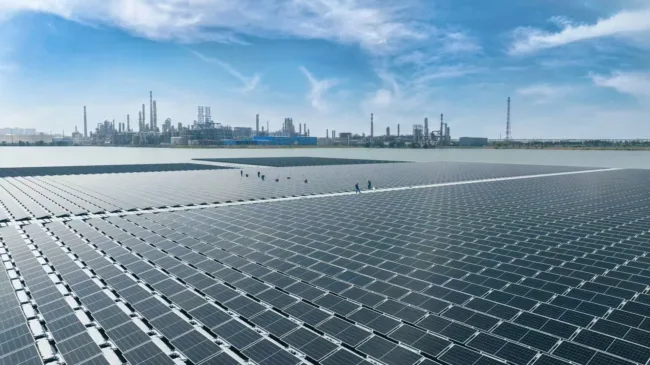
California has formally put the Trump administration on a 60-day legal clock over the cancellation of Golden State Wind, the 2 GW floating offshore project sponsored by Ocean Winds, the 50/50 joint venture between EDP Renováveis (Euronext: EDPR) and ENGIE (Euronext: ENGI), together with Canada Pension Plan Investments. The state’s Notice of Intent to sue, delivered to the Department of the Interior on June 23, targets a $120 million lease buyback that requires the developer to redeploy an equivalent amount into Gulf Coast oil and gas infrastructure. The action marks the first serious legal challenge to a novel federal mechanism that pays renewable developers to exit their leases and switch sectors. For listed parents EDPR and ENGIE, the dispute reopens questions about the carrying value, optionality, and exit pathway of their joint US offshore portfolio at a moment when EDPR has already been publicly exploring a stake sale in the Ocean Winds platform.
What the Notice of Intent to sue actually challenges and why the structure of the buyout matters
The legal challenge filed by California Attorney General Rob Bonta and California Energy Commission Chair David Hochschild is narrower and more interesting than a standard policy lawsuit. The state is not challenging the federal government’s authority to manage offshore leasing in the abstract. It is challenging the financial mechanics of a single transaction. Under the April 2026 settlement between Ocean Winds and the Department of the Interior, Golden State Wind can recover roughly $120 million in previously paid lease fees, but only if the joint venture invests an equivalent $120 million into oil and gas assets, infrastructure, or projects along the Gulf Coast. California’s legal team is arguing that Interior illegally reallocated federal taxpayer dollars to incentivise a private developer to abandon an offshore wind lease and redirect capital out of state into fossil fuel infrastructure that does nothing for California’s energy economy.
The structural novelty here is the conditional reinvestment clause. Federal lease buybacks are not new, but a buyback that requires the recipient to deploy matching capital into a specific competing sector in a different geography is a meaningful policy innovation. If California’s legal theory holds, it could constrain Interior’s ability to use lease refunds as a mechanism to redirect private capital flows between energy verticals. If the theory fails, the model becomes a template that the administration can extend to other state coastlines and other developers. The case will therefore have consequences far beyond the central California shelf.
There is also a tactical signal in the timing. California issued the Notice of Intent only after federal courts blocked earlier executive efforts to halt offshore wind through pure administrative action. The state is choosing the venue and the framing rather than waiting to be brought into a forum chosen by Washington.
How the lawsuit reshapes the offshore wind risk profile for EDPR and ENGIE shareholders
For equity holders of EDPR and ENGIE, the California action does not change the operational status of Golden State Wind, which has already been agreed for cancellation. What it changes is the visibility on the exit. Ocean Winds publicly framed the April settlement as providing clarity for the venture and its investors, with chief executive Michael Brown of Ocean Winds North America emphasising the closure value to lenders and partners. The Notice of Intent reopens that clarity. Until the 60-day window closes or the state files suit, the JV cannot fully treat the $120 million recovery as settled cash, and any matched Gulf Coast investment commitment now carries litigation risk that did not exist 72 hours ago.
There is a second-order issue specific to EDPR. The Portuguese renewables operator, which is 71.3% owned by EDP, was reported by Bloomberg in early 2025 to be exploring a sale of its 50% stake in Ocean Winds. A pending US legal action involving the JV’s largest cancelled lease introduces a real diligence question for any prospective buyer, particularly one assessing US offshore exposure as a feature rather than a liability. The lawsuit does not necessarily depress valuation, since the underlying lease has already been written down to the settlement value, but it complicates the timing of a clean transfer. Sellers prefer to close stake sales before regulatory or legal uncertainty is in motion, not during.
ENGIE faces a different exposure. Its US offshore strategy is largely expressed through Ocean Winds, and any extended litigation over the Golden State Wind settlement will limit the JV’s flexibility to pursue replacement projects in friendlier domestic markets, particularly given that two of the five federal leases off California’s coast are now being cancelled, including the second project held by privately held Invenergy.
Why the Gulf Coast reinvestment clause raises questions about federal capital reallocation
The clause that California is targeting is unusual in federal energy policy. Lease buyback arrangements typically involve a refund and a release, with the developer free to redeploy capital wherever it sees commercial return. The Interior Department under Secretary Doug Burgum has structured these recent settlements with a directional requirement. The departmental position, articulated in public statements, is that companies are voluntarily shifting investment toward what the administration characterises as dependable, secure energy infrastructure. California’s counterargument is that the directionality is not voluntary in any meaningful sense, because the only way to recover paid lease fees is to commit to the alternative investment.
If this dispute proceeds to substantive litigation, courts will be asked to assess whether a federal agency can use the conditional refund of fees originally collected for one purpose to engineer private capital flows into an unrelated sector and geography. That is a question with implications well beyond wind. The same legal architecture could theoretically be deployed in mineral leasing, transmission rights of way, or other federal land-use contexts. Sector lobbyists in both renewables and traditional energy will be reading the eventual filings carefully.
For Ocean Winds and CPP Investments, the practical concern is execution. Even if the matched Gulf Coast investment is permissible, the JV must now identify, diligence, and commit to oil and gas assets it did not originally plan to own, on a timeline driven by federal counterparty preferences rather than the venture’s own investment criteria. That is a meaningful corporate strategy question for a platform whose stated purpose is the development of offshore wind.
What the broader pattern of offshore wind cancellations signals about US energy policy direction
Golden State Wind is not isolated. Bluepoint Wind, an early-stage project off the New Jersey and New York coasts, agreed to a similar lease termination in April. A second California lease held by Chicago-based Invenergy is also being unwound through a separate Interior Department deal. That makes three confirmed offshore wind cancellations through the buyback mechanism in a roughly two-month window, alongside ongoing administrative friction across the broader US offshore pipeline.
The pattern suggests that the administration’s approach has shifted from broad executive action, which courts have repeatedly blocked, to project-by-project settlement. The settlement route is harder to enjoin because each transaction is voluntary on its face, even if the underlying federal posture is uniformly hostile to the technology. For sector incumbents, this is more difficult to plan around than a blanket policy. A blanket policy can be litigated once. A series of bilateral settlements requires either developer willingness to refuse on principle, which is rare when a recovery cheque is on offer, or state-led intervention of the type California is now attempting.
California’s commitment to 25 gigawatts of offshore wind by 2045 represents one of the largest sub-national offshore targets in the world. The state has cited more than $100 million in port, transmission, and industrial readiness spending over the past decade, much of which depends on actual offshore generation coming online. If the cancellation mechanism is allowed to stand and is extended, California faces a stranded investment problem that the state will need to either litigate, refinance, or absorb. The Notice of Intent is, in part, an effort to avoid that outcome.
How investors should read the market reaction in EDPR and ENGIE shares against the political backdrop
Trading in EDPR and ENGIE has not historically been hypersensitive to individual project cancellations, in part because Ocean Winds is a contained joint venture and in part because European utility valuations remain anchored to regulated domestic asset bases rather than US growth optionality. The market reaction to the California Notice of Intent has therefore been muted relative to the strategic significance for the offshore segment. That gap between price action and structural news is itself worth flagging.
Analysts covering EDP and EDPR have for some time treated the US offshore pipeline as upside optionality rather than core earnings. The current sequence of cancellations is, in effect, the market being shown that the optionality has lower expected value than previously modelled. For ENGIE, where Ocean Winds is a smaller share of the consolidated story, the read-through is more reputational than financial in the near term. Both companies will be pressed at upcoming results presentations to clarify how much US offshore capacity they still intend to develop on a five-year view and how they will deploy the recovered $120 million if the California legal challenge does not unwind the settlement.
The political backdrop is also a constraint on resolution speed. The Trump administration has staked a clear public position against offshore wind, and the Interior Department’s enthusiasm for renegotiating the settlement to satisfy California is, on any reasonable read, low. That implies the 60-day window is more likely to expire than to be used productively, and a formal lawsuit becomes the base case rather than the tail scenario.
What the second-order consequences look like for the broader floating offshore wind industry
Golden State Wind was not just another offshore project. It was a floating project in waters too deep for fixed-bottom turbines, sitting roughly 20 miles off the central California coast in depths of 900 to 1,300 metres. Floating offshore wind is the technological frontier of the sector, and California, alongside parts of Europe and Asia, was meant to be one of the largest commercial proving grounds. The cancellation of two of the five California floating leases meaningfully reduces near-term scale for the supply chain, which depends on a small number of large projects to justify investment in specialised vessels, mooring systems, and dynamic cables.
For turbine manufacturers, mooring specialists, and floating platform designers, the message is that US floating offshore is in indefinite suspension, with European waters and selected Asian markets carrying the near-term order book. That is a meaningful capital allocation signal for original equipment manufacturers and tier-one suppliers, several of whom had been quietly building US-facing capacity assumptions into their medium-term plans.
The California Notice of Intent does not by itself reverse any of this. What it does is buy time and create a forum in which the underlying mechanism can be tested. Whether that forum produces a substantive ruling, a renegotiated settlement, or a quiet expiry of the dispute will determine whether floating offshore wind in the United States has a credible path back to the development pipeline this decade.
Key takeaways on what California’s offshore wind lawsuit means for EDPR, ENGIE, and the broader sector
- California’s Notice of Intent targets the financial mechanics of the Interior Department’s lease buyback, not federal leasing authority in general, which makes the case narrower and more legally tractable than a broad policy challenge.
- The $120 million Gulf Coast reinvestment clause is the structural novelty, and a ruling against it would constrain federal ability to use refund mechanisms to redirect private capital between energy sectors.
- EDPR and ENGIE face limited near-term financial impact since the Golden State Wind lease has already been written to settlement value, but exit clarity for both companies is reduced until the litigation resolves.
- EDPR’s previously reported exploration of a stake sale in Ocean Winds becomes harder to execute cleanly while a US legal action involving the JV is pending.
- The cancellation pattern across Golden State Wind, Bluepoint Wind, and Invenergy’s California lease points to a shift from executive action to bilateral settlements as the administration’s preferred tool, which is harder for industry to litigate against collectively.
- California’s $100 million-plus in port, transmission, and industrial readiness spending creates a stranded investment risk that the state is using the lawsuit to mitigate rather than absorb.
- Floating offshore wind, which depends on a small number of anchor projects to support specialised supply chain investment, loses meaningful near-term scale with two of five California leases now being unwound.
- The political backdrop makes settlement renegotiation unlikely, so the 60-day window most probably expires into a formal lawsuit rather than a resolved compromise.
- Sector original equipment manufacturers and tier-one suppliers should expect US floating offshore demand assumptions to be reduced in medium-term planning, with European and selected Asian markets carrying the near-term order book.
- The case has implications beyond wind, since the same conditional refund architecture could theoretically be applied to mineral leasing, transmission corridors, and other federal land-use contexts.
Discover more from Business-News-Today.com
Subscribe to get the latest posts sent to your email.