


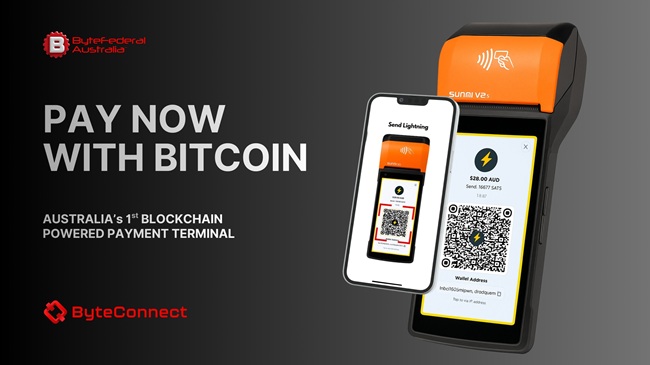
ByteFederal Australia, in partnership with Byte Federal Inc., has launched ByteConnect nationwide, a Bitcoin-enabled payment terminal and online payment gateway operating under the Australian Securities and Investments Commission (ASIC) Enhanced Regulatory Sandbox. The rollout positions ByteConnect as a regulated experiment in real-world crypto payments, testing whether digital assets can move beyond speculation and into compliant, merchant-scale commerce. Strategically, the launch signals growing confidence that Australia’s regulatory framework is mature enough to support controlled crypto payment adoption.
How ByteConnect’s launch under ASIC’s Enhanced Regulatory Sandbox reshapes crypto payment legitimacy in Australia
The decision to operate ByteConnect within the Australian Securities and Investments Commission’s Enhanced Regulatory Sandbox is not a procedural footnote but the core strategic anchor of the launch. Australia’s sandbox framework allows limited-scale deployment of financial products under defined compliance parameters, enabling innovation without abandoning regulatory oversight. For crypto payments, this is critical, as regulatory uncertainty has historically been the single largest barrier to merchant adoption.
By placing ByteConnect inside the sandbox, ByteFederal Australia effectively reframes crypto payments from a fringe alternative into a supervised financial experiment. This changes the risk calculus for merchants, banks, and institutional partners. Instead of asking whether crypto payments are legal or tolerated, the question becomes whether the operational and economic benefits justify adoption within a controlled regulatory envelope.
This approach also provides regulators with real transaction data, compliance performance metrics, and consumer behavior insights. In that sense, ByteConnect is as much a regulatory learning exercise as it is a commercial product, aligning innovation incentives on both sides of the policy table.
Why ByteConnect’s Bitcoin-only design reflects regulatory realism rather than technological conservatism
ByteConnect currently supports Bitcoin payments through both on-chain transactions and the Lightning Network, a choice that may appear conservative in an ecosystem crowded with stablecoins and alternative tokens. However, from a regulatory and risk-management perspective, this design is pragmatic.
Bitcoin remains the most widely recognized and institutionally analyzed digital asset, with clearer compliance precedents around custody, transaction monitoring, and anti-money laundering controls. Supporting Bitcoin exclusively simplifies risk profiling, customer due diligence, and reporting obligations under Australia’s AML and counter-terrorism financing frameworks.
The inclusion of the Lightning Network addresses one of Bitcoin’s historic weaknesses in retail environments, namely transaction speed and cost. Faster settlement and lower fees make small-value transactions viable, while on-chain support preserves auditability for larger payments. This dual-rail approach suggests ByteFederal Australia is prioritizing operational reliability and compliance clarity over feature breadth.
What ByteConnect signals about merchant appetite for regulated crypto payments beyond speculation
ByteConnect is positioned primarily for retail and hospitality merchants, sectors where margins are thin and payment friction matters. The platform’s broader applicability to property, automotive, luxury goods, and professional services, subject to enhanced due diligence, indicates a longer-term ambition to capture high-value transaction flows where traditional payment rails can be slow or costly.
However, the real test will be merchant demand rather than technical capability. Australian merchants have historically been cautious adopters of crypto payments, citing volatility, accounting complexity, and uncertain consumer demand. By embedding transaction monitoring, analytics, and structured onboarding into the platform, ByteConnect attempts to lower these barriers and present crypto payments as an operational choice rather than a philosophical one.
If early sandbox participants demonstrate measurable efficiency gains or customer acquisition benefits, it could trigger a second wave of adoption driven by competitive pressure rather than crypto enthusiasm. Conversely, weak uptake would reinforce the view that crypto payments remain a niche use case despite regulatory accommodation.
How ByteConnect fits into Australia’s evolving digital asset regulatory trajectory
Australia’s digital asset policy has been gradually shifting from reactive enforcement toward supervised enablement. The Enhanced Regulatory Sandbox reflects this evolution, offering controlled environments for testing new financial infrastructure without committing to full-scale regulatory reform upfront.
ByteConnect’s launch aligns with this trajectory by providing a concrete use case that regulators can observe and evaluate. Issues such as transaction traceability, consumer protection, merchant compliance burden, and interoperability with existing payment systems can be assessed empirically rather than hypothetically.
From a policy perspective, successful sandbox outcomes could inform future licensing regimes for crypto payment providers. Failure, on the other hand, would strengthen arguments for tighter controls or limited scope approvals. Either way, ByteConnect contributes data to a regulatory debate that has often lacked practical evidence.
How ByteConnect’s regulated rollout could reshape competitive dynamics for crypto payment infrastructure providers in compliance-heavy markets
The regulated positioning of ByteConnect differentiates ByteFederal Australia from crypto payment providers operating in lightly supervised or offshore jurisdictions. While this may limit speed and feature expansion, it enhances credibility with merchants who prioritize compliance over experimentation.
Competitors offering multi-asset or stablecoin-based solutions may argue for greater flexibility and price stability, but they also face higher regulatory complexity. ByteConnect’s sandbox-backed approach could set a benchmark for how crypto payment infrastructure is introduced in tightly regulated markets, potentially influencing similar initiatives in other Asia-Pacific jurisdictions.
Over time, the competitive advantage may hinge less on supported assets and more on compliance automation, reporting quality, and integration with accounting and tax systems. In that race, early alignment with regulators could prove more valuable than rapid feature deployment.
What execution risks and operational challenges ByteConnect faces as it transitions from ASIC sandbox testing to commercial scale
Despite its regulatory positioning, ByteConnect faces several execution risks. Merchant education remains a significant hurdle, as many businesses lack internal expertise to evaluate crypto payment options. Volatility exposure, even with immediate conversion options, can complicate cash flow management and accounting practices.
Operationally, scaling beyond the sandbox will require sustained investment in compliance systems, customer support, and infrastructure resilience. Any compliance misstep during the sandbox phase could slow regulatory approvals or constrain future expansion. Additionally, consumer demand remains uncertain, as mainstream Australian consumers have yet to demonstrate consistent preference for crypto payments in everyday transactions.
These risks underscore that regulatory approval is a necessary but not sufficient condition for success. Commercial traction will ultimately determine whether ByteConnect evolves into a scalable payments platform or remains a controlled pilot.
How investor and industry sentiment is shifting toward regulated crypto infrastructure plays over speculative digital asset platforms
While ByteFederal Australia is not publicly listed, broader investor sentiment toward regulated crypto infrastructure has been cautiously constructive rather than euphoric. Institutional capital has increasingly favored compliance-first models over speculative trading platforms, reflecting lessons learned from recent market cycles.
Industry observers are likely to view ByteConnect as a modest but meaningful signal that crypto infrastructure is entering a more disciplined phase. Rather than chasing rapid user growth, the focus is shifting toward durability, regulatory alignment, and real economic utility. This shift may not generate immediate headlines, but it aligns more closely with long-term institutional adoption narratives.
Key takeaways: What ByteConnect’s launch means for ByteFederal Australia, merchants, and Australia’s crypto ecosystem
- ByteConnect’s launch under the Australian Securities and Investments Commission sandbox reframes crypto payments as a regulated financial experiment rather than a speculative novelty.
- The Bitcoin-only, dual-rail design prioritizes compliance clarity and operational reliability over asset diversity.
- Merchant adoption will be the decisive metric, not technical capability or regulatory approval alone.
- The platform provides regulators with real-world data to inform future crypto payment policy decisions.
- Competitive differentiation increasingly favors compliance-first infrastructure in regulated markets.
- Execution risks remain high, particularly around merchant education and consumer demand.
- Successful sandbox outcomes could accelerate broader regulatory acceptance of crypto payments.
- Failure would reinforce skepticism about crypto’s role in everyday commerce.
Discover more from Business-News-Today.com
Subscribe to get the latest posts sent to your email.