




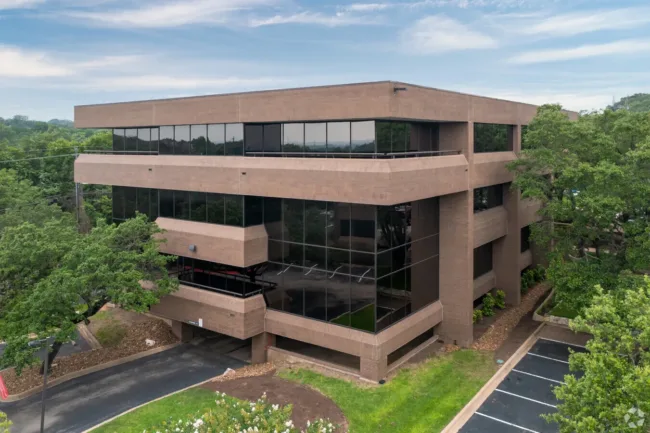
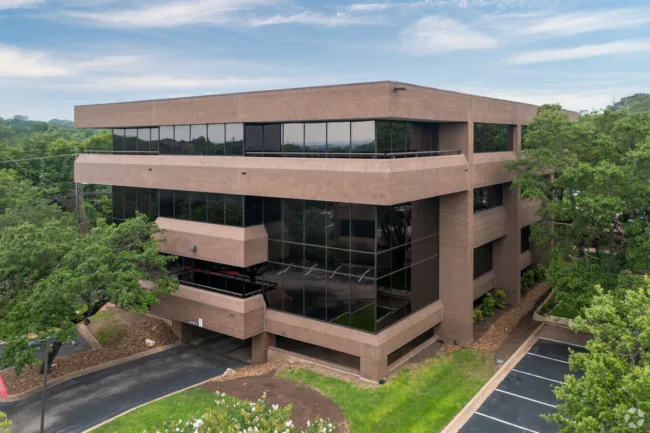
Buchanan Capital Partners, a performance-based real estate investment firm headquartered in Austin, has acquired the Escalade Office Park in an off-market transaction and rebranded it as Westbank Pointe. The 116,434-square-foot office building, situated at 4301 Westbank Drive in the affluent Westlake district, marks the firm’s latest strategic move in a high-barrier, low-vacancy submarket. Although financial terms were not publicly disclosed, internal references to a “significant discount to intrinsic value” and the firm’s zero-fee model suggest an opportunistic entry amid broader softness in the U.S. office sector.
Located at the intersection of Loop 360 and Westbank Drive, the asset directly faces Westlake High School and caters to a tenant base dominated by long-term, locally rooted businesses. With available suites ranging from 4,533 to 21,754 square feet, Buchanan Capital Partners is offering competitive lease packages in a market where class A suburban inventory remains constrained. Tenants already signed include Prime Bank of Texas, Chicago Title, and Cagle Pugh Law Firm—each representing embedded demand in a micro-market defined by affluent demographics and institutional-grade schools.
Why is Buchanan Capital Partners targeting suburban Texas office markets with high occupancy resilience?
The Westbank Pointe acquisition aligns with Buchanan Capital Partners’ ongoing strategy to invest in community-integrated assets with proven occupancy histories, low churn, and upside from targeted capital upgrades. Westlake, located west of downtown Austin, has long been recognized as one of the metro’s most desirable enclaves for both residential and commercial property. Unlike downtown Austin, where office vacancies have surged post-pandemic, Westlake’s office assets remain relatively insulated due to tight land availability, minimal new development, and a sticky tenant base.
In this case, Buchanan Capital Partners emphasized the continuity of leasing and property management teams—led by Transwestern Real Estate Services’ Brandon Lester and Connor Atchley—as a key component of its value thesis. The firm also revealed plans to invest over $1 million in aesthetic improvements to Westbank Pointe’s lobby and common areas. These upgrades are aimed at enhancing tenant experience while supporting above-market leasing velocity during a period of demand bifurcation in Texas’ office sector.
What role do strategic upgrades and pre-acquisition leasing activity play in the value thesis for Westbank Pointe?
Institutional investors increasingly view suburban office repositioning as a viable counter-cyclical play, especially when assets can be acquired at a reduced cost basis and demonstrate real-time leasing traction. According to Buchanan Capital Partners, multiple leases were signed during the acquisition’s due diligence phase—a signal of tenant confidence and submarket stability. This pre-acquisition activity effectively de-risks the asset while supporting immediate cash flow.
Keith Buchanan, the firm’s founder, noted that Westbank Pointe’s appeal lies not just in its location but in its community roots. Businesses operating within the building have maintained strong local reputations, and the surrounding Westlake area offers a rare blend of executive housing, premier schools, and natural amenities. This combination supports higher tenant retention and reduces capex volatility over time, which institutional capital often values when underwriting suburban assets.
How does Buchanan Capital Partners’ zero-fee model influence investor alignment and market positioning?
Buchanan Capital Partners operates under a no-fee structure, meaning investors receive full principal and return targets before the firm earns any performance-based compensation. This model is relatively rare in commercial real estate, where acquisition, asset management, and disposition fees are standard. The firm believes its investor-first approach gives it a competitive edge when courting capital partners for both direct acquisitions and joint venture structures.
In this transaction, Buchanan Capital Partners has leveraged its reputation for disciplined underwriting and local expertise to secure a high-visibility property in one of Texas’ most desirable suburban corridors. With a 28-year track record spanning all major commercial asset types—retail, office, industrial, and mixed-use—the firm continues to focus on high-growth metros like Austin, Dallas, and Houston. Its Westbank Pointe acquisition is positioned not as a speculative office turnaround, but as a value-conservation play grounded in demographic fundamentals and capital stewardship.
What is the institutional view on suburban office investment in Texas and how does it apply to this deal?
While national sentiment toward office real estate remains cautious, particularly in coastal urban cores, institutional investors have shown renewed interest in suburban submarkets with strong household income, limited new supply, and education-linked demand clusters. Austin’s Westlake fits squarely within this framework, offering affluent residential catchments and a deeply rooted tenant ecosystem.
Investors have generally preferred stabilized, transit-adjacent suburban assets or those linked to healthcare, education, or professional services demand. Westbank Pointe appears to meet several of these filters. Transwestern’s continued leasing and management role adds operational continuity, while Buchanan Capital Partners’ immediate improvement program provides a visibility roadmap for NOI growth.
Though the broader office market is experiencing a slow recalibration, assets like Westbank Pointe are viewed as hedges against core market volatility. Analysts point to long-term lease durations, limited speculative exposure, and embedded equity creation as key reasons why suburban repositionings—when executed with precision—are seeing relative outperformance compared to urban office high-rises.
What signals are institutional investors watching for in Buchanan Capital Partners’ next moves after Westbank Pointe?
Institutional sentiment around Buchanan Capital Partners remains cautiously optimistic as the firm continues to focus on cash-generating, risk-adjusted opportunities with near-term upside. Market observers are closely watching whether the Westbank Pointe playbook becomes a repeatable model across other suburban nodes in Texas. The firm’s emphasis on no-fee structures, local operator continuity, and pre-renovation leasing success could set a precedent for similar mid-cap private equity players eyeing post-COVID office realignments.
While not a direct bellwether for public REITs, Buchanan Capital Partners’ investment strategy does reflect broader market thinking around tenant experience, space optimization, and cost-basis resets. Investors also remain attentive to how asset management execution, leasing velocity, and capital improvements at Westbank Pointe unfold over the next 12–18 months, particularly in light of fluctuating interest rates and revaluation cycles in commercial real estate.
What could define success for Buchanan Capital Partners’ suburban office repositioning strategy going forward?
The success of the Westbank Pointe acquisition will likely hinge on a combination of factors: sustained tenant retention, speed of lease-up for the remaining suites, ROI on capital improvements, and visibility into stabilized yields. In a rising cost environment, executing value-add upgrades without overcapitalizing remains a delicate balance. If Buchanan Capital Partners achieves full occupancy while maintaining operational margin discipline, Westbank Pointe could emerge as a proof point for value-forward, suburban office investing.
As institutional investors evaluate capital deployment strategies in Texas, data points from Westbank Pointe will be scrutinized. This includes whether the no-fee model continues to attract aligned capital partners, how quickly NOI ramps post-upgrades, and whether tenant churn stays minimal. Ultimately, Buchanan Capital Partners’ thesis rests on executing better-than-market leasing outcomes in highly localized, resilient corridors—something few firms have historically scaled, but which may become increasingly relevant in the post-urban reset era.
Discover more from Business-News-Today.com
Subscribe to get the latest posts sent to your email.

