




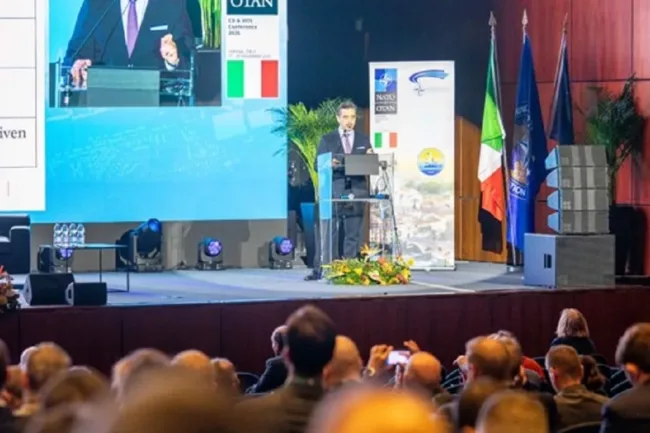
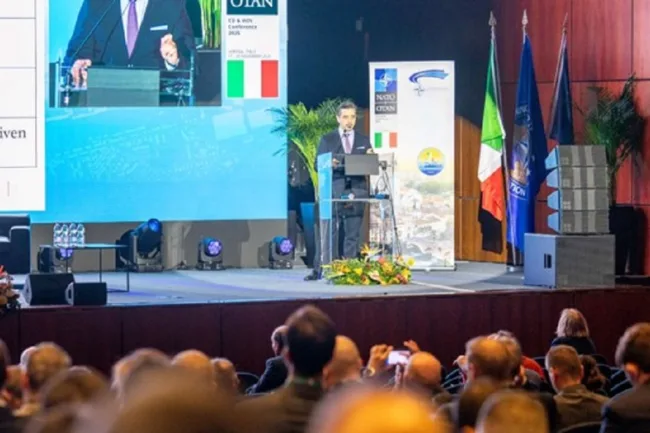
The United Kingdom has underscored its leadership in analytical defence wargaming through a high-profile showcase at the Concept Development plus Wargaming Initiative for NATO Conference (CD & WIN 2025), held in Verona, Italy. The event brought together NATO allies, partner nations, industry stakeholders, and academic institutions to strengthen collective military preparedness, exchange methodologies, and explore how strategic simulation can guide planning in a world of growing complexity and disruption.
Britain’s presence was anchored by the Defence Science and Technology Laboratory (Dstl) and the Cyber and Specialist Operations Command’s Integrated Warfare Centre (IWC), operating under the wider UK Ministry of Defence. These organisations jointly demonstrated the UK’s progress in building a next-generation defence experimentation and wargaming capability, designed to accelerate NATO’s ability to adapt at pace. At the heart of the showcase was a reaffirmation of Britain’s commitment to making wargaming a profession, not just a tool, and to aligning simulation-based decision-making with long-term force design and mission readiness goals.
Why the UK’s Defence Experimentation and Wargaming Hub and Dstl-led centre stage in Verona
Two British institutions featured prominently throughout the conference. The Defence Experimentation and Wargaming Hub (DEWH), led by Captain Eugene Morgan OBE RN, and the Defence Wargaming Centre (DWC), helmed by Dstl’s Chief Wargamer Colin Marston, jointly presented the evolution of the UK’s wargaming architecture. Their coordinated presence reflected not only operational synergy but also a formalised partnership established in 2024 through a charter that codifies shared goals, resourcing efficiency, and strategic coherence.
The first major UK presentation at CD & WIN 2025 focused on the Wargaming Defence Enterprise, an umbrella initiative highlighting the UK’s growing capacity to deploy national and multilateral simulation exercises as tools for strategic insight and decision calibration. The presentation emphasized how the UK is building a networked wargaming ecosystem, where defence analysts, technologists, planners, and warfighters operate through a common lens to test force options and develop scenario-based insights.
The second session introduced the Analysis-Led Wargaming Framework, or ALWF. This is a structured approach being developed to standardise how analytical wargaming is commissioned, conducted, and interpreted within defence contexts. It provides a repeatable methodology for aligning simulation exercises with specific decision points, turning war games from illustrative thought experiments into rigorous planning mechanisms. By doing so, it gives NATO stakeholders a shared language and format for driving data-backed choices, whether in concept development, operational planning, or capability experimentation.
What Britain’s presentations revealed about its One-Defence approach to simulation-led readiness
Throughout the event, UK delegates promoted a One-Defence perspective that places coherence at the center of defence transformation. The One-Defence model calls for closer collaboration not only within branches of the armed forces but across government, industry, and academia. Within the wargaming context, this means standardising processes, removing duplication, and ensuring simulation exercises directly inform doctrine, procurement, and capability development.
The British delegation’s contributions also reflected a long-term strategy to mainstream rigorous analytical techniques into all levels of military planning. Captain Morgan framed analytical wargaming as critical to shaping “credible future force options” and said that by sharing methods and building partnerships across NATO, the United Kingdom was helping the Alliance arrive at more evidence-based and coherent defence decisions.
Dstl’s Colin Marston added that NATO’s future operational advantage would depend heavily on the Alliance’s ability to think and learn collectively. He reinforced that the DEWH and DWC partnership is intended not just to streamline domestic capability, but to deepen collaborative experimentation across NATO theatres and operational planning circles.
How NATO members are responding to UK efforts to formalise wargaming frameworks across the Alliance
The presentations delivered by the UK received significant interest from NATO planners, especially as the Alliance prepares for a world where traditional warfighting doctrine is under pressure from cyber, hybrid, and autonomous warfare paradigms. In that context, wargaming is being reimagined as a cognitive accelerator that can compress planning timelines, model outcomes, and anticipate adversary responses with greater granularity than historical tools allow.
The ALWF, in particular, is being watched as a blueprint that could eventually underpin NATO-wide simulation standards. While still in development, the framework has already gained traction within certain Allied training environments as a way to guide experimentation outcomes toward usable planning insights. According to experts familiar with NATO’s evolving doctrine development cycle, the Alliance will increasingly favour such structured methodologies in upcoming joint exercises and concept validation trials.
The UK’s emphasis on inclusive wargaming design also attracted attention. British officials promoted the integration of diverse teams, spanning gender, professional background, and domain expertise, as a force multiplier for red-teaming, scenario robustness, and decision realism. By making wargaming more representative of the full spectrum of NATO’s human capital, the UK is pushing for more nuanced outcomes that better reflect contemporary operational complexity.
Why analysts believe wargaming is becoming central to defence policy, not just training
Analysts tracking NATO’s doctrinal evolution believe wargaming is quickly shifting from a niche capability to a strategic pillar. As artificial intelligence, space-based surveillance, and cyber operations expand the battlespace beyond conventional domains, scenario-based simulation provides a valuable bridge between abstract planning and real-world execution. Britain’s push to treat wargaming as a repeatable, analytics-led enterprise is viewed by defence observers as an important step toward institutionalising anticipatory decision-making.
At the policy level, the UK’s Defence Command Paper Refresh and the Integrated Review both included explicit references to wargaming as a critical enabler of defence transformation. The DEWH and DWC’s presence in Verona signals that this ambition is moving from strategy documents into practice, with operational impact likely to be seen in future force design, AI-enabled concept trials, and international defence collaboration.
Financially, the UK’s investments in defence experimentation, including the DEWH’s resourcing and toolset upgrades, align with the broader trend across NATO for digital twin capabilities, simulation-as-a-service platforms, and the use of behavioural science in military readiness modelling. With these investments gaining policy and funding traction, analysts expect structured wargaming to feature heavily in NATO’s 2030 and 2040 concept cycles.
What the road ahead looks like for Britain’s influence in NATO’s wargaming ecosystem
While Britain’s integrated wargaming framework remains in evolution, the institutional commitment and strategic alignment it represents are already shaping NATO’s posture. Future iterations of the CD & WIN conference may see more formal adoption of ALWF elements or joint methodological testing among NATO members. Discussions are reportedly underway for a series of NATO-endorsed workshops to standardise simulation outputs and explore metrics for scenario validation.
In the interim, the DEWH–DWC partnership is likely to focus on building interoperability across bilateral and multilateral wargaming exercises, ensuring that ALWF’s principles can be adapted to various operational cultures and command frameworks. There is also a push to embed the framework within NATO Centres of Excellence, where doctrine, experimentation, and training intersect.
The United Kingdom’s position in the Alliance’s evolving wargaming landscape is now seen as both an intellectual anchor and a practical catalyst. Its approach merges tradition with transformation, coupling the time-tested art of red-teaming with emerging needs for digital analysis, scalable simulations, and cross-domain foresight.
As the Alliance faces an uncertain future marked by contested domains and accelerating threats, Britain’s push for a structured, human-centric, and analytics-led wargaming culture may well define how NATO plans, adapts, and prevails.
What are the key takeaways from Britain’s wargaming showcase at NATO CD & WIN 2025?
- The United Kingdom spotlighted its integrated approach to defence wargaming at NATO’s CD & WIN 2025 conference in Verona, Italy, reinforcing its leadership in simulation-based strategic planning.
- The Defence Experimentation and Wargaming Hub (DEWH) and the Defence Wargaming Centre (DWC) jointly presented on the Wargaming Defence Enterprise and the Analysis-Led Wargaming Framework (ALWF), a structured methodology for analytical simulation.
- UK presentations promoted enterprise-wide coherence under the One-Defence model, pushing for deeper collaboration between military, civilian, and academic stakeholders in simulation design and execution.
- Emphasis was placed on analytical rigour, repeatability, and evidence-based insights to help NATO planners make faster and more informed operational and capability decisions.
- Diversity and inclusion were framed as critical for enhancing scenario realism and improving decision-making in complex wargaming environments.
- British officials positioned wargaming not just as a training tool but as a foundational pillar for NATO’s strategic agility in an era of cyber, hybrid, and autonomous warfare threats.
- Analysts expect Britain’s ALWF and other methodological contributions to shape NATO’s evolving concept development and joint planning cycles through 2030 and beyond.
- Future adoption may include integration into NATO Centres of Excellence and formal inclusion in multinational exercises or concept validation protocols.
- The UK’s approach signals a long-term shift toward institutionalising human-centric, simulation-driven decision-making as a core defence capability.
- Britain’s Verona showcase reaffirms its intent to serve as both a conceptual leader and practical enabler within NATO’s emerging wargaming ecosystem.
Discover more from Business-News-Today.com
Subscribe to get the latest posts sent to your email.


