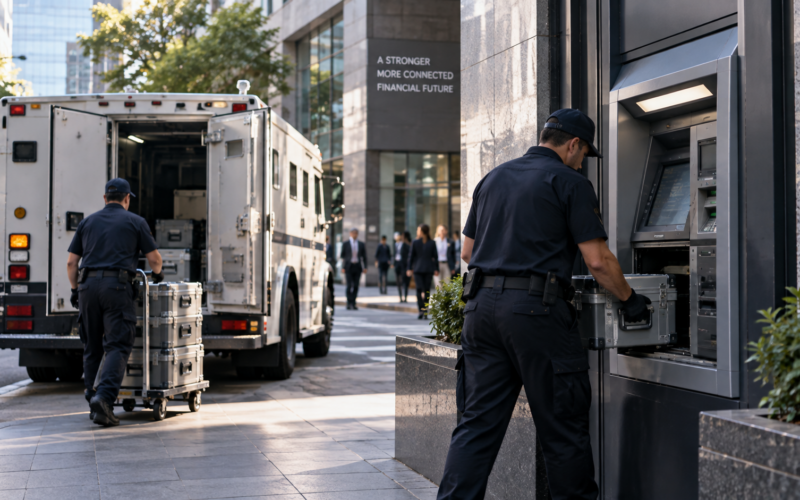
The steady rise of digital payments should, at first glance, be terrible news for companies built around cash. Consumers increasingly use cards, mobile wallets and remote-payment channels, banks are closing branches, and financial institutions have spent years encouraging customers toward digital self-service. Yet one of the largest financial-infrastructure transactions of 2026 suggests that the business of making physical cash available is not disappearing so much as being reorganised.
The Brink’s Company (NYSE: BCO) agreed in February to acquire NCR Atleos Corporation (NYSE: NATL) in a cash-and-stock transaction valued at approximately $6.6 billion, including cash consideration, Brink’s shares and assumed NCR Atleos debt. Shareholders of both companies approved the transaction in June, while Brink’s said in August that regulatory momentum could allow completion early in the first quarter of 2027. The transaction is significant not simply because of its size, but because it joins one of the world’s best-known cash-management businesses with a company operating hundreds of thousands of self-service banking devices and a large independent ATM network.
The apparent contradiction is the interesting part. Cash has lost substantial share to digital payment methods over the past decade, but the infrastructure required to keep cash available remains enormous, geographically distributed and operationally complex. As banks increasingly question whether they need to own and operate every part of that infrastructure themselves, ATM management may be evolving from a declining hardware business into an outsourcing market.
Why has cash survived the digital-payment boom longer than many forecasts expected?
Federal Reserve Financial Services data illustrates why the idea of a completely cashless economy remains premature. Its 2026 Diary of Consumer Payment Choice found that cash represented roughly one in seven U.S. consumer payments in 2025. Four out of five surveyed consumers had used cash during the previous 30 days, while 90% said they expected to continue using it.
Cash is clearly no longer the dominant everyday payment mechanism. Credit and debit cards together accounted for roughly two-thirds of payments, while consumers made an average of six monthly payments in cash compared with 16 by credit card and 15 by debit card. Nevertheless, those six cash transactions have remained surprisingly resilient after the dramatic pandemic-era decline, suggesting that digital adoption has not translated into straightforward elimination of physical currency.
The persistence becomes more important when demographics and contingency behaviour are considered. Lower-income households, older consumers and rural residents show greater dependence on cash, while cash also functions as a backup when preferred electronic methods cannot be used. Federal Reserve research found that 76% of consumers carried cash in 2025, and nearly half stored additional cash elsewhere for savings or emergency use.
That means banks and retailers cannot simply treat cash access as a legacy product that can be shut down without consequences. Even a consumer who conducts most transactions digitally may still expect reliable access to banknotes, withdrawals, deposits and emergency liquidity. Maintaining that access across thousands of locations creates an infrastructure requirement even when the percentage of purchases completed with cash continues to decline.
How is the ATM business moving from hardware sales toward recurring services?
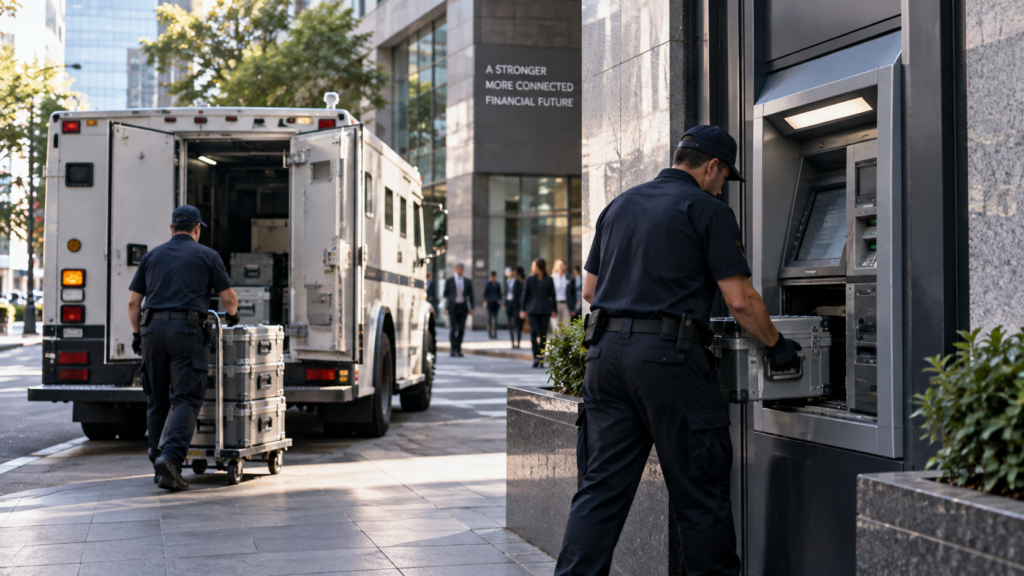
NCR Atleos demonstrates the shift particularly clearly. The company still manufactures and sells ATMs, but its economic model increasingly includes software, maintenance, transaction processing, managed services and ATM-as-a-Service arrangements. Its 2025 annual report described an ATMaaS model under which financial institutions can outsource functions including back-office activity, cash management, software management, transaction processing, deployment and maintenance.
Revenue from NCR Atleos ATMaaS arrangements increased to $258 million in 2025 from $194 million in 2024 and $153 million in 2023. Annualised recurring revenue within Self-Service Banking reached $1.714 billion, while approximately 58% of segment revenue was recurring. The company also reported a global installed base of roughly 600,000 devices and an independently owned ATM network of about 78,000 units in the transaction presentation prepared for the Brink’s deal.
That changes the question banks face. Instead of deciding whether an ATM is worth buying, they can increasingly decide whether operating an ATM estate should remain an internal capability at all.
The economics resemble developments elsewhere in enterprise infrastructure. Companies once bought servers and ran their own data centres before cloud computing shifted capital ownership and operational complexity toward specialist providers. The analogy is imperfect, because ATMs are physical devices handling regulated cash and security risks, but the strategic logic is comparable. Outsourcing can convert fragmented internal operations into contracted services delivered at scale.
Why does combining Brink’s with NCR Atleos make strategic sense?
The Brink’s Company already sits on the physical side of the cash ecosystem. Its activities include cash and valuables management, ATM managed services and digital retail solutions, while NCR Atleos brings the self-service device estate, ATM software, transaction networks and a much larger bank-facing technology infrastructure.
Brink’s said the combination is expected to produce at least $200 million in annual run-rate cost synergies within three years after closing and projected at least 35% earnings-per-share accretion. Its transaction materials showed an illustrative combined company with around $10 billion of revenue and approximately $2 billion of adjusted EBITDA based on consensus estimates used in the presentation.
The opportunity is therefore not merely to transport cash to more machines. A combined platform could potentially manage more of the ATM lifecycle, covering device technology, software, processing, cash forecasting, replenishment, maintenance and associated retail services. The more of that chain one provider controls, the greater the potential for route optimisation, procurement savings, network density and recurring contractual revenue.
Brink’s own operating performance suggests why management is attracted to the model. Second-quarter 2026 revenue increased 7%, adjusted EBITDA rose 11% and non-GAAP earnings per share advanced 18%. The company highlighted what it described as its 14th consecutive quarter of mid-teens-or-better organic growth in ATM managed services and digital retail solutions.
Could fewer bank branches actually increase demand for outsourced cash infrastructure?
Branch closures do not necessarily eliminate demand for cash access. They can instead separate the function of cash distribution from the traditional bank branch.
A bank can reduce expensive staffed locations while continuing to offer customers physical access through independently operated ATMs, retailer-based machines or shared networks. Digital banks face an even clearer version of the same challenge because they may have no meaningful branch estate while their customers still occasionally require cash.
NCR Atleos’ Allpoint network illustrates that model by giving banks, credit unions, fintech companies and digital financial providers access to an external ATM network. The infrastructure can therefore behave less like a proprietary bank asset and more like a utility shared across institutions.
This is one reason declining cash share does not automatically translate into equivalent declines in infrastructure value. If the number of institutions willing to operate their own networks falls faster than consumer demand for physical access, specialist operators can gain share even in a mature underlying market.
What are the biggest risks in the Brink’s and NCR Atleos strategy?
Scale does not remove transaction risk. Brink’s is paying substantial consideration and assuming significant NCR Atleos debt, so the financial case depends on successful integration, synergy delivery and continued growth in higher-margin service lines. A larger company can generate savings through overlapping systems and procurement, but combining two operationally complex global infrastructures can also generate execution costs that are difficult to forecast.
Technology risk also remains important. Cash may be resilient today, but its long-term share of consumer transactions could resume declining as younger consumers age and mobile payment acceptance becomes nearly universal. The relevant strategic defence is therefore not simply ownership of more ATMs, but the ability to generate higher recurring revenue from each unit and provide services that remain useful even as transaction patterns change.
Cybersecurity and uptime become more consequential as networks consolidate. An ATM is no longer simply a cash dispenser connected to a bank. Modern networks include software, telecommunications, transaction routing, remote monitoring and cash-management systems, increasing both service opportunities and the operational consequences of disruption.
The transaction therefore represents a bet that specialisation will matter more than absolute cash-volume growth. Brink’s does not need physical cash to recapture its former share of consumer spending if banks increasingly outsource the expensive infrastructure required to keep it available.
What does the market currently appear to think about The Brink’s Company?
The Brink’s Company closed at $112.01 on September 11, up roughly 2.5% for the session after advancing over several preceding trading days. The recent pattern suggests constructive rather than euphoric sentiment as investors weigh the company’s improving service mix against the financing and integration requirements surrounding NCR Atleos.
That distinction is important because the transaction effectively changes the investment proposition. Brink’s is attempting to become less dependent on conventional cash-in-transit economics and more exposed to technology-enabled, recurring financial infrastructure services.
If that transformation works, the surprising winner from digital banking may not be a company betting against digital payments. It could be a company recognising that even a digital financial system still needs physical endpoints, and that fewer banks may want the burden of operating those endpoints themselves.
Discover more from Business-News-Today.com
Subscribe to get the latest posts sent to your email.