


The Boeing Company (NYSE: BA) reported fourth quarter 2025 earnings marked by a $23.9 billion revenue surge, a $9.6 billion gain on its Digital Aviation Solutions divestiture, and the completion of its acquisition of Spirit AeroSystems. The aerospace giant posted net earnings of $8.2 billion for the quarter and ended the year with its highest commercial deliveries since 2018, cementing a $682 billion backlog that spans over 6,100 aircraft.
The company’s Q4 performance saw GAAP operating margins recover to 36.7 percent, a stark contrast to the prior year’s loss-driven negative margins. While the divestiture gain played a dominant role, core operating earnings also turned around significantly, and commercial deliveries reached 160 aircraft in the quarter. Operating cash flow came in at $1.3 billion, and free cash flow (non-GAAP) was $375 million.
Boeing’s leadership reiterated a cautious but determined outlook for 2026, targeting free cash flow of $1 billion to $3 billion despite known headwinds from certification delays, legacy program burnoffs, and integration costs from the Spirit AeroSystems acquisition.
How is Boeing leveraging strategic asset shifts to reset its financial and operational runway?
Boeing’s fourth quarter results were structurally transformed by two major transactions. The $10.6 billion divestiture of portions of its Digital Aviation Solutions unit contributed an $11.83 per share boost to earnings and helped boost cash reserves to $29.4 billion by year-end. Simultaneously, the company closed its acquisition of Spirit AeroSystems, a move aimed at stabilizing production quality and supply chain resilience across the 737 and 787 programs.
The net impact was a notable shift in Boeing’s capital posture. While debt rose modestly to $54.1 billion due to the Spirit transaction, the balance sheet was partially de-risked by divestiture proceeds and improved free cash generation. Boeing emphasized that its $10 billion credit facilities remain undrawn, suggesting it is not leaning on liquidity buffers as aggressively as in previous years.
From a strategic standpoint, the Spirit deal was positioned as a forward-looking bet on executional control. Boeing executives highlighted that the integration will allow for tighter guidance over rate ramps and factory health, particularly as 737 production scales toward 47 per month and the Everett North Line comes online.
What were the performance inflection points across commercial, defense, and services segments?
In the commercial airplane segment, revenue rose 139 percent year-over-year to $11.4 billion for the quarter, while losses from operations narrowed sharply. Boeing delivered 600 aircraft for the full year, with the 737 program stabilizing at 42 per month and a 2026 ramp to 47 on track. The company booked 336 net orders in Q4, including major deals with Emirates and Alaska Airlines.
However, program profitability remains a concern. Commercial Airplanes still posted an operating loss of $632 million in Q4, though this was significantly improved versus the $2.1 billion loss in the prior year period. Boeing disclosed that Spirit-related impacts reduced margins by approximately 1.5 percentage points in the quarter, reinforcing the strategic logic behind the acquisition.
In Defense, Space & Security, revenue rose 37 percent to $7.4 billion, but the segment recorded a $507 million loss from operations due to a $565 million charge on the KC-46A tanker. Boeing attributed this to higher support costs, quality investments, and supply chain pressures—including from Spirit—though it also reported a 20 percent drop in average rework in the factory as a sign of stabilization.
The Global Services segment was the clear outlier in profitability, posting a 202.4 percent operating margin thanks to the Digital Aviation Solutions gain. Even when adjusted for the divestiture, BGS recorded double-digit margins in both its commercial and government lines, buoyed by strong sustainment performance and $10 billion in quarterly orders.
How do free cash flow dynamics and capital allocation reflect Boeing’s transition priorities?
Boeing reported positive free cash flow of $375 million for the quarter and full-year usage of $1.9 billion—an improvement from a $14.3 billion outflow the prior year. Management guided to 2026 free cash flow of $1 billion to $3 billion, citing ongoing cost absorption from 777X delays, 737/787 delivery considerations, and the legacy development program burnoff in Defense.
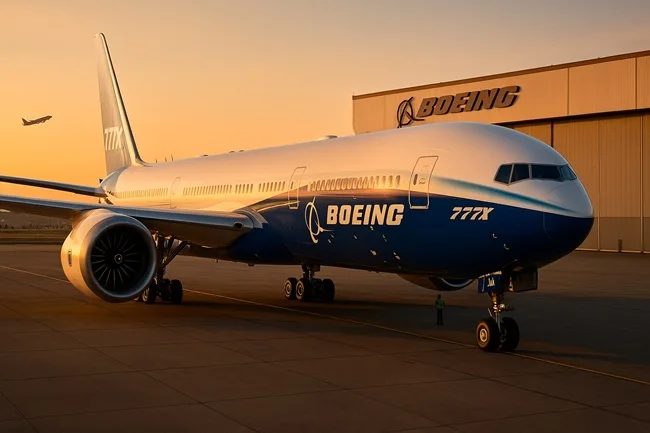
Notably, the company stated that 777X certification delays would continue to drive negative cash flow until deliveries begin in 2027. Boeing expects net cash use from this program to improve over the next few years but only turn positive by 2029.
For 737 and 787, inventory and customer considerations remain a drag, but Boeing believes production stability will be the lever to gradually unwind these burdens. Executives also confirmed that excess advance payments and rework-related costs will improve over time if on-time delivery performance is sustained.
Capital expenditure is set to rise to approximately $4 billion in 2026, largely driven by facility investments in Saint Louis, Charleston, and the integration of Spirit AeroSystems. Management reiterated its long-term confidence in reaching $10 billion in annual free cash flow, calling it “very attainable” assuming successful execution across programs and margin recovery in Commercial Airplanes.
What are the execution risks and production constraints heading into 2026?
The company flagged several bottlenecks in the near-term production roadmap. The 737 program’s ramp to 47 aircraft per month is supported by internal KPIs and excess inventory, but moving to 52 will require material supply chain performance improvements, including from Spirit.
On the 787, Boeing reported successful stabilization at eight per month and has targeted a ramp to 10, but continues to face delivery constraints related to seat certifications with both FAA and EASA regulators. These are not expected to hinder production but could delay revenue recognition and cash inflows.
In Defense, the outlook is mixed. Boeing achieved multiple milestones in Q4 including delivery of the T-7A Red Hawk and progress on the MQ-25 and sixth-generation fighter platform, but repeated charges on the KC-46A and legacy development programs continue to weigh on margins and investor confidence. The Defense backlog now stands at $85 billion, with 26 percent of orders from non-U.S. customers.
How is institutional sentiment shifting after Boeing’s 2025 reset?
Investor sentiment appears to be stabilizing, but remains cautious. The $9.6 billion gain from the Digital Aviation Solutions sale distorts core profitability optics, and analysts have probed for clearer line of sight into normalized free cash flow. Management reiterated its belief that Spirit AeroSystems integration will not materially dilute cash margins over time and that pricing tailwinds should support out-year recovery.
With commercial order books stretching into the next decade and segmental performance improving, the narrative is beginning to shift toward execution rather than survival. However, the path remains steep, especially given outstanding risks around certification, supply chain reliability, and the maturity of Boeing’s fixed-price development approach in Defense.
What are the strategic and financial implications of Boeing’s Q4 performance for peers and investors?
- Boeing reported Q4 2025 revenue of $23.9 billion, up 57 percent year-over-year, supported by 160 commercial deliveries.
- A $9.6 billion gain from the Digital Aviation Solutions divestiture inflated quarterly earnings, contributing $11.83 to EPS.
- The company completed its acquisition of Spirit AeroSystems, aiming to stabilize supply chain and margin drag in core programs.
- Operating cash flow was $1.3 billion in Q4; free cash flow for the full year improved to negative $1.9 billion, with guidance of $1–3 billion positive in 2026.
- The commercial aircraft segment delivered 600 planes for the year, its highest since 2018, with backlog rising to $567 billion.
- 777X remains in certification testing with first delivery still expected in 2027; engine durability issues are being assessed with GE.
- Defense segment posted $507 million quarterly loss, including a $565 million charge on KC-46A; backlog hit a record $85 billion.
- Global Services posted an adjusted 18.6 percent operating margin excluding divestiture impact, reflecting solid growth in both government and commercial support.
- Capital expenditure expected to reach $4 billion in 2026, driven by production capacity investments and Spirit integration.
- Boeing reiterated its long-term $10 billion free cash flow target, but emphasized that 2026 will remain a year of transition and investment.
Discover more from Business-News-Today.com
Subscribe to get the latest posts sent to your email.