


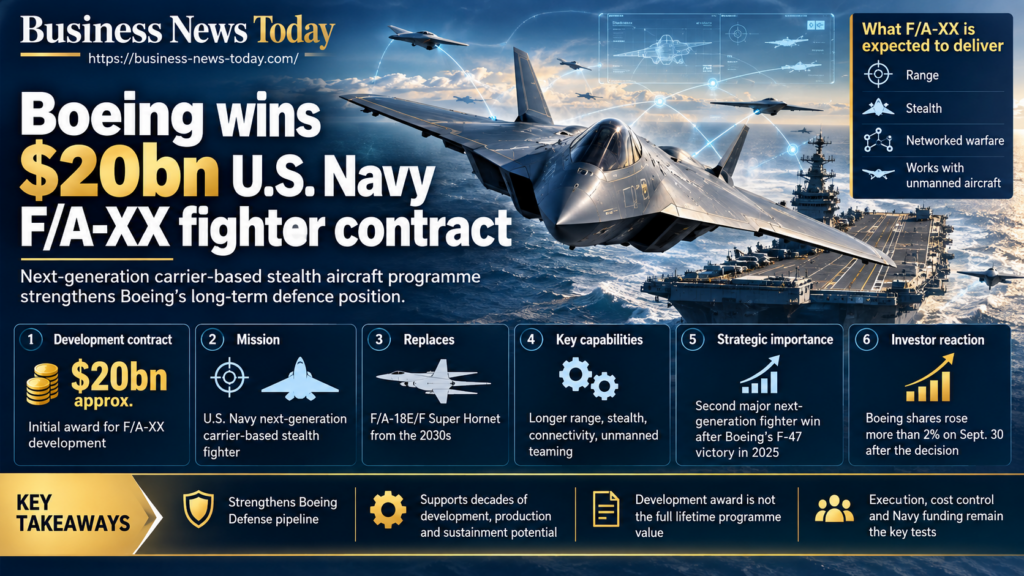
The Boeing Company (NYSE: BA) has been selected to develop the United States Navy’s F/A-XX next-generation carrier-based stealth fighter under a contract valued at approximately $20bn, defeating Northrop Grumman Corporation in one of the most strategically important US combat-aircraft competitions of the decade. The programme is intended to replace the Navy’s Boeing-built F/A-18E/F Super Hornet fleet beginning in the 2030s.
The award gives Boeing a second major next-generation fighter victory after the company won the United States Air Force’s F-47 programme in 2025. Together, the two competitions significantly strengthen Boeing Defense, Space & Security’s long-term position at a time when the commercial-aircraft business continues working through production, quality and balance-sheet challenges.
F/A-XX is expected to combine greater range, stealth and connectivity with the ability to work alongside unmanned aircraft. Many technical details remain classified, and the $20bn development contract should not be confused with the eventual lifetime value of the programme if the aircraft proceeds into full-rate production over several decades.
Why is the F/A-XX contract strategically important for Boeing?
Boeing already builds the F/A-18 Super Hornet, giving it decades of experience designing and supporting carrier-based combat aircraft. Yet the current Super Hornet production line is approaching its end, creating a potential industrial gap for Boeing’s fighter workforce in St. Louis.
F/A-XX changes that outlook. A new fighter-development programme can support thousands of engineering, manufacturing and supplier positions across many years before production even begins. If the aircraft eventually enters large-scale service, sustainment, upgrades, training and spare parts could create a much longer revenue stream.
The contract therefore carries more strategic value than its initial dollar amount indicates. Development awards position a company inside an architecture that can remain operational for 30 or 40 years, especially when governments continue upgrading sensors, weapons and software throughout a platform’s life.
Boeing’s earlier F-47 selection already strengthened its position in next-generation tactical aviation. Winning F/A-XX means Boeing could participate deeply in both the Air Force and Navy fighter fleets that follow today’s F-35, F-22 and F/A-18 era.
The company still has to execute. Advanced aircraft programmes regularly face technical complexity, schedule pressure and cost growth, meaning winning the competition merely transfers Boeing from bidding risk into development risk.
What capabilities is the US Navy seeking from F/A-XX?
The Navy wants an aircraft able to operate farther from an aircraft carrier while surviving against increasingly sophisticated air defences. Range has become particularly important because long-range anti-ship missiles can force carrier groups to operate farther from contested coastlines.
Greater combat radius allows aircraft to strike or defend across larger distances without depending as heavily on vulnerable aerial refuelling. Stealth reduces the probability of detection, while advanced sensors and communications allow the fighter to function as part of a network rather than as an isolated aircraft.
F/A-XX is also expected to work with unmanned Collaborative Combat Aircraft and other autonomous systems. That means the future fighter may control or coordinate additional aircraft carrying sensors, weapons or electronic-warfare payloads.
This architecture changes aircraft economics. The Navy does not simply need one exquisite fighter with every capability physically installed onboard. A crewed aircraft could operate as a command node within a wider formation of lower-cost unmanned systems.
Boeing therefore needs to demonstrate competence across software, communications, autonomy and open-system integration in addition to traditional aircraft design.
Why did Boeing beat Northrop Grumman after Lockheed Martin had already exited?
Lockheed Martin Corporation had previously been removed from the competition, leaving Boeing and Northrop Grumman as the principal contenders. The Pentagon has not publicly disclosed enough technical or pricing information to establish precisely why Boeing’s proposal prevailed.
Northrop Grumman possesses deep stealth experience through programmes including the B-21 Raider, while Boeing brings extensive carrier aviation history from the F/A-18 and EA-18G Growler. The Navy’s selection therefore should not be interpreted simply as a judgement about which contractor possesses better stealth technology.
Programme management, cost, production capacity, carrier suitability, schedule, industrial-base considerations and technical architecture can all influence a classified competition.
The award also reflects the importance of sustaining multiple US combat-aircraft design teams. Concentrating every future fighter programme with one manufacturer could weaken competition and reduce the industrial options available for later programmes.
Boeing’s recent victories alter that balance materially. After years in which Lockheed Martin dominated US fighter production through the F-35, Boeing now owns two opportunities to rebuild a much larger combat-aircraft franchise.
Could the F/A-XX programme become much larger than $20bn?
Yes, but that should not be treated as guaranteed future revenue. The disclosed figure principally relates to development. A successful programme could later move into production, upgrades and sustainment worth many additional billions of dollars.
The eventual number of aircraft will depend on Navy budgets, programme cost, geopolitical priorities and how extensively unmanned aircraft supplement crewed fighters.
International opportunities may also emerge eventually, although carrier aviation narrows the immediate customer universe compared with a land-based fighter. Export policy and classified technologies could further limit foreign participation.
The financial profile of defence development programmes also differs from ordinary commercial contracts. Revenue is recognised as work progresses, while programme margins depend on contract structure and Boeing’s ability to control engineering costs.
Boeing has experienced painful defence charges in recent years on fixed-price development programmes. Investors therefore have reason to celebrate backlog while remaining cautious about margin assumptions until contract details and execution become clearer.
A $20bn win creates opportunity. It does not automatically create $20bn of profit-quality revenue.
What does the fighter award mean for Boeing’s wider turnaround?
Boeing’s equity story remains dominated by commercial aircraft, especially the 737 MAX and 787, because those programmes generate most of the company’s long-term industrial scale and cash potential. Defence nevertheless provides diversification and can help stabilise the company when commercial deliveries are under pressure.
The F/A-XX award arrived as Boeing shares were recovering from a sharp September 28 decline. The stock had closed at $187.68 on September 29 and rose more than 2% during September 30 trading after the Pentagon decision became public, while Northrop Grumman shares declined.
That reaction indicates investors regarded the award as financially and strategically meaningful, but the size of Boeing means a development contract alone cannot reset the valuation.
The more interesting consequence is industrial. Boeing now has two marquee next-generation fighter programmes, potentially giving its defence business a much stronger product pipeline through the 2030s.
The company must translate those awards into disciplined programme execution. Boeing’s recent history demonstrates that backlog without cost control can destroy value rather than create it.
For F/A-XX, the central milestones will include engineering progress, prototype development, cost performance and whether the Navy preserves procurement funding as budget priorities evolve. Winning the competition was difficult. Building the aircraft on schedule and at acceptable economics will be considerably harder.
Discover more from Business-News-Today.com
Subscribe to get the latest posts sent to your email.