

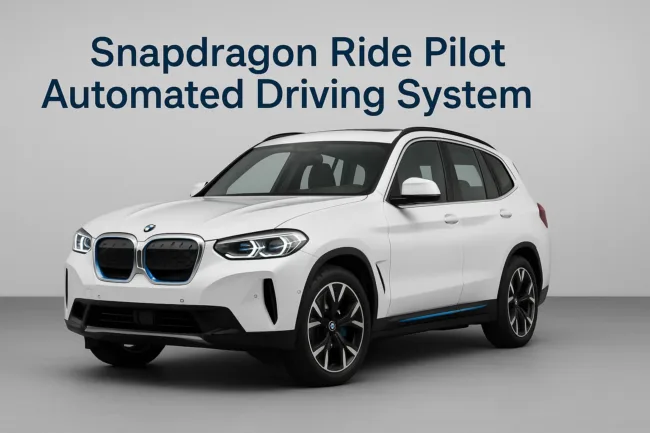
Qualcomm Technologies, Inc. (NASDAQ: QCOM) and BMW Group have officially launched their co-developed automated driving system, Snapdragon Ride Pilot, in the all-new BMW iX3, the first production vehicle in BMW’s Neue Klasse EV platform. The launch marks a major inflection point in advanced driver assistance systems (ADAS), combining Qualcomm’s Snapdragon Ride system-on-chip (SoC) hardware with a jointly engineered Snapdragon Ride AD software stack—a scalable solution now being offered to all global automakers and Tier-1 suppliers.
Validated for use in over 60 countries and targeted for rollout in more than 100 countries by 2026, the AI-driven system is designed for flexibility—supporting both entry-level NCAP safety features and Level 2+ automated driving, including highway and urban navigation on autopilot.
This rollout positions Qualcomm Technologies as a serious contender in the autonomous driving race, where rivals like NVIDIA, Intel’s Mobileye, and Tesla’s Dojo have historically dominated both investor attention and OEM integrations.
How does Snapdragon Ride Pilot elevate Qualcomm’s global ambitions in the ADAS and autonomous driving market?
Snapdragon Ride Pilot represents the culmination of a three-year joint effort between Qualcomm Technologies and BMW Group, involving more than 1,400 specialists across five countries—Germany, the United States, Sweden, Romania, and the Czech Republic. The software stack was co-developed with the intent to serve a dual purpose: offering carmakers a turnkey solution or enabling modular integration into custom driving stacks.

Qualcomm’s Group General Manager for Automotive and Industrial & Embedded IoT, Nakul Duggal, characterized the partnership as transformative, stating that the jointly developed system sets a new benchmark in safety, comfort, and regional applicability. BMW’s Dr. Mihiar Ayoubi added that the collaboration was instrumental in defining the Neue Klasse’s leap into next-gen intelligent driving, guided by the philosophy of “smart, symbiotic, and safe.”
Snapdragon Ride Pilot is now commercially available for integration by other OEMs and Tier-1s, expanding Qualcomm’s addressable market beyond BMW and into the broader global automotive industry.
What software innovations set the Snapdragon Ride AD stack apart from existing autonomous driving platforms?
The Snapdragon Ride AD software stack is layered into four key components: 360-degree perception, context-aware driving intelligence, functional safety, and a cloud-connected simulation environment. At its core, the system employs a camera-first approach, powered by high-definition 8M and 3M pixel camera arrays, in combination with radar sensors and bird’s eye view (BEV) processing to detect objects, lanes, traffic signs, and complex intersections.
The perception engine is co-optimized through hardware-software co-design, including network architecture search techniques to manage computing and memory loads—particularly important for supporting real-time decisions in dense urban environments.
Behavior prediction and path planning leverage hybrid AI models, balancing rule-based logic with machine-learned inference. Safety remains a primary differentiator, with support for NCAP, FMVSS127, DCAS, and advanced compliance frameworks like SOTIF (Safety of the Intended Functionality) and robust automotive cybersecurity layers, including multi-layer encryption and threat detection.
The system is also designed to be future-proof, with over-the-air (OTA) update capability and a robust software development kit (SDK) that enables automakers to tailor the ADAS experience across various vehicle segments.
How is data from real-world and synthetic environments shaping Qualcomm’s approach to autonomous driving?
A defining feature of the Snapdragon Ride ecosystem is its data and simulation factory—a cloud-based AI pipeline that synthesizes real-world driving data from global fleets with synthetic simulations. This feedback loop not only accelerates training cycles but also equips Qualcomm with global context-awareness, a key ingredient in making ADAS features adaptable across varying road rules, climates, and traffic behavior.
The data flywheel supports the entire lifecycle of Snapdragon Ride Pilot, enabling continuous enhancement of perception, behavior, and safety models. This strategy mirrors industry trends seen at NVIDIA (with DriveSim) and Tesla (with shadow mode), emphasizing the shift from one-time feature delivery to continual fleet learning as a product differentiator.
What automated driving features does the BMW iX3 offer through Snapdragon Ride Pilot?
The BMW iX3’s ADAS suite, underpinned by the Snapdragon Ride platform, unlocks multiple L2+ driving capabilities. These include contextual lane changes, which trigger based on subtle driver inputs such as mirror glances or steering nudges; active lane change and highway assist, which support hands-free operation on approved road networks; and AI-based parking assistance, which uses Snapdragon’s perception stack for slot detection.
BMW also integrates driver monitoring systems (DMS) using in-cabin cameras, aligning with global safety mandates. The central intelligent computer, dubbed BMW’s “Superbrain of Automated Driving,” delivers 20x higher computing performance than the previous generation, bringing unprecedented autonomy, reliability, and scalability to the Neue Klasse EVs.
Additionally, the iX3 is equipped with Qualcomm’s V2X 200 chipset, enabling vehicle-to-everything (V2X) communication. This allows the vehicle to “see” beyond its sensor range—communicating directly with nearby infrastructure, pedestrians, and other vehicles to enhance situational awareness and reduce collision risk.
How are institutional investors viewing Qualcomm’s automotive strategy and ADAS expansion plans?
While Qualcomm Technologies is widely known for its mobile chip dominance, its automotive revenue segment has been a quietly growing component of its business. Institutional investors have increasingly pointed to automotive SoCs and ADAS software platforms as long-term growth drivers, especially as Qualcomm aims to offset mobile segment cyclicality with diversified verticals like IoT, XR, and automotive.
The launch of Snapdragon Ride Pilot—now available to all OEMs and Tier-1s—may be seen as a key monetization lever for its automotive pipeline, especially if adoption expands beyond BMW to other automakers. Analysts have also noted Qualcomm’s ability to offer a horizontal platform rather than bespoke solutions, which could boost its volume-based scalability and licensing opportunities.
The fact that Snapdragon Ride Pilot is cloud-connected, OTA-updatable, and available via SDK puts it in a strong position to compete in a space where differentiation increasingly comes from software upgradability and fleet feedback loops, rather than just sensor count or raw compute.
What’s next for Qualcomm’s automated driving push beyond the BMW iX3 integration?
With the initial rollout in the BMW iX3 validated across 60+ countries and an expansion to over 100 markets planned by 2026, Qualcomm appears to be entering the mass commercialization phase of its automotive ambitions. Snapdragon Ride Pilot’s availability to third-party OEMs signals a broader shift in Qualcomm’s business model—moving from component supplier to platform provider for AI-powered mobility.
The broader ADAS and autonomous driving market is projected to exceed USD 150 billion by 2030, and Qualcomm’s Ride Pilot stack, cloud-based development factory, and ecosystem integrations (like V2X and DMS) place it in a competitive position to claim a meaningful slice of this opportunity. If other automakers adopt the stack—particularly in the high-volume EV or mid-tier luxury segments—Snapdragon Ride Pilot could become Qualcomm’s breakout moment in automotive.
Discover more from Business-News-Today.com
Subscribe to get the latest posts sent to your email.