Barratt Redrow plc (LSE: BTRW), Britain’s largest homebuilder, has reported fiscal 2026 adjusted profit before tax of £572.8 million while delivering 17,667 homes, 5% more than the aggregated prior-year figure. The company nevertheless reduced its fiscal 2027 completion expectation to between 17,500 and 17,900 homes from an earlier range of 17,700 to 18,200, reflecting planning bottlenecks, fewer expected sales outlets and a housing market that remains sensitive to affordability and financing conditions.
Investors concentrated on the stronger parts of the update. Barratt Redrow’s net private reservation rate improved, forward sales increased and adjusted profit came in above the approximately £540 million market expectation cited by Reuters. Shares closed September 16 up 11.72% at £3.09, dramatically outperforming the wider FTSE 100.
What do Barratt Redrow’s fiscal 2026 numbers reveal after the Redrow integration?
The company completed 17,667 homes during the 52 weeks ended June 28, compared with an aggregated 16,826 in fiscal 2025. Adjusted operating profit before purchase-price-accounting effects reached £598.1 million, slightly above £594.4 million in the prior-year comparison, although adjusted operating margin declined to 9.9% from roughly 10.5%.
Adjusted profit before tax declined 7.1% to £572.8 million, while statutory profit before tax rose to £363.5 million as transaction, integration and accounting effects associated with the Redrow combination became less burdensome. The distinction highlights the mixed economics of the year: greater scale and merger synergies supported operations, but cost pressure and incentives limited margin improvement.
The Redrow integration itself is progressing toward the financial case originally presented to shareholders. Barratt Redrow said it delivered £73 million of cost synergies during fiscal 2026 and maintained its £100 million synergy target. Twelve revenue-synergy sites were opened during the year, giving the group another mechanism to generate value from operating multiple brands on land within the combined portfolio.
Why did Barratt Redrow lower its fiscal 2027 completion forecast?
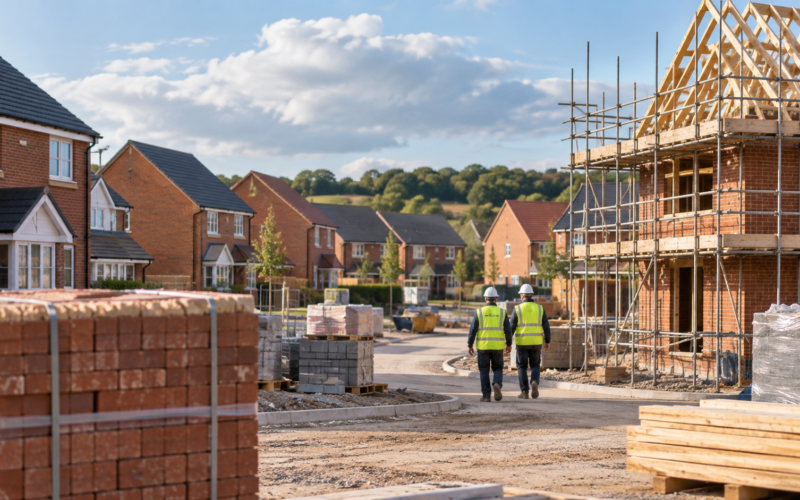
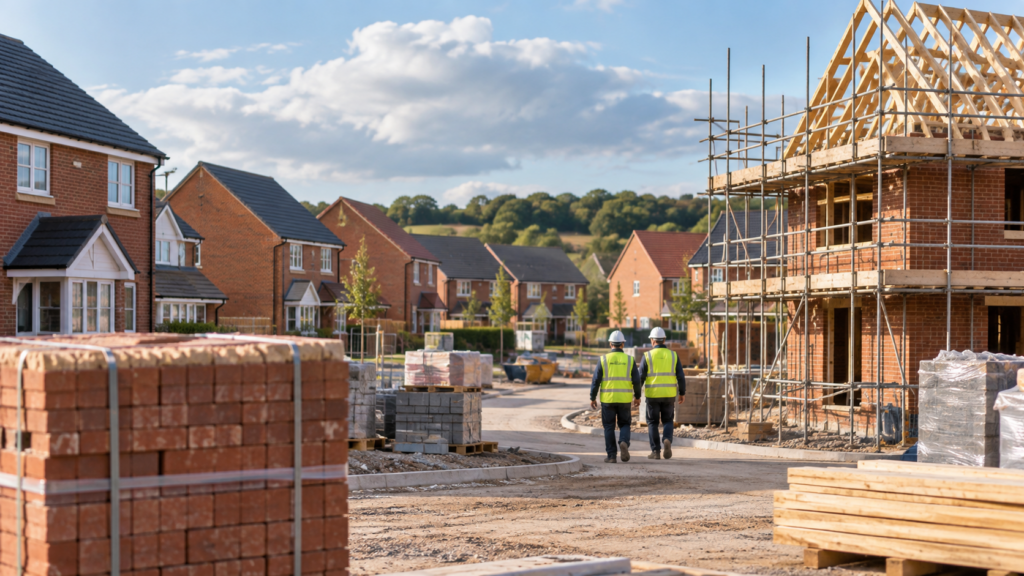
The biggest operational constraint is not simply a shortage of customers. Planning delays have restricted the number of active sales outlets from which the company can sell homes, prompting Barratt Redrow to reduce its expected average outlet count to around 405 from approximately 415. That directly constrains the number of homes that can move through the pipeline even when reservation activity is holding up.
Affordability remains another challenge. Higher borrowing costs and economic uncertainty have made buyers more cautious, forcing homebuilders to use incentives such as part-exchange schemes and other sales support. Those measures can protect volumes, but they also weigh on margins because the developer effectively absorbs part of the customer’s affordability problem.
Barratt Redrow’s fiscal 2026 margin decline demonstrates that tension. The company can sell homes and preserve scale, but supporting demand becomes economically expensive when mortgage affordability remains stretched.
The revised guidance is therefore less a signal that demand has collapsed than recognition that the UK housing recovery remains operationally and financially uneven.
Why did the shares rise nearly 12% despite the guidance cut?
The market appears to have focused on evidence that underlying demand was stronger than feared. Barratt Redrow’s net private weekly reservation rate between June 29 and September 6 rose to 0.62 from 0.55 a year earlier, while forward sales reached approximately 11,200 homes compared with 10,593.
That gives investors better visibility into future revenue even though the company has lowered the number of completions it expects to deliver. A strong order book reduces the risk that volumes fall because customers are disappearing, while the planning constraint may prove more manageable if sales outlets eventually increase.
The £572.8 million adjusted pre-tax profit also exceeded the roughly £540 million expectation cited by LSEG data, providing a positive earnings surprise against a difficult operating backdrop.
The September 16 share-price rally therefore appears to reflect expectations rather than headline direction. Investors had already priced in substantial weakness, and results that were better than feared were enough to trigger a strong revaluation even though management simultaneously trimmed volume guidance.
How much financial flexibility does Barratt Redrow still have?
The balance sheet remains an important strength. Barratt Redrow ended fiscal 2026 with £772.8 million of net cash after paying £242.2 million in dividends and completing £100 million of share repurchases. The company has also announced a £400 million fiscal 2027 capital return, including approximately £386 million expected to be deployed through buybacks.
That capital return demonstrates management confidence that cash can be distributed while the group continues integrating Redrow and investing in land and development. It also provides an additional source of shareholder return during a period when earnings growth is constrained by sector conditions.
The trade-off is that housing is cyclical. Returning large amounts of cash makes sense when the balance sheet is strong, but preserving liquidity becomes valuable if rates, construction costs or buyer confidence deteriorate materially.
Barratt Redrow therefore has to balance three capital demands: investing enough to increase future outlets, returning excess cash and maintaining resilience through a volatile housing cycle.
What should investors watch after David Thomas hands over as chief executive?
Chief Executive David Thomas is due to hand leadership to Dean Banks after more than a decade running the business. The transition occurs after completion of the Redrow integration but before the combined group has demonstrated its potential through a sustained housing-market recovery.
Banks inherits a company with greater scale, three differentiated housing brands and a significant synergy programme, but also a sector facing planning delays, cost inflation and affordability constraints. That makes execution more important than simple market growth.
The crucial metrics over the coming quarters will be sales outlets, reservation rates, incentives, operating margin and the pace at which the remaining £27 million of targeted cost synergies is captured.
September’s share-price rally shows that investor expectations had fallen low enough for stronger orders and a profit beat to matter more than a small reduction in completion guidance. Sustaining that improvement will require Barratt Redrow to convert the order book into homes without sacrificing further margin.
Discover more from Business-News-Today.com
Subscribe to get the latest posts sent to your email.