

British Columbia’s fast-moving Bald Range wildfire has claimed its first reported death as the blaze expands through the Okanagan region and keeps more than 20,000 people displaced from their homes. Canadian police said an 80-year-old woman from Meadow Valley died while evacuating with a family member, although the circumstances surrounding her death remain under investigation. The wildfire had grown beyond 13,600 hectares, or roughly 33,600 acres, by August 10 after nearly doubling in size over the weekend. Fire officials are now warning that lightning, high temperatures and stronger wind gusts could ignite additional fires or accelerate existing ones across the Okanagan and southeastern British Columbia.
The Bald Range fire has produced the province’s largest evacuation event of the summer, forcing residents from Summerland, Peachland and surrounding communities west of Okanagan Lake. British Columbia remains under a provincial state of emergency, giving authorities additional powers to coordinate evacuations, restrict travel and secure accommodation for displaced residents. The Canadian federal government has also approved assistance for shelter and temporary housing as thousands of families wait to learn whether their properties survived.
The crisis is particularly significant because the Okanagan is one of Canada’s most important agricultural and wine-producing regions. Homes, farms and other properties have already been destroyed, but authorities have not yet completed a comprehensive damage assessment because some affected areas remain too dangerous to enter. The combination of extreme fire behavior, limited rainfall and fresh lightning risk means the emergency could expand even while firefighters concentrate on the communities already threatened by the Bald Range blaze.
First reported death shows how rapidly the Bald Range evacuation became dangerous
The Royal Canadian Mounted Police said the 80-year-old Meadow Valley resident died while attempting to leave her home with a family member as the wildfire threatened the area. Police believe her death was connected to the wildfire, but investigators are continuing to examine exactly what happened. The fatality is the first reported death associated with the Bald Range fire and adds a human toll to an emergency that had already destroyed property and forced mass evacuations.
Summerland presents particular evacuation challenges because the community has a substantial older population. Local officials said senior residences received advance warnings as conditions deteriorated, reflecting concern that residents with mobility limitations or medical needs could require additional time and assistance to evacuate safely. Summerland itself has a population of about 12,000, while nearby Peachland has roughly 6,500 residents, meaning evacuation orders affected a large share of the communities along this section of Okanagan Lake.
The speed of the fire left little room for hesitation. Residents began leaving around midnight as flames advanced toward populated areas, with many driving south toward Penticton or north toward Kelowna before major roads were closed. Highway 97, a critical transportation route through the region, became part of the evacuation challenge as traffic built and authorities attempted to prevent people from entering danger zones.
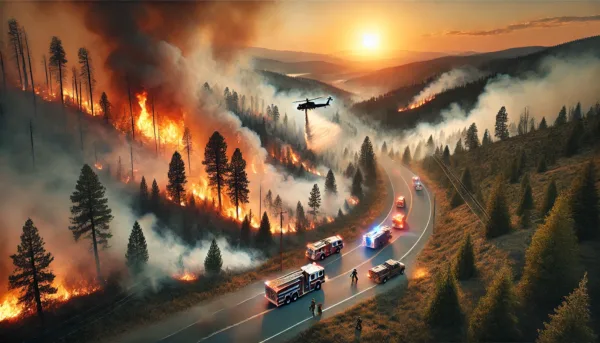
Emergency officials have emphasized that wildfire evacuation orders are issued before every property is visibly threatened because conditions can change in minutes. The Bald Range blaze demonstrated that risk when its growth became so aggressive that firefighters described flames extending far above mature trees and producing a localized weather system capable of generating additional lightning. That type of fire behavior makes traditional assumptions about predictable movement much less reliable.
More than 20,000 evacuations have created British Columbia’s largest displacement event this summer
More than 20,000 people across British Columbia have been forced to leave their homes as the Bald Range wildfire and other active fires threaten populated areas. Officials described the event as the province’s largest wildfire evacuation of the summer, with Summerland and Peachland among the communities most heavily affected. The scale of the displacement has required coordination between provincial emergency agencies, municipalities, police, firefighters and the federal government.
Some residents had to be rescued rather than evacuating independently because the fire advanced too quickly. Eighteen firefighting aircraft were involved in rescuing more than 50 people during the most dangerous period, while search-and-rescue teams looked for others who may have become trapped. Those operations illustrate why evacuation timing becomes critical when roads, smoke and flames can close the remaining escape routes with little warning.
The federal government has approved assistance focused on shelter and accommodation for people displaced around Summerland, Peachland and other affected communities. Provincial emergency powers can also be used to secure temporary accommodation and prevent scarce resources from being diverted during the crisis. These measures become increasingly important when thousands of residents may remain away from home for days or potentially weeks.
Displacement also creates problems beyond housing. Families may need medications, transportation, pet accommodation, childcare and access to financial services while businesses lose workers and customers. Communities receiving evacuees must simultaneously provide shelter and services without knowing how long the emergency will continue, creating a second layer of pressure outside the immediate fire zone.
Fire growth from Friday to 13,600 hectares shows the severity of current conditions
The Bald Range fire was first discovered on Friday and expanded with extraordinary speed. It had reached approximately 9,500 hectares by Saturday and more than 10,300 hectares later that night before growing beyond 13,600 hectares by August 10. The expansion has taken place under hot and dry conditions that have left vegetation highly receptive to ignition and rapid fire spread.
Fire behavior became so intense during the weekend that provincial officials described flames racing through large trees and producing their own weather. Pyrocumulonimbus development can occur when the heat from an extreme wildfire drives powerful columns of smoke and hot air high into the atmosphere, creating thunderstorm-like conditions that may generate additional lightning and erratic winds. The phenomenon can make fire direction and intensity much harder for crews to predict safely.
Heavy smoke has created another operational problem. Helicopters and aircraft must be able to see terrain, other aircraft and their target areas clearly enough to operate safely, and thick smoke combined with turbulence restricted some aerial operations over the weekend. Ten helicopters and a night-vision-equipped helicopter were among the resources supporting the response, while international personnel were also deployed.
Firefighters from Australia, New Zealand and Mexico have joined provincial crews, reflecting the scale of Canada’s wider wildfire season. Earlier in the emergency, British Columbia had around 1,500 firefighting personnel responding to more than 100 active fires across the province, with nearly half classified as out of control. International reinforcements help expand capacity, but simultaneous fires can quickly consume personnel and aircraft that might otherwise be concentrated on a single major blaze.
Lightning and stronger winds could create new fires before crews contain the current emergency
The August 10 forecast is particularly concerning because fire officials expect lightning across the Okanagan, which has received limited rainfall. High temperatures and stronger wind gusts are also forecast for the Okanagan and southeastern British Columbia, creating conditions capable of accelerating existing fires and igniting additional ones.
Lightning can create fires in remote locations that are difficult to detect immediately, particularly when storms produce little meaningful rainfall. Some ignitions can smolder before becoming visible after temperatures rise or wind increases, meaning firefighters may face new incidents even after the storm itself has moved away. A surge of simultaneous starts would force emergency managers to divide aircraft and ground crews across a larger area.
Wind poses an equally serious threat to the Bald Range fire. Strong gusts can push flames through dry vegetation, carry burning embers across firebreaks and cause new spot fires ahead of the main perimeter. Wind can also complicate aerial firefighting by making low-altitude operations more dangerous.
The continued warning explains why authorities are cautious about allowing evacuees to return immediately. A neighborhood may appear safe after the main fire front passes while nearby vegetation, falling trees, damaged power infrastructure and hidden hotspots continue to create hazards. Re-entry decisions therefore depend on road conditions, utility safety and the probability of renewed fire movement rather than visible flames alone.
Okanagan farms and wineries face losses that could extend well beyond burned buildings
The affected region produces most of British Columbia’s wine and represents Canada’s second-largest wine-producing area. Wildfire damage therefore threatens not only houses but vineyards, farms, tourism businesses and supporting infrastructure that contribute substantially to the local economy.
Local officials have confirmed that farms were affected, although the number of damaged properties remains uncertain. Agricultural losses can extend beyond crops visibly burned by flames because smoke, power outages, irrigation disruption and evacuation orders may prevent farmers from tending livestock or harvesting produce at critical times.
Vineyards face particularly complex wildfire risks. Direct fire damage can destroy vines and infrastructure, while prolonged smoke exposure close to harvest may affect grape quality depending on timing and concentration. Tourism is also vulnerable because visitors may cancel trips even after roads reopen if smoke remains heavy or nearby communities are still recovering.
Summerland additionally experienced a power outage and issued a boil-water advisory after untreated water entered part of the municipal system during the emergency. Damage to utilities demonstrates how wildfires can interrupt essential services even in properties that survive the flames, potentially delaying the safe return of residents.
Canada’s 4 million burned hectares show why the Okanagan fire is part of a wider national crisis
Canada has recorded more than 4,600 fires during 2026, burning approximately 4 million hectares of land. British Columbia is only one part of a broader season in which hot and dry conditions have fueled wildfires across several provinces and stretched firefighting resources over vast distances.
The Okanagan crisis also follows destructive fires in the neighboring United States, including the Spokane-area fires that forced as many as 64,000 people to evacuate at their peak. Firefighters there have recently made enough progress for some residents to return, but similarly dry conditions remain across large sections of western North America.
Repeated severe wildfire seasons create cumulative costs that extend beyond acreage burned. Governments must fund aircraft, shelters, rebuilding, forest management and damaged infrastructure while households face insurance claims and prolonged displacement. Communities exposed to multiple evacuations may also experience longer-term population and economic changes if residents decide rebuilding carries too much future risk.
The immediate priority in British Columbia remains protecting lives and preventing the Bald Range fire from reaching additional communities. The first reported death on August 10 is a reminder that the danger extends beyond property destruction, while the forecast for lightning and stronger winds means firefighters may be confronting a wider emergency before the existing blaze is fully controlled.
Key takeaways from the deadly Bald Range wildfire and British Columbia evacuation crisis
- An 80-year-old Meadow Valley woman has become the first reported death connected to the Bald Range wildfire after dying while evacuating with a family member.
- The fire had expanded beyond 13,600 hectares by August 10 after growing rapidly since it was first discovered on Friday.
- More than 20,000 people have been forced from their homes, making the crisis British Columbia’s largest wildfire evacuation event of the summer.
- Summerland and Peachland are among the hardest-hit communities, with homes, farms and other properties already destroyed or damaged.
- More than 50 people were rescued by firefighting aircraft after rapidly changing conditions trapped some residents during the evacuation.
- British Columbia remains under a provincial state of emergency, while the Canadian government has approved federal assistance for shelter and accommodation.
- Fire crews are receiving international support from personnel from Mexico, Australia and New Zealand as British Columbia battles numerous active fires.
- Lightning, high temperatures and stronger wind gusts are expected to create additional wildfire danger across the Okanagan and southeastern British Columbia.
- The affected Okanagan region is a major Canadian wine and agricultural area, meaning economic losses could continue long after the immediate fire threat subsides.
- Canada has recorded more than 4,600 wildfires and approximately 4 million hectares burned during 2026, demonstrating the broader pressure on national firefighting resources.
Discover more from Business-News-Today.com
Subscribe to get the latest posts sent to your email.