



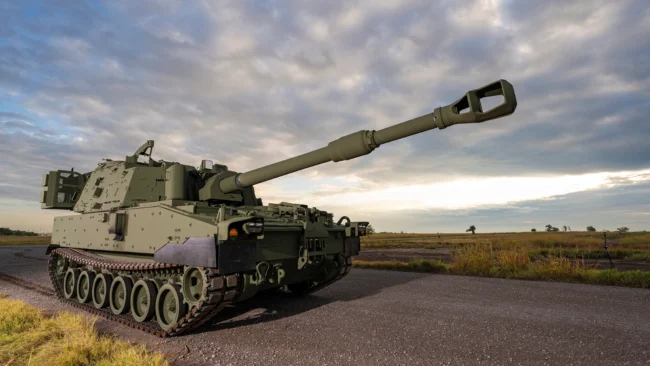
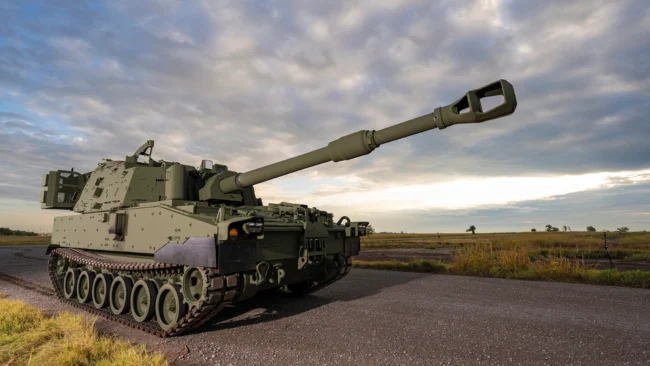
BAE Systems plc (LON: BA) has been awarded a $473 million contract by the U.S. Army Contracting Command for the production of 40 additional M109A7 Paladin Self-Propelled Howitzer systems and corresponding M992A3 ammunition carrier vehicles. The award, which includes refurbishment and technical support services, represents the first tranche of a broader five-year framework agreement aimed at modernizing and expanding the U.S. Army’s armored artillery capability.
The contract reinforces BAE Systems’ position in the U.S. defense industrial base, particularly in tracked combat vehicles, and sets the tone for multi-year production visibility. Manufacturing will span three states—Pennsylvania, Oklahoma, and Alabama—linking strategic domestic supply chains to defense readiness initiatives as geopolitical tensions remain elevated.
How does this Paladin production award advance BAE Systems’ multi-year defense revenue visibility?
The M109A7 contract positions BAE Systems to deepen its role in one of the few remaining modernization programs for tracked artillery within the U.S. Army’s legacy platform portfolio. The Paladin Integrated Management (PIM) program represents the Army’s effort to extend the utility of self-propelled howitzers with enhanced survivability, power systems, and battlefield connectivity. This specific award, while part of an overarching contract framework, creates committed revenue with defined deliverables—important in a budget environment where multi-year certainty is increasingly rare.
The new order covers 40 full system sets, comprising both the M109A7 mobile artillery system and the M992A3 ammunition resupply variant. By linking both platforms in the order, BAE Systems ensures vertical integration and service continuity across firepower delivery and logistics support, reinforcing its value proposition to the Department of Defense.
The award also includes non-hardware services such as technical support packages, post-production refurbishment, and welding compliance, which typically offer higher margin profiles and longer lifecycle touchpoints. These services not only sustain BAE Systems’ recurring revenue stream but also lock the company into sustainment contracts that outlast the production window.
Why does the M109A7 matter now in a shifting global defense posture?
While U.S. Army modernization efforts have largely pivoted toward next-generation platforms, including robotic vehicles and long-range precision fires, the M109A7’s continued procurement signals a parallel investment in proven legacy systems that can be deployed at scale. In a global context where near-peer threats such as Russia and China are expanding their conventional artillery capabilities, the decision to invest in the Paladin reflects a risk-mitigation approach rooted in deployable firepower rather than solely experimental platforms.
The M109A7 replaces the previous M109A6 Paladin with a new chassis derived from the Bradley Infantry Fighting Vehicle, incorporating a 600-volt on-board power system designed to support future digital upgrades. It aligns with the Army’s interim focus on survivability and mobility enhancements while broader firepower platforms—such as the Extended Range Cannon Artillery (ERCA)—are still undergoing field testing.
BAE Systems has capitalized on the enduring relevance of mobile artillery in both symmetric and asymmetric warfare scenarios. From Ukraine’s reliance on NATO-supplied howitzers to Indo-Pacific deterrence strategies, mobile indirect fire systems remain a cornerstone of maneuver warfare. The award underscores the U.S. Army’s recognition that operational availability today must be balanced against technological leapfrogging tomorrow.
What does this say about defense industrial base alignment and production resilience?
By distributing manufacturing across York, Pennsylvania; Elgin, Oklahoma; and Anniston, Alabama, BAE Systems embeds geographic redundancy and labor resilience into its execution model. The company is leveraging decades-old industrial footprints in these regions, many of which have been retrofitted to meet modern welding compliance and digital quality assurance standards.
This localization strategy aligns with broader U.S. Department of Defense policies encouraging reshoring and redundancy in critical defense manufacturing. It also insulates BAE Systems against single-point-of-failure risks, whether from skilled labor shortages, geopolitical disruptions, or regulatory hurdles.
Moreover, the Paladin line has historically functioned as a buffer for sustaining core engineering and welding skill sets across U.S. production facilities. With few tracked vehicle programs currently in active multi-year procurement, this award ensures that key industrial capabilities remain warm, potentially supporting future platforms like the XM30 Mechanized Infantry Combat Vehicle.
How does this tie into BAE Systems’ capital allocation and investor outlook?
For BAE Systems, the award strengthens its U.S. segment order backlog while requiring minimal incremental capital outlay. The M109A7 program leverages existing supply chains and long amortized production assets, creating operational leverage and contributing to margin consistency in the Combat Mission Systems unit.
The announcement comes amid a favorable institutional backdrop. BAE Systems’ shares have risen steadily over the past year, supported by robust defense demand in NATO and Indo-Pacific regions. Analysts have pointed to the company’s balanced exposure to electronic systems, naval platforms, and land systems as a key differentiator in a defense market increasingly driven by multipolar threats.
From a capital markets standpoint, the visibility offered by five-year contracts of this nature is especially important for institutional investors evaluating long-cycle defense exposure amid political budget volatility. It de-risks near-term revenue forecasts, supports dividend predictability, and reinforces BAE Systems’ reputation as a core portfolio holding in defense-focused funds.
What risks or constraints could affect execution or program continuity?
Despite the visibility afforded by this award, BAE Systems still faces executional constraints common to legacy defense programs. Labor availability, especially in welding-intensive roles, remains a bottleneck in regions like Pennsylvania and Oklahoma. Although the company has implemented apprenticeship programs and trade school partnerships, retention remains a concern.
There is also some ambiguity around the U.S. Army’s long-term artillery roadmap. While the M109A7 has been the backbone of armored fire support, emerging programs like ERCA and autonomous artillery drones could shift procurement emphasis over time. A shift toward multi-domain operations may eventually reduce demand for traditional towed and self-propelled howitzers.
Additionally, the award’s size—though material in absolute terms—is not transformative in isolation. The key will be whether subsequent orders under the five-year agreement are executed at consistent cadence, especially amid a U.S. presidential election year and evolving Congressional budget priorities.
What are the key takeaways from BAE Systems’ $473 million Paladin production award?
- BAE Systems plc has secured a $473 million contract to produce 40 M109A7 Paladin Self-Propelled Howitzers and M992A3 ammunition vehicles.
- The award marks the first order under a five-year framework agreement with the U.S. Army Contracting Command.
- Production spans facilities in Pennsylvania, Oklahoma, and Alabama, reinforcing BAE Systems’ U.S. defense manufacturing footprint.
- The contract includes high-margin services like post-production refurbishment and technical support packages.
- The M109A7 program supports BAE Systems’ Combat Mission Systems unit with recurring revenue and lifecycle visibility.
- The award demonstrates continued U.S. investment in proven artillery platforms amid global conflict escalation.
- It reinforces multi-year revenue visibility, key for investor confidence in a volatile budgetary environment.
- Execution risks remain tied to skilled labor availability and evolving long-range artillery modernization plans.
- The deal aligns with BAE Systems’ broader capital allocation strategy of low-capex, margin-consistent defense production.
- The announcement strengthens BAE Systems’ position in NATO-aligned and Indo-Pacific-focused artillery strategy.
Discover more from Business-News-Today.com
Subscribe to get the latest posts sent to your email.