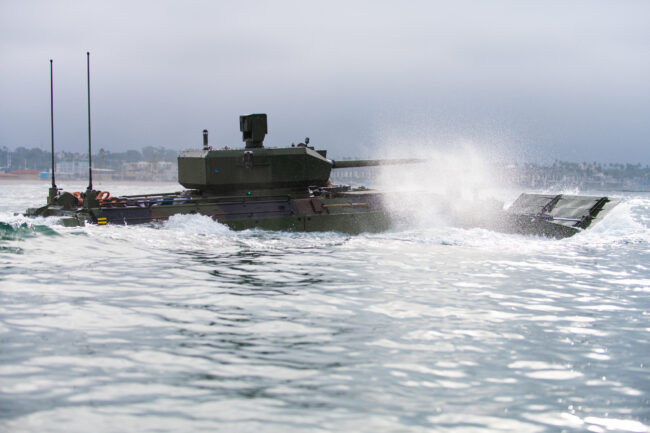
BAE Systems plc (LON: BA) has been awarded a $184 million full-rate production contract by the United States Marine Corps for the delivery of 30 additional ACV-30 Amphibious Combat Vehicles. This latest order, designated as Lot 6A, is part of the broader FRP 5/6 tranche and brings total procurement of the ACV-30 variant to over 100 units. The award reinforces the strategic relevance of the ACV program in the United States Department of Defense’s ground mobility transformation and highlights BAE Systems’ sustained leadership in amphibious platform delivery.
This milestone comes as the Marine Corps deepens its push to modernize expeditionary warfare capabilities under its Force Design 2030 roadmap, prioritizing survivability, modularity, and lethality in contested maritime zones. For BAE Systems, the Lot 6A contract ensures continuity across its Pennsylvania-based production lines and strengthens cross-sector integration with KONGSBERG’s remote weapon systems.

Why the ACV-30 is becoming a core enabler of future amphibious firepower
The Amphibious Combat Vehicle platform was introduced to gradually replace the legacy Amphibious Assault Vehicle fleet, offering greater survivability, ocean-to-shore mobility, and battlefield integration. Within this family of variants, the ACV-30 stands out as a turreted direct fire support vehicle equipped with the KONGSBERG 30mm Remote Weapon Station. This addition offers enhanced lethality while preserving the platform’s core transport role.
The ACV-30 integrates heavy-caliber firepower onto the same amphibious base as the ACV-Personnel and ACV-Command variants, creating an interoperable and scalable fleet. By equipping the Marines with a weaponized, digitally networked amphibious vehicle, the ACV-30 addresses critical capability gaps in littoral combat, especially in Indo-Pacific scenarios where distributed operations and peer-level threats demand precision support at sea and ashore.
From a systems engineering perspective, the ACV-30 exemplifies a shift toward modular, upgradeable architecture. Its electrical backbone, software-defined subsystems, and scalable turret configuration are aligned with the Marine Corps’ long-term need for adaptable vehicles that can accommodate emerging threat countermeasures, battlefield networking, and future payloads.
What the Lot 6A contract reveals about defense industrial strategy and platform maturity
This latest $184 million contract award to BAE Systems signals confidence not just in the vehicle, but in the company’s ability to meet cost, schedule, and integration demands. The ACV program has undergone extensive developmental review since its launch and has faced previous scrutiny following incidents involving water safety and field reliability. Despite those hurdles, BAE Systems has steadily advanced the program to full-rate production status, securing both Pentagon and Congressional buy-in for incremental scaling.
Production of the Lot 6A vehicles will occur at BAE Systems’ facilities in York and Johnstown, Pennsylvania, with turret integration support at the Naval Warfare Information Center in Charleston, South Carolina. This arrangement reflects a blended government-industry model in which key integration tasks such as crane systems for ACV-Recovery units are handled in partnership with public-sector sites like Anniston Army Depot.
By spreading program responsibilities across both private-sector manufacturing and defense depots, the United States Department of Defense is reinforcing a dual-sourcing approach to industrial resilience. This geographic distribution also supports skilled labor retention and regional defense economies in key manufacturing corridors.
For BAE Systems, the significance of Lot 6A lies in predictable production volume, cost amortization across vehicle variants, and continued relevance in high-demand procurement programs. The ACV’s platform stability now provides a launchpad for future variants, including command and logistics configurations that extend its utility across Marine Air-Ground Task Force formations.
How the ACV-30 positions BAE Systems against competitors in the armored vehicle segment
BAE Systems has leveraged its incumbent status as the prime contractor on the ACV program to defend against competitive pressure from companies such as General Dynamics Land Systems and Textron Systems. Both rivals have pitched hybrid-electric and optionally manned concepts for future expeditionary missions, but none have achieved the same level of operational certification or full-rate production status for an amphibious platform of this scale.
The ACV-30’s deployment readiness and turret integration provide BAE Systems with a battlefield-proven differentiator in the current cycle of defense procurement. While platforms like the Amphibious Combat Vehicle do not deliver the headline-grabbing scale of fighter jets or missile defense systems, they are essential enablers of joint force maneuver and ground-based deterrence strategies.
Internationally, BAE Systems may also benefit from allied interest in co-developing or purchasing interoperable vehicle systems. NATO and Asia-Pacific partners with amphibious doctrines—including Australia, Japan, and South Korea—could view the ACV program as a viable template for hybrid procurement strategies that mix domestic production with foreign systems acquisition. These second-order effects are critical for sustaining long-term volume and export positioning.
What integration and delivery risks remain for the ACV-30 program
While the Lot 6A order reflects growing institutional trust, it does not eliminate all risk from the ACV program. Turret integration remains a complex process, particularly when involving multiple vendors and government agencies. Power draw, vehicle balance, crew ergonomics, and software harmonization are all variables that can introduce delays or rework cycles.
Additionally, operational feedback from fielded ACV-30 units will influence future procurement decisions. As the Marine Corps ramps up exercises that simulate Indo-Pacific conditions, issues related to corrosion, water handling, and systems durability may surface, especially when operating in saltwater environments or extreme climate zones. The service’s recent experience with expeditionary vehicle setbacks has made program managers cautious about expanding orders without validated performance metrics.
There is also the broader challenge of aligning turret production from KONGSBERG with BAE Systems’ vehicle delivery schedules. Any supply chain bottlenecks, whether from electronics, optics, or sensor suites, could ripple through the schedule and force reprioritization of variant types. The use of distributed production facilities and shared integration points helps mitigate these risks, but does not eliminate them.
How investors are viewing BAE Systems’ execution in the defense vehicles segment
Investor sentiment around BAE Systems remains favorable, anchored by consistent performance in the land and maritime domains and a visible multi-year contract pipeline. The ACV-30 award adds modest top-line revenue but signals discipline in execution and alignment with Department of Defense priorities.
Recent market activity has shown institutional interest in defense contractors with strong order books, stable dividend policies, and exposure to programs less vulnerable to political fluctuation. BAE Systems fits this profile, particularly in the wake of broader rebalancing within the United States defense budget toward distributed platforms, logistical enablers, and digital integration rather than large monolithic systems.
While the ACV program may not move BAE Systems’ share price in isolation, it reinforces the company’s reputation as a reliable partner for platform-level execution. For investors, the visibility and modular roadmap of the ACV series support long-term margin stability, especially when paired with upside potential from follow-on variants and allied licensing.
What could happen next if the ACV-30 program continues to meet performance and strategic goals
If BAE Systems delivers the Lot 6A order on time and without integration failures, it will likely accelerate the Marine Corps’ internal planning for next-phase vehicle enhancements. These could include C4ISR upgrades, unmanned teaming capabilities, and expanded survivability kits tailored to different regional theaters.
There is also the potential for new variant development such as an ACV-Logistics configuration with autonomous resupply systems or an ACV-Command variant integrated with AI-assisted battlefield management tools. BAE Systems’ existing contracts for ACV-Personnel and ACV-Command variants position it well to lead such expansions.
Beyond the U.S. context, the company could use successful ACV-30 deployment as a showcase to market the platform in allied defense modernization efforts. Nations seeking joint interoperability with the United States may prioritize proven, fielded platforms that can integrate with U.S. doctrine and systems architecture. If that trend continues, the ACV-30 may represent a beachhead for broader amphibious and expeditionary platform sales.
Key takeaways on BAE Systems’ ACV-30 Lot 6A contract and strategic direction
- BAE Systems has secured a $184 million contract for 30 additional ACV-30 vehicles under Lot 6A, expanding the Marine Corps’ commitment to the turreted amphibious variant.
- The ACV-30’s integration of KONGSBERG’s 30mm turret provides a scalable firepower solution aligned with Force Design 2030 and Indo-Pacific operational priorities.
- Production spans BAE Systems facilities in Pennsylvania and integration points in South Carolina, supporting industrial base continuity and labor retention.
- This award increases the total number of ACV-30s ordered to over 100, reflecting growing institutional trust after earlier operational concerns were addressed.
- The contract supports BAE Systems’ competitive positioning against General Dynamics and Textron, which have yet to field comparable full-rate amphibious platforms.
- Execution risks include turret integration complexity, environmental performance, and variant interoperability in contested maritime zones.
- Investor sentiment remains constructive, with the ACV program viewed as a source of steady revenue and strategic alignment with evolving defense priorities.
- Future program success could unlock additional variants, allied sales opportunities, and embedded command-and-control roles across the Marine Corps modernization roadmap.
Discover more from Business-News-Today.com
Subscribe to get the latest posts sent to your email.