



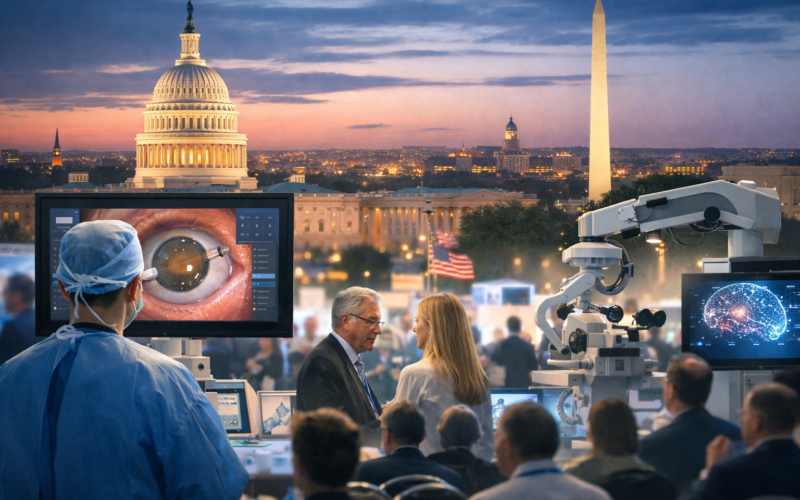
The American Society of Cataract and Refractive Surgery (ASCRS) is holding its 2026 Annual Meeting in Washington DC from April 10 to 13, and the timing matters for anyone who works in anterior segment surgery, ophthalmic practice management, or the medical technology industry. This is the year’s most concentrated gathering of cataract and refractive surgeons in the United States, and it arrives at a moment when the specialty is navigating simultaneous pressure on three fronts: rapid clinical innovation in intraocular lens technology and surgical techniques, deteriorating practice financial viability in an era of Medicare reimbursement compression, and the accelerating integration of artificial intelligence into surgical workflows and patient engagement platforms. Surgeons who need CME credit in cataract, cornea, refractive, or glaucoma surgery, practice administrators assessing operational strategy, and device and pharma companies planning US commercial launches are all converging on a single venue for four days this April.
What is ASCRS and where does the 2026 meeting take place?
ASCRS is a professional society for surgeons specialising in eye surgery, based in Fairfax, Virginia, and founded in 1974. It is an international, educational organisation with more than 8,000 members, and its mission is to advance the art and science of ophthalmic surgery and the knowledge and skills of ophthalmic surgeons by providing clinical and practice management education and by working with patients, government, and the medical community to promote the delivery and advancement of high-quality eye care. The 2026 Annual Meeting takes place at the Walter E. Washington Convention Center, 801 Allen Y. Lew Place NW, Washington DC. ASCRS describes the meeting as the largest US gathering dedicated exclusively to the needs of anterior segment surgeons as well as their technical and practice management staff, with a focus on innovation, education, and collaboration. The society operates alongside a sister organisation, the American Society of Ophthalmic Administrators, which holds its own parallel annual meeting at the same venue and dates, making the combined event a dual-track professional gathering addressing both surgical and administrative dimensions of ophthalmic practice.

Who leads ASCRS and who is governing the 2026 programme?
Kevin M. Miller, MD, is incoming ASCRS President at the 2026 meeting, taking over from Francis Mah, MD. Dr. Miller is chief of the cataract service at UCLA and a prolific researcher, educator, and innovator advancing modern anterior segment and refractive surgery worldwide. The 2026 programme chair is Thomas Samuelson, MD, of Minnesota Eye Consultants in Minneapolis. Steve Speares serves as ASCRS Executive Director and opened the pre-meeting SightLine event on April 9. ASCRS publishes a monthly Journal of Cataract and Refractive Surgery as a joint production with the European Society of Cataract and Refractive Surgeons. The accreditation framework for all CME content at the meeting is provided by the Accreditation Council for Continuing Medical Education, and ASCRS holds full ACCME accreditation to provide continuing medical education for physicians.
What education and programming does the 2026 ASCRS Annual Meeting offer surgeons?
ASCRS Annual Meeting physician registration opens access to more than 300 hours of education, including labs, workshops, and live demonstrations of technologies across cataract, cornea, refractive, and glaucoma fields. The programme features more than 200 sessions including main-stage events, symposia, and instructional courses, with the latest innovations showcased through presentations of over 650 papers across 53 paper sessions. The structure is built around a combination of broad and subspecialty content. Subspecialty tracks cover cornea, glaucoma, and refractive care, and attendees can follow a dedicated track or customise their schedule. Hands-on training in cataract, cornea, and glaucoma procedures is guided by expert faculty in a skills transfer lab environment, and dedicated sessions and labs are designed specifically for early-career surgeons.
The Main Stage programme carries particular weight in the ASCRS meeting calendar. The Sunday Main Stage event features the Charles D. Kelman, MD, Innovator’s Lecture, given by Sean Ianchulev, MD, and the ASCRS Richard L. Lindstrom, MD, Lecture, given by David F. Chang, MD. The Saturday Main Stage features the Cornelius D. Binkhorst, MD, Lecture given by Kerry Solomon, MD, along with interviews with incoming and outgoing ASCRS Presidents, the Chang-Crandall Humanitarian Award, and the ASCRS Hall of Fame Ceremony. These named lectures are among the most-cited CME touchstones in American ophthalmology, and the selection of recipients signals where the specialty’s intellectual centre of gravity sits at any given moment.
Programme Chair Samuelson noted that this year the committee deliberately trimmed the volume of content, reducing the overall breadth of sessions to give attendees greater opportunity to gather in groups and encourage more interaction. He specifically recommended the Main Stage lectures, describing an invitation to give such a keynote as a once-in-a-career honour for the recipients.
How does the 2026 ASCRS Subspecialty Day address cornea, glaucoma, and refractive surgery?
ASCRS Subspecialty Day took place on Friday, April 10, ahead of the main Annual Meeting programme, covering topics across refractive, cornea, and glaucoma. The cornea programme, co-chaired by Marjan Farid, MD, addressed surgical approaches for various types of keratoplasty, including novel keratoprosthesis in the design phase, and updates on advanced treatments for endothelial disease including EndoArt from EyeYon Medical, an artificial endothelial layer and synthetic implant to treat corneal oedema, alongside injectable endothelial cell therapy updates.
On the refractive side, the programme covered sessions on LASIK, PRK, small-incision lenticule extraction, phakic IOLs, and refractive lens exchange. A third session titled “Judicial Innovations” examined cutting-edge topics including artificial intelligence, pharmacologic treatments, new corneal and scleral lasers, refractive indexing, robotic surgery, and the latest pseudoaccommodating and accommodating IOLs. The annual Steinert Lecture on the refractive programme was delivered by Steven Dell, MD. David F. Chang, MD, introduced what he terms the “visual QRS triad,” a new clinical framework addressing visual quality, visual range, and visual symptoms as a guide for presbyopia-correcting IOL technologies, developed in collaboration with the ASCRS Functional Vision Working Group and international partner societies.
What is SightLine at ASCRS 2026 and why does it matter for ophthalmology business leaders?
SightLine is a dedicated day ahead of the ASCRS Annual Meeting designed to galvanise key leaders to develop solutions for the most pressing issues facing the business of ophthalmology. Industry professionals, administrators, surgeons, payors, and regulators gather to examine market trends, debate emerging issues, and explore strategies for long-term financial sustainability. The 2026 programme focuses specifically on how ophthalmology and government intersect.
At the 2026 SightLine event on April 9, ASCRS Executive Director Steve Speares opened the session by emphasising that SightLine is not an innovation meeting but one focused on the financial health of practices, bringing together surgeons, administrators, and industry partners who will sometimes hold opposing interests but need to engage in open dialogue. Cathleen McCabe, MD, led a session examining the picture of practice financial viability, framing it as a slow-moving but serious structural problem for the specialty. A panel on FDA developments was moderated by Robert Stanislaro of FTI Consulting and featured John Berdahl, MD, Kuldev Singh, MD, MPH, Barrett Thornhill of Forbes Tate Partners, and Steve Usdin of BioCentury. The addition of a government and policy thread to the 2026 agenda reflects the specialty’s growing engagement with Washington on Medicare reimbursement reform, a pressure point that has been accelerating across US surgical specialties.
How does ASCRS compare to other major global ophthalmology conferences?
ASCRS occupies a distinct position in the global ophthalmology conference calendar. The European Society of Cataract and Refractive Surgeons holds a parallel annual meeting that serves as the dominant gathering for European anterior segment surgeons, and the two societies co-publish the Journal of Cataract and Refractive Surgery. ASCRS and ESCRS are widely regarded as the world’s largest international organisations for cataract and refractive surgeons with open memberships. The American Academy of Ophthalmology annual meeting is a broader, multi-subspecialty gathering that draws higher total attendance across all ophthalmology disciplines, but ASCRS is differentiated by its intensive focus on anterior segment surgery specifically. For companies in the cataract, refractive, cornea, and minimally invasive glaucoma surgery device and pharmaceutical spaces, ASCRS is generally regarded as the more commercially targeted of the two major US events. The meeting’s exhibit hall, skills transfer labs, and symposia provide direct access to the surgical decision-makers who determine which IOL platforms, laser systems, and surgical consumables their practices will adopt.
What is the founding history and legacy of ASCRS as a medical society?
ASCRS traces its origins to the American Intra-Ocular Implant Society, incorporated on August 28, 1974, by Kenneth J. Hoffer, MD, to provide a forum for the discussion, education, and advancement of intraocular lenses. The founding executive officers were Dr. Hoffer, John Darin, MD, Jeremy Levenson, MD, and Steve Cooperman, MD. The early years were defined by regulatory conflict: the California FDA sought to classify IOLs as drugs in 1975, threatening to end implantation in the United States, and the society led the effort to protect surgeons’ and patients’ access to these implants. In 1985, the name changed from the American Intra-Ocular Implant Society to the American Society of Cataract and Refractive Surgery, reflecting the rise of refractive lens-based and corneal refractive surgery. The ASCRS Foundation’s domestic programme, Operation Sight, has helped provide nearly 10,000 charitable cataract surgeries to underserved patients. The society also hosts an Ophthalmology Hall of Fame, established in 1999, which periodically elects pioneers of the field. In 2024, ASCRS marked its 50th anniversary, a milestone that reinforced its standing as the institutional backbone of American anterior segment surgery.
What key clinical and technology announcements are expected at ASCRS 2026?
The 2026 meeting has already generated significant pre-conference industry activity, with device and pharmaceutical companies making simultaneous commercial announcements timed to the convention. Zeiss is unveiling a wave of innovations at ASCRS 2026 including expanded cataract surgical tools, enhanced IOL calculation platforms, and the launch of VisioGen, a human-verified AI patient engagement system for ophthalmology practices. The Zeiss IOLMaster 700 receives expanded calculation capabilities through a new Kane Suite and an upgraded Barrett Suite with additional formulas, and the Zeiss VERACITY Surgery Planner adds the Barrett RX formula and a Zeiss AI IOL Calculator for post-laser vision correction patients, targeting improved accuracy in complex toric IOL and post-LVC cataract cases.
Viatris is presenting four abstracts at the 2026 meeting, including full results from VEGA-3, a Phase 3 study evaluating MR-141, a phentolamine ophthalmic solution, for presbyopia, and an encore of LYNX-2, a Phase 3 study evaluating MR-142 for visual disturbances in low-light conditions in post-refractive surgery patients. Glaukos is sponsoring an educational symposium on April 10 on Epioxa, described as the first FDA-approved epithelium-on, oxygen-enriched corneal cross-linking treatment, and is presenting multiple scientific abstracts covering trabecular micro-bypass stent outcomes and travoprost intracameral implant data. The convergence of these announcements at a single event reflects ASCRS’s role as the primary US commercial launch platform for the anterior segment device and pharmaceutical sector.
What practical information do attendees need for the 2026 ASCRS Annual Meeting?
The 2026 ASCRS Annual Meeting runs April 10 to 13 at the Walter E. Washington Convention Center in Washington DC. Registration for the 2026 meeting opened with early-bird rates, and skills transfer labs, workshops, and other add-on events require separate registration during the booking process. Discounted hotel room blocks are available through the official ASCRS housing portal on a first-come, first-served basis. On-demand digital access to more than 200 sessions from the 2025 meeting, including symposia and instructional courses, is available for those who want to review prior-year content before attending. The ASCRS Film Festival, now in its 44th edition, takes place on Sunday evening and awards prizes for exceptional submissions in ophthalmic surgery film, providing a social anchor to the technical programming. The Party for a Purpose social event on Friday evening at the Westin DC Downtown benefits the ASCRS Foundation and is open to all meeting attendees aged 21 and over. The SightLine business programme runs on April 9, the day before the main meeting opens, and requires separate registration. The Business of Interventional Glaucoma programme also runs on April 9 and is designed for both surgeons and practice administrators assessing the commercial case for expanding interventional glaucoma services.
What does the future hold for ASCRS as a society and for the annual meeting format?
The field is shifting from standardised surgery to individualised treatment, where imaging, biomolecular therapies, and adjustable technologies work together to maximise vision quality, safety, and patient satisfaction. ASCRS is positioning its annual meeting to reflect that trajectory, with the Subspecialty Day format expanding its coverage of pharmacologic and AI-driven interventions alongside traditional surgical technique programming. The society’s broader institutional direction is increasingly oriented toward advocacy in Washington as Medicare reimbursement pressures intensify and the role of private equity in ophthalmic practice consolidation grows as a structural concern for the specialty. ASCRS relocated its headquarters to the Washington DC region specifically to have a stronger voice in government relations, and its advocacy work has engaged Congress on reimbursement, patent law, and surgeon access issues. Over the next two to three years, the annual meeting format is likely to continue its pivot toward practice economics, AI integration, and policy engagement alongside the surgical education core that has defined the event since the 1970s. The society’s 50-year track record of advocacy and clinical leadership gives it a durable institutional position in a specialty that will only grow in strategic importance as global ageing populations drive cataract volume upward across all major healthcare markets.
Discover more from Business-News-Today.com
Subscribe to get the latest posts sent to your email.