

NASA’s Mission Control at the Johnson Space Center in Houston regained communication with the four-person crew of the Artemis II mission on April 6, 2026, following a planned communications blackout of approximately 40 minutes that occurred as the Orion spacecraft passed behind the far side of the Moon. The resumption of contact confirmed that the crew had safely completed two of the mission’s most significant milestones entirely without ground support: a record-breaking maximum distance from Earth and the closest human approach to the lunar surface in more than five decades.
Mission Control temporarily lost communication with the Orion spacecraft at approximately 6:43 p.m. Eastern Time. The loss of signal occurred as Orion moved out of line-of-sight contact with NASA’s Deep Space Network, a global array of large radio antenna complexes located in California, Spain, and Australia that serves as the primary communications link between Earth and deep space missions. With the Moon physically blocking the radio path between the spacecraft and those antenna installations, all direct communication between Mission Control and the crew was severed. The brief blackout lasted about 40 minutes, and Mission Control regained communication with the Orion spacecraft at approximately 7:21 p.m. Eastern Time.
The Artemis II crew consists of NASA astronauts Reid Wiseman, who serves as mission commander, Victor Glover, who serves as mission pilot, and Christina Koch, who serves as mission specialist, alongside Canadian Space Agency astronaut Jeremy Hansen, who serves as mission specialist. After contact was regained with the Orion spacecraft, mission specialist Christina Koch shared a message with NASA’s Mission Control on behalf of the crew, stating that the crew would explore, build, build ships, and visit again. NASA Mission Control confirmed that Orion had technically begun its journey home.
How did NASA’s Deep Space Network lose and restore contact with the Artemis II Orion spacecraft during the planned far side blackout on April 6, 2026?
The communications blackout occurred as the Orion spacecraft passed behind the Moon. For about 40 minutes, the lunar surface blocked the radio signals from NASA’s Deep Space Network on Earth needed to stay in contact with the crew. Similar blackouts occurred during the Artemis I and Apollo missions and are expected when using an Earth-based communications system. The Deep Space Network’s three antenna complexes are positioned approximately 120 degrees apart in longitude to provide near-continuous coverage of spacecraft across most trajectories, but no Earth-based system can maintain contact when the Moon itself is interposed between the spacecraft and Earth. The Artemis II crew witnessed an Earthrise as Orion emerged from behind the Moon, moments before the Deep Space Network reacquired the spacecraft’s signal and restored communications.
Before the blackout began, capsule communicator Jenni Gibbons transmitted a farewell message to Wiseman, Koch, Glover, and Hansen, saying it was a privilege to witness them carrying the fire past humanity’s farthest reach, and wishing them Godspeed. Artemis II flight director Judd Frieling had described the blackout in straightforward terms ahead of the event, stating that physics takes over and physics will absolutely get the spacecraft back to the front side of the Moon.
What records did the Artemis II crew set during the planned communications blackout while passing behind the far side of the Moon on April 6, 2026?
The four astronauts aboard NASA’s Artemis II test flight made history on April 6, 2026, traveling 252,756 miles from Earth at their farthest point, surpassing the record for human spaceflight’s greatest distance from Earth previously set by the Apollo 13 mission in 1970 at 248,655 miles, by more than 4,100 miles. The spacecraft reached its maximum distance at approximately 7:02 to 7:07 p.m. Eastern Time, during the communications blackout period, meaning the crew made history entirely without contact with Mission Control.
The Apollo 13 record was itself a result of the emergency free-return trajectory that mission adopted in April 1970 after a critical equipment failure forced the crew to abandon the planned lunar landing and loop around the Moon to return safely to Earth. The Artemis II mission achieved its record distance as part of a planned free-return trajectory designed to test the Orion spacecraft and Space Launch System rocket in a crewed environment prior to surface landing missions.
During the blackout, the crew also made their closest approach to the Moon at approximately 4,067 miles above the lunar surface. That altitude was considerably higher than the roughly 70 miles above the surface at which Apollo command modules conducted their orbital operations, a consequence of Artemis II’s free-return trajectory, which swings Orion around the Moon in a figure-eight pattern rather than placing it in a sustained lunar orbit. At that altitude, the Moon appeared approximately the size of a basketball held at arm’s length, according to NASA. The crew nonetheless had a full-disk view of the Moon encompassing regions near both the north and south poles, a perspective not available to Apollo crews operating in low lunar orbit.
How does the Artemis II communications blackout compare with signal losses during Apollo missions and the Artemis I test flight?
The communications blackout experienced on Artemis II Flight Day 6 followed a pattern that has defined lunar spaceflight since the Apollo program of the 1960s and 1970s. Every crewed Apollo mission that flew around or orbited the Moon encountered similar planned signal losses as the command module passed behind the lunar far side. During the Apollo 8 mission in December 1968, the first crewed flight to reach the Moon, flight controllers described the blackout period as deeply unsettling, with no ability to communicate with or monitor the crew until the spacecraft emerged from behind the Moon. The uncrewed Artemis I mission, which flew a similar free-return trajectory around the Moon in late 2022, experienced comparable planned blackouts that were used to validate the communications infrastructure of the Deep Space Network ahead of the Artemis II crewed flight.
Mission pilot Victor Glover had said in advance of the mission that the communication blackout would be a tense time for the crew, and that he would welcome global support during that window. Retired NASA astronaut Chris Cassidy, who spoke to media during the mission, noted that planned communication outages of this kind are sometimes welcome for both Mission Control teams and astronaut crews, giving both sides a rare period of uninterrupted focus.
What scientific observations did the Artemis II crew conduct during the lunar flyby on April 6, 2026?
The roughly seven-hour flyby covered the period when the Orion spacecraft was close enough to the Moon for the crew to make detailed observations of geologic features on the lunar surface. Crew members used a variety of digital handheld cameras to produce high-resolution photography of specific geological targets selected by the NASA lunar science team. The crew reported color nuances observed from orbit that will help enhance scientific understanding of the Moon, with shades of brown and blue visible to the human eye providing indicators of mineral composition and the relative age of surface features. As crew reports were received, the NASA Science Evaluation Room team updated the observation plan in real time.
Among the specific targets observed were the Orientale basin, a 3.8-billion-year-old impact crater on the near side of the Moon’s western limb, and the Hertzsprung basin on the far side. Mission Commander Reid Wiseman, during observations before the blackout, proposed provisional names for two small, unnamed craters near the Orientale basin, including one the crew suggested naming Integrity after the Orion spacecraft and the mission.
Toward the end of the observation period, starting at 8:35 p.m. Eastern Time, the crew witnessed a solar eclipse from space as Orion, the Moon, and the Sun aligned. The astronauts saw the Sun disappear behind the Moon for nearly an hour. During that period, they viewed a mostly darkened Moon and used the opportunity to analyze the solar corona, the outermost atmosphere of the Sun, as it appeared around the lunar edge. The crew also used the eclipse period to look for flashes of light produced by meteorite impacts on the far side of the lunar surface, a phenomenon observed during Apollo missions and by orbital spacecraft.
What is the mission timeline for Artemis II following the completion of the lunar flyby on flight day six?
The Artemis II crew is scheduled to splash down off the coast of San Diego in the Pacific Ocean at approximately 8:07 p.m. Eastern Time on Friday, April 10, 2026, nine days after launch. Following splashdown, recovery teams will retrieve the crew members using helicopters and deliver them to the USS John P. Murtha. Once aboard, the astronauts will undergo post-flight medical evaluations in the ship’s medical bay before traveling back to shore and onward to NASA’s Johnson Space Center.
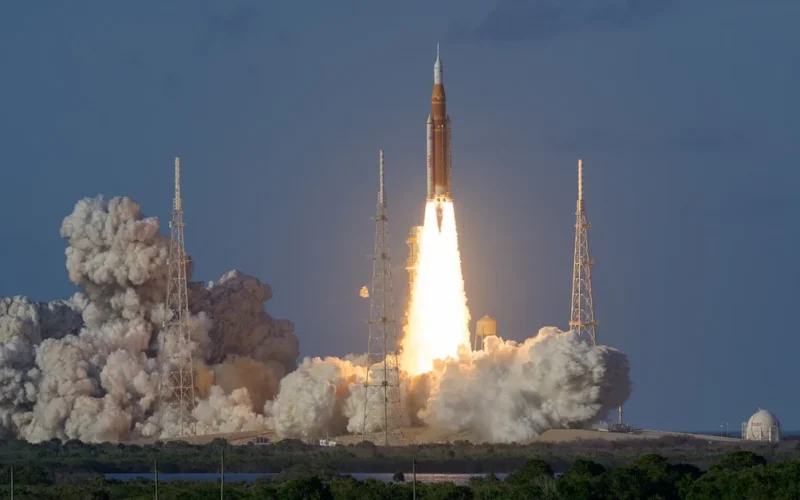
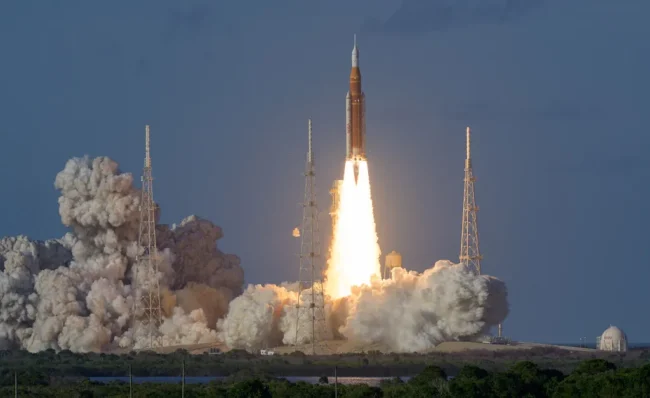
During the return journey from the Moon, the crew is scheduled to link up via radio with astronauts aboard the International Space Station, marking the first time a crew traveling from the Moon has had colleagues simultaneously in space. The Artemis II mission launched from Launch Complex 39B at Kennedy Space Center in Florida on April 1, 2026, aboard the Space Launch System rocket. Following a series of trajectory correction burns to depart Earth orbit, the Orion spacecraft set course for the Moon and entered the lunar sphere of influence at 12:37 a.m. Eastern Time on April 6, the point at which the Moon’s gravitational pull exceeded Earth’s.
Under the Artemis program, NASA will send astronauts on increasingly challenging missions to explore more of the Moon for scientific discovery, economic benefit, and to build a foundation for the first crewed missions to Mars. The Artemis II mission is a test flight intended to validate the Space Launch System rocket and Orion spacecraft in a crewed configuration before committing to surface landing operations under subsequent Artemis missions. Data gathered across all phases of the Artemis II flight, including biomedical data on crew response to the deep space radiation environment beyond Earth’s protective magnetosphere, will inform mission planning for future Artemis missions and the agency’s longer-term Mars objectives.
Key takeaways on what the Artemis II lunar far side blackout and signal restoration on April 6, 2026, means for NASA’s Artemis program, human spaceflight records, and future lunar exploration
- Mission Control lost signal with the Artemis II Orion spacecraft at approximately 6:44 p.m. Eastern Time on April 6, 2026, and regained contact at approximately 7:21 p.m. Eastern Time, confirming the crew’s safe passage around the far side of the Moon.
- The Artemis II crew set a new record for the farthest distance from Earth traveled by a human mission, reaching 252,756 miles and surpassing the Apollo 13 record of 248,655 miles set in April 1970.
- NASA Mission Control confirmed that Orion had technically begun its journey home following the restoration of communications, with the crew scheduled to splash down off the coast of San Diego on April 10, 2026.
- The 40-minute blackout, caused by the Moon blocking radio signals between NASA’s Deep Space Network and the Orion spacecraft, was a fully planned event consistent with communications constraints experienced during Artemis I and multiple Apollo missions.
- The Artemis II mission is designed to validate the Space Launch System rocket and Orion spacecraft in a crewed configuration, with data from this flight informing future Artemis missions intended to land astronauts on the Moon and eventually support crewed missions to Mars.
Discover more from Business-News-Today.com
Subscribe to get the latest posts sent to your email.