

Why are high-efficiency gas turbines still being built in Asia if net-zero is the goal and renewables are growing?
In a world racing toward net-zero emissions, high-efficiency gas turbines might seem like a relic of the past. Yet across Asia, countries are doubling down on gas turbine combined cycle (GTCC) infrastructure—even as they invest heavily in renewables. The recent $5.2 billion contract awarded to Mitsubishi Power and Taiwan’s CTCI Corporation for a 2,800 MW expansion of the Tung Hsiao Power Plant is just the latest example.
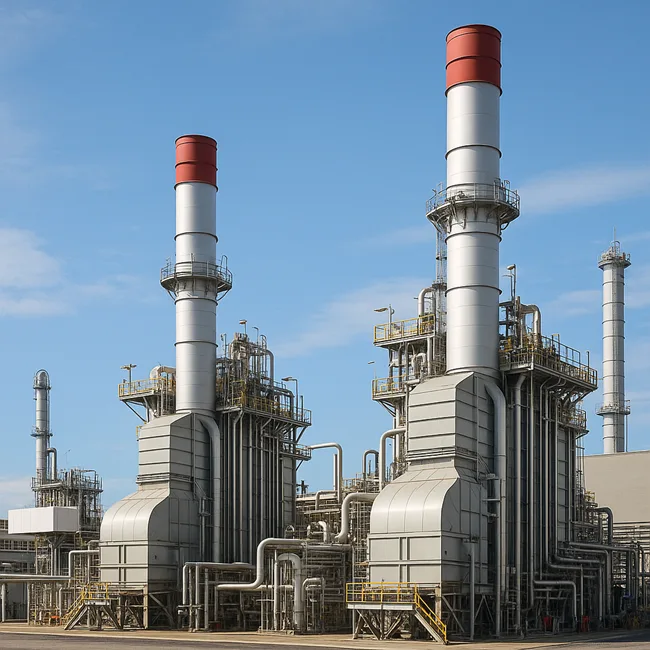
Taiwan Power Company, the island’s state-owned utility, signed the contract to deploy five of Mitsubishi’s M501JAC (J-Series Air-Cooled) gas turbines. Scheduled to come online between 2030 and 2031, these units will add significant base-load capacity while replacing older, less efficient thermal generation. The project marks the second phase of a broader modernization effort at the Tung Hsiao site, where three Mitsubishi J-series turbines have already been in operation since 2018.
At first glance, this seems to conflict with Taiwan’s stated net-zero targets. But it reflects a deeper truth shaping the energy transition across Asia: clean energy capacity may be growing, but it’s not yet enough to meet the region’s soaring demand for reliable power. High-efficiency GTCC plants—offering lower emissions and high dispatchability—are increasingly seen as the “bridge fuel” infrastructure required to get to a greener future without sacrificing grid stability.
What makes modern GTCC units like Mitsubishi’s JAC series uniquely suited as transition assets toward cleaner energy?
Modern gas turbines have come a long way from their carbon-heavy predecessors. Mitsubishi’s JAC series, along with competitors such as GE Vernova’s HA-class and Siemens Energy’s HL-class turbines, are pushing the boundaries of efficiency and flexibility. These units are not only more fuel-efficient—achieving thermal efficiencies exceeding 64% in combined-cycle mode—but they also reduce NOₓ and CO₂ emissions compared to coal-fired plants by up to 65%.
Crucially, they’re also being engineered to handle the fuels of the future. Mitsubishi Power reports that its current J-series turbines can co-fire up to 30% hydrogen. The company aims to increase this to 50% in mid-decade, and to achieve 100% hydrogen combustion capability by 2030. These performance characteristics make high-efficiency turbines particularly attractive in markets that are beginning to develop hydrogen production and infrastructure.
The JAC series’ air-cooled design also reduces water consumption—a growing concern in many parts of Asia. And with fast startup capabilities, these turbines offer the flexibility needed to support grids increasingly dominated by intermittent solar and wind power.
In which Asian countries is GTCC gaining traction, and what’s driving these investments?
The GTCC trend isn’t limited to Taiwan. Across Asia, several governments and utilities are scaling up gas-fired generation to complement renewable energy rollouts and to phase out coal.
In Thailand, Mitsubishi Power has delivered ten J-series GTCC units across three provinces—Chonburi, Rayong, and Ratchaburi—supporting the country’s move toward lower-emission base-load capacity. These projects have helped reduce greenhouse gas emissions by as much as 65% compared to equivalent coal-fired plants.
Vietnam has included GTCC as a core component of its power development plan, with GE and Siemens competing for capacity additions. Bangladesh continues to deploy GTCC systems for reliable urban and industrial power, including facilities powered by GE Vernova’s HA turbines. Malaysia is pursuing a hydrogen-capable GTCC buildout in Sarawak, with plans for phased ammonia integration.
The drivers are consistent: rapidly rising electricity demand, land and storage constraints limiting the pace of renewable deployment, and pressure to move away from coal without sacrificing reliability. In these conditions, GTCC has become the default transitional asset—cleaner than coal, faster to deploy than nuclear, and more controllable than renewables alone.
Are gas turbines delaying net-zero or accelerating it by serving as flexible, cleaner baseload?
The debate over GTCC’s role in the transition is intensifying. Critics warn that new gas infrastructure risks creating “lock-in”—building capital-intensive assets that remain dependent on fossil fuels for decades. They argue that this can undermine investment in truly clean alternatives and delay long-term decarbonization.
But proponents counter that GTCC can actually accelerate the transition if deployed strategically. By replacing coal with gas, emissions drop dramatically in the short term. When paired with carbon capture or future hydrogen retrofits, these plants can potentially continue operating well into a net-zero future. For many Asian governments, the choice is not between perfect and problematic—it’s between GTCC and blackouts.
Analysts have also noted that Asian utilities are increasingly including “hydrogen-readiness” as a specification in tenders. This reflects growing institutional awareness of future fuel switching. Mitsubishi Power’s ongoing investments in hydrogen R&D, such as its Takasago Hydrogen Park and pilot blending projects, are aimed at turning this promise into a deployable reality.
Ultimately, GTCC’s role in accelerating or delaying net-zero depends on how the assets are framed and managed. If they are built as permanent baseload gas facilities with no path to transition, they may become stranded assets. But if they are seen as flexible, upgradable components of a broader clean grid, they could be an essential enabler of decarbonization.
What role are OEMs like Mitsubishi, GE, and Siemens playing in deploying GTCC as Asia’s bridge to net-zero?
The OEM landscape is consolidating around three major players: Mitsubishi Power, GE Vernova, and Siemens Energy. All are vying for a piece of Asia’s gas infrastructure buildout—but they are also evolving their business models to align with the energy transition.
Mitsubishi Power has been aggressive in positioning its turbines as hydrogen-capable and environmentally resilient. Its digital solutions, including the TOMONI suite of performance optimization tools, are aimed at maximizing turbine efficiency and lifecycle economics. The company’s long-term service agreements (LTSAs) help reduce cost volatility for utilities while providing a predictable revenue stream.
GE Vernova’s HA-series turbines have seen strong adoption in countries like India and Bangladesh. The company has emphasized its technology’s ability to integrate with renewables, operate flexibly, and transition to cleaner fuels. Siemens Energy, for its part, is targeting high-efficiency HL-class deployments and smart grid integration as part of its decarbonization strategy.
These OEMs are not just selling turbines—they’re selling future-proofed power solutions, with hybrid controls, digital twins, and decarbonization roadmaps built in. In this way, they are reshaping the narrative around gas—not as a dead-end, but as a platform for transformation.
How long will the GTCC “bridge” last in Asia—and what comes next beyond gas?
The lifespan of GTCC as a “bridge” depends on several converging timelines: the pace of renewable deployment, the scale-up of hydrogen production, battery storage cost curves, and regulatory frameworks for carbon pricing and offsets.
Based on current project timelines and fuel-blending roadmaps, GTCC will likely remain a central pillar of Asia’s power mix through at least the mid-2030s. By then, if hydrogen production becomes cost-competitive and distribution networks mature, the shift to 100% hydrogen-fired turbines may be feasible. Several pilot projects—including those by Mitsubishi Power and Kawasaki Heavy Industries—are already testing hydrogen combustion in industrial-scale turbines.
In the long term, renewables plus storage may take over many of the functions GTCC serves today. But in the near and medium term, GTCC appears to be the only reliable option for countries balancing rapid economic growth, decarbonization, and grid stability.
From an investor perspective, the key question is not whether gas is “clean enough”—but whether the infrastructure is adaptable enough to remain valuable in a decarbonizing world. In that light, projects like Taiwan’s Tung Hsiao expansion may be less of a contradiction and more of a calculated risk hedge in the age of transition.
Discover more from Business-News-Today.com
Subscribe to get the latest posts sent to your email.