

Aramark (NYSE: ARMK) has secured a new collegiate hospitality partnership with Suffolk University that is scheduled to begin in summer 2026, introducing a redesigned Suffolk Dining program built around more predictable meal access, expanded grab-and-go options, and technology-enabled service. For Aramark, the deal matters because it reinforces a higher-education growth strategy at a time when the company’s stock is trading near the top of its 52-week range. For Suffolk University, the move is being positioned as part student-experience upgrade, part competitive enrollment tool, and part operational redesign for an urban campus in downtown Boston. The underlying announcement came from Aramark Collegiate Hospitality and Suffolk University on April 10, 2026.
What makes this partnership more interesting than the average food-service contract is that it sits at the intersection of retention economics, campus differentiation, and service model modernization. Suffolk University said the new default residential meal plan will increase meals per week while eliminating the need for students to manage declining balances, replacing that uncertainty with more predictable access through all-you-care-to-enjoy dining, meal exchange, and Dining Dollars. Aramark also said the program will add global menu rotation, commuter-friendly options, mobile ordering, self-service kiosks, and a future smart-locker pickup concept, while shifting the campus ordering interface to Grubhub. That is not just menu tinkering. It is a bet that convenience, inclusivity, and reduced budgeting friction now matter as much as food quality in student satisfaction.
Why does the Suffolk University dining contract matter for Aramark’s growth strategy in higher education?
Aramark is not entering an unfamiliar market here. Its collegiate hospitality division says it serves more than 275 colleges and universities nationwide, which means Suffolk University is less a standalone moonshot and more another brick in a scale business where contract wins, renewals, and operating consistency matter. In that context, the Suffolk University agreement looks like a proof point for Aramark’s ability to sell higher education clients on a broader value proposition: dining not simply as outsourced operations, but as a visible part of campus life, enrollment competitiveness, and student well-being.
That framing matters for investors because campus dining contracts are rarely about one quarter’s revenue pop. They are about recurring institutional relationships, embedded operations, and the possibility of margin improvement if service models become more digital, better utilized, and easier to forecast. When Aramark talks about hospitality-first positioning, throughput improvements, and long-term financial sustainability, the investor translation is fairly simple: tighter service design can support stickier contracts and potentially better unit economics. Cafeteria economics are not glamorous, but they do like repetition, and Wall Street usually does too.
Aramark’s current market positioning adds another layer. The stock closed at about $42.86 on April 10, 2026, with a market capitalization of roughly $9.6 billion according to the finance tool, while Yahoo Finance listed a 52-week range of $31.18 to $44.49 and an intraday market cap above $11 billion, reflecting source-method differences that are common across market-data platforms. Either way, the broad message is the same: Aramark is trading much closer to its yearly high than its low, which suggests investors are already giving the company some credit for execution and growth visibility.
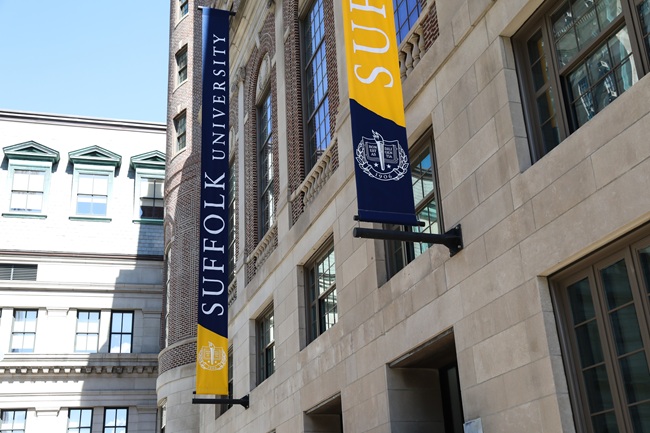
How does Suffolk University fit the broader shift in student experience and enrollment competition?
Suffolk University’s own positioning makes this contract strategically legible. The university describes itself as a private institution in downtown Boston with undergraduate, graduate, and law programs, and it has been emphasizing outcomes, access, and urban-campus experience in its public messaging. More recently, it also announced expanded tuition coverage for qualifying Boston Public Schools and Boston Charter Schools graduates entering in fall 2026. Put those pieces together and the dining overhaul starts to look less like an isolated vendor switch and more like part of a wider student-value narrative.
That matters because universities are under pressure to prove value in more tactile ways. Tuition, housing, food, and day-to-day convenience are no longer side issues for enrollment offices. They are central to yield, retention, and parent perception. Suffolk University’s statement said the new dining model was intended to be more welcoming, inclusive, and aligned with how students actually live and learn on an urban campus. Reworded in plain English, the university appears to be saying that campus services now function as recruitment infrastructure.
The commuter angle is especially important. Suffolk University is in downtown Boston rather than on a traditional enclosed campus, and Aramark’s emphasis on grab-and-go retail options, meal exchange, and technology-enabled ordering suggests the service design is being built around fragmented schedules rather than old-school dining hall rhythms. That is a meaningful operational detail. Urban campuses often need flexibility more than spectacle. Students want food where they already are, not a heroic trek for pasta at 2:15 p.m. because the meal swipe gods demand it.
Could technology-led campus dining become a bigger competitive weapon for Aramark and its peers?
The technology piece deserves more attention than it may get in a standard rewrite. Aramark said the Suffolk program will include mobile ordering, self-service kiosks, improved throughput, and potential smart-locker pickup. Those features sound mundane until you remember that food-service profitability often hinges on labor efficiency, order flow, peak-time congestion, and customer satisfaction. In that sense, campus dining is gradually starting to borrow the playbook of quick-service retail, only with longer contract cycles and more institutional oversight.
For Aramark, that could be valuable beyond Suffolk University itself. If these tools improve convenience and reduce service friction, they become easier to pitch across other higher education accounts. The same is true of culturally inclusive menus, rotating concepts, and wellness-led offerings. Those features are not just student-friendly. They are procurement-friendly because they help universities justify why a contract partner is enhancing campus life rather than merely feeding it.
The competitive implication is that campus dining operators may increasingly be judged on product design and digital usability, not just purchasing scale and back-end execution. That does not make the sector suddenly glamorous. It just means the winner may be the operator that best blends logistics, hospitality, and light consumer-tech thinking without making the whole thing feel like an app demo with fries.
What does recent Aramark stock sentiment suggest about how investors may view deals like this?
Aramark’s share price context suggests the market is not treating the company like a broken story. The stock was at $42.86 on April 10, 2026, down modestly on the day, and trading not far from its 52-week high of $44.49. Separately, recent analyst commentary surfaced by Yahoo Finance indicated target-price resets around the low-to-mid $40s, while one March 2026 report cited a Truist target increase to $50 on stronger-than-expected organic growth. That does not prove universal bullishness, but it does suggest analysts have been focused on execution quality and revenue momentum rather than on a turnaround narrative.
In that environment, a contract like Suffolk University’s is unlikely to move the stock on its own. What it can do is reinforce a pattern. Investors often reward service companies when they show they can keep winning institutional business while modernizing delivery models. A steady stream of such wins helps support the idea that Aramark’s collegiate business remains relevant, adaptable, and commercially sticky.
There is still a caution flag here. Service contracts can look elegant in press releases and messier in execution. Dining upgrades require operational follow-through, labor discipline, food-cost management, and client satisfaction over time. If the student experience does not improve materially, the strategic language around belonging and access can age badly in a hurry. Universities are not shy about measuring pain points when enough students complain.
What execution risks could shape whether the Suffolk University partnership becomes a real win?
The biggest risk is the familiar one in outsourced services: promises are easy, operating reality is harder. Suffolk Dining is being marketed around expanded access, better technology, and broader menu variety. Each of those elements adds complexity. More flexibility can improve satisfaction, but it can also create traffic imbalances, forecasting challenges, and cost pressure if usage patterns differ from plan.
A second risk is that student expectations are rising faster than dining economics. When institutions position food service as a pillar of student belonging and success, they raise the bar. Students then compare campus offerings not just with rival universities but with consumer apps, neighborhood food options, and delivery convenience shaped by the rest of urban life. In downtown Boston, that comparison set is not exactly forgiving. A mediocre sandwich becomes a strategic issue when better alternatives are two blocks away.
A third risk is that contract wins in higher education are part of a broader contest over institutional budgets. Universities want service improvements, but they also want affordability and predictability. Aramark’s long-term financial sustainability language implies the company is trying to reassure clients that enhancement does not have to mean uncontrolled cost inflation. Whether that balance holds will matter more than any themed dining night, however photogenic the taco station may be.
What does this Aramark and Suffolk University deal signal about the future of campus hospitality?
The clearest signal is that campus hospitality is being repositioned as a strategic layer of the university experience rather than a background utility. Suffolk University is using dining to support inclusion, convenience, and competitive positioning. Aramark is using the same deal to showcase its ability to align hospitality operations with institutional priorities. That is a useful reminder that even seemingly modest contracts can reveal where spending priorities are heading.
For the wider sector, the message is that higher education vendors will increasingly need to sell outcomes, not just services. The contract narrative now revolves around access, well-being, commuter flexibility, digital ordering, and campus identity. Operators that cannot translate their offer into those terms may find themselves looking less like strategic partners and more like commodity caterers with better PowerPoint decks.
For Aramark, the Suffolk University win is best read as incremental but meaningful. It strengthens the company’s collegiate hospitality story, supports its image as an operator that can modernize campus service models, and fits a market backdrop in which investors appear willing to reward consistent execution. It is not a blockbuster deal. But it is the sort of contract that helps explain how a mature services business keeps extending relevance in a sector where student expectations and institutional economics are both changing at the same time.
Key takeaways on what the Aramark and Suffolk University partnership means for the company, competitors, and campus dining
- Aramark’s Suffolk University win reinforces higher education as a steady strategic growth channel rather than a peripheral business line.
- The partnership shows that campus dining contracts are now being sold on student experience, retention support, and enrollment relevance, not just food operations.
- Suffolk University appears to be using dining as part of a broader value proposition for an urban student population in downtown Boston.
- Flexible meal access, commuter-friendly formats, and digital ordering are becoming core competitive features in campus hospitality procurement.
- Technology investments such as kiosks, mobile ordering, and smart pickup can support both customer satisfaction and operating efficiency if executed well.
- For Aramark investors, deals like this matter less as one-off revenue events and more as evidence of durable institutional demand and contract stickiness.
- The stock’s position near its 52-week high suggests the market is already pricing in a reasonable degree of confidence in Aramark’s execution story.
- Execution risk remains real because expanded service choice can increase complexity, labor pressure, and expectations from both students and university administrators.
- Competitors in collegiate hospitality may face pressure to pitch more holistic campus-life solutions rather than traditional food-service models.
- The broader industry signal is that student dining is being recast as infrastructure for belonging, convenience, and campus competitiveness.
Discover more from Business-News-Today.com
Subscribe to get the latest posts sent to your email.