


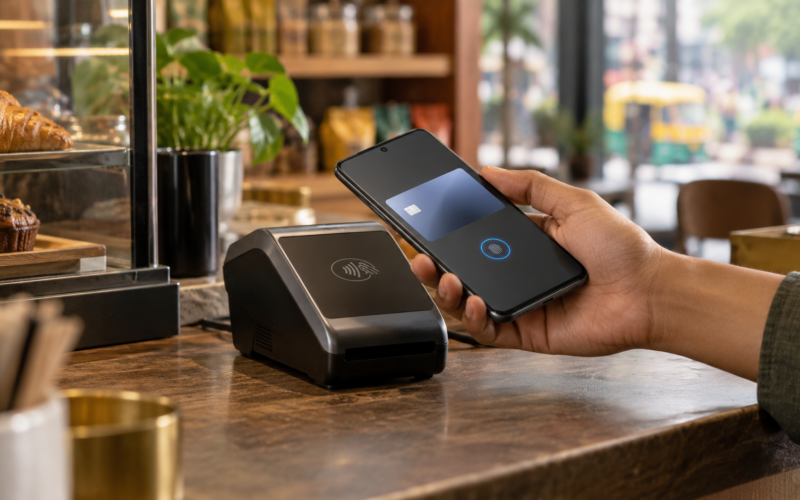
Apple Inc. (Nasdaq: AAPL) is poised to launch Apple Pay in India in October 2026 with Axis Bank Limited (NSE: AXISBANK) as its first card-issuing partner, according to three people familiar with private preparations. The initial service would allow eligible Axis Bank credit-card customers to store tokenised credentials on an iPhone and make contactless payments using Face ID or Touch ID, without opening a separate payments application. Apple has also held talks with HDFC Bank Limited and ICICI Bank Limited, but commercial terms with those larger private-sector lenders had not been agreed when Reuters reported the plan. Apple and HDFC Bank did not comment to Reuters, while Axis Bank and ICICI Bank declined to comment, so the timing, product scope and launch partnership remain reported intentions rather than formally announced commitments.
The proposed entry would close one of the largest gaps in Apple Pay’s global footprint. India is a strategically important market for Apple because the company’s smartphone share has doubled since 2022 to about 8%, according to Counterpoint Research data cited by Reuters, while local manufacturing and retail investment have made the country more important to Apple’s supply and sales strategy. The payments opportunity is substantial, but the route is not straightforward. India’s Unified Payments Interface already accounts for roughly 84% of digital-payment volume, meaning Apple would enter a market where instant bank-to-bank transfers and QR codes are deeply embedded in daily consumer behaviour.
How would Apple Pay work with Axis Bank credit cards in India?
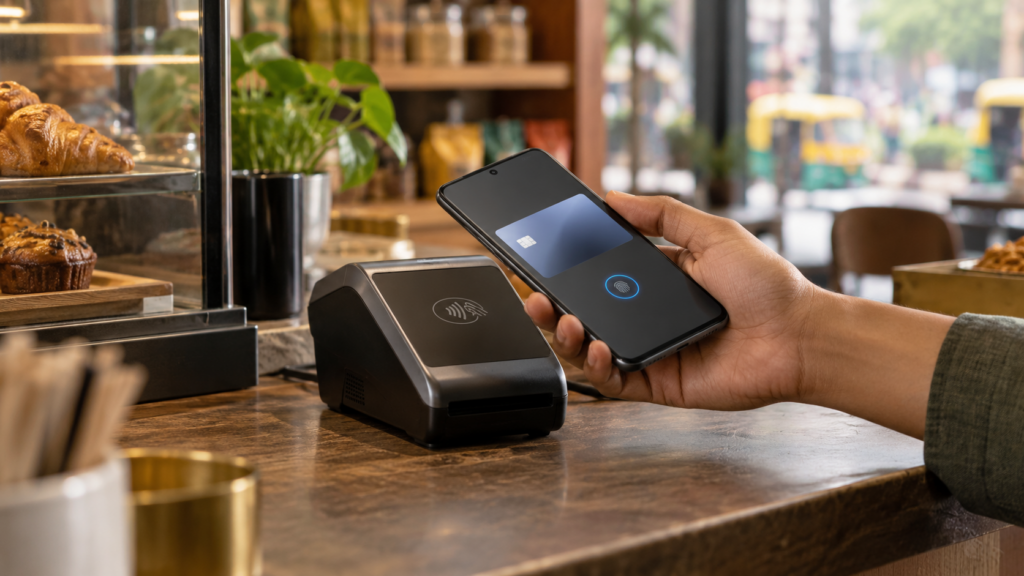
The reported first phase would focus on Axis Bank credit cards rather than trying to reproduce the full breadth of India’s UPI ecosystem on day one. Users would add an eligible card to Apple Wallet, after which the underlying card number would be replaced by a device-specific token for transactions. At a compatible terminal, the customer could authenticate by biometric check and tap the iPhone or Apple Watch to pay. This keeps the payment on existing card rails while changing the user interface, credential storage and authentication method.
That distinction is commercially important. Apple Pay would not initially displace UPI’s low-cost account-to-account transfers, nor would it automatically work at every merchant displaying a QR code. Its strongest early use case would be contactless card acceptance among urban merchants, travel businesses, premium retail and other locations already equipped with near-field-communication terminals. Apple can broaden usefulness only by signing more issuers, securing wide merchant acceptance and making the experience more convenient than using a physical card or an established domestic application.
The phased bank-by-bank model mirrors Apple’s expansion in other markets. It gives the company control over certification, security and the customer experience, but it also means reach depends on individual commercial agreements. A customer whose bank is not supported cannot simply enrol another issuer’s card, so the speed at which HDFC Bank, ICICI Bank, State Bank of India and other large card providers join will determine whether Apple Pay becomes a national product or remains a premium niche. The reported Axis Bank start is therefore a launch bridge, not the final measure of market penetration.
Why would Axis Bank become Apple’s first Indian banking partner?
Axis Bank is India’s fourth-largest credit-card issuer, with 16.26 million active cards in July 2026, according to Reserve Bank of India data cited by Reuters. That portfolio is large enough to give Apple a meaningful test population while remaining smaller than the books of HDFC Bank, SBI Cards and Payment Services Limited and ICICI Bank. For Axis Bank, being first could create a sharper marketing proposition among affluent and digitally active customers who already use Apple devices. It may also generate more card spending if Apple Wallet makes an Axis Bank credential easier to use for everyday contactless purchases.
The partnership would not automatically translate into high incremental profit. The economics depend on merchant discount revenue, interchange, reward costs, fraud performance, Apple-related commercial terms and the extent to which wallet transactions replace spending that would have occurred on the physical card anyway. Axis Bank would also need smooth token provisioning, dispute handling and customer support to prevent a premium feature from becoming an operational burden. The attraction lies in customer engagement and share of wallet as much as in immediate transaction revenue.
Apple may also see Axis Bank as a pragmatic opening partner because a single large issuer simplifies launch control. The company can validate authentication, tokenisation, terminal acceptance and support processes before adding more banks. If transaction success rates and customer adoption are strong, that evidence can help negotiations with other issuers. If problems emerge, the narrower first phase limits the number of affected customers and gives both partners time to adjust.
Can Apple Pay compete in a payments market dominated by UPI?
Apple Pay and UPI solve overlapping but not identical problems. UPI connects bank accounts for person-to-person and merchant payments, usually through a mobile application and QR code, while Apple Pay typically turns existing payment cards into secure contactless credentials stored on a device. UPI’s 84% share of Indian digital-payment volume gives it a scale advantage that no new wallet can quickly overcome. Apple Pay’s opportunity is to own a high-value slice of card spending rather than to replace the country’s dominant payment network.
The competitive backdrop is changing at the margin. India is introducing a merchant discount rate of 0.4% on qualifying UPI merchant transactions above Rs 2,000 from 15 October 2026, while retaining exemptions and lower charges for defined merchants and sectors. The change does not erase UPI’s cost and reach advantages, but it slightly narrows the contrast between free UPI acceptance and card-based payments for larger purchases. An October Apple Pay launch would therefore arrive just as banks, merchants and payment applications reassess the economics of higher-value digital transactions.
Apple’s strongest differentiator is the integration of hardware, biometric authentication and tokenised cards in a device ecosystem used by a relatively affluent customer base. Its limitation is that iPhones still represent a minority of the Indian handset market, while UPI applications work across Android and iOS and are accepted through inexpensive printed QR codes. Apple Pay can be strategically successful without leading transaction volume if it captures travel, dining, electronics and premium-retail spending. The measure to watch is not whether it overtakes UPI, but whether it increases card usage and customer retention among iPhone owners.
What regulatory change made an Indian Apple Pay launch more practical?
The Reserve Bank of India introduced a more flexible authentication framework that took effect in April 2026, retaining two-factor protection while allowing issuers to use risk-based checks and emerging authentication technologies. Reuters reported that the central bank’s acceptance of biometric authentication for card payments enabled Apple Pay to work with Indian cards through Face ID and Touch ID. This matters because Apple Pay depends on device-level authentication rather than an SMS one-time password for every in-person tap. A regulatory framework that recognises those methods removes a major design conflict.
Compliance will still extend well beyond biometrics. Apple and participating banks must meet Indian rules on card tokenisation, data handling, transaction monitoring, customer consent and grievance resolution. Banks remain responsible for the regulated payment relationship even when Apple supplies the wallet interface. The partners must therefore align a global product with local supervisory expectations rather than simply switch on an existing international service.
The regulatory route also explains why the report should not be treated as a completed launch. Technical readiness, issuer certification and commercial agreement can be advanced while final operating details remain unsettled. Until Apple or Axis Bank names an availability date and publishes eligible card types, customers cannot assume that every credit card, device or merchant terminal will work. The October target is credible reporting from unnamed sources, but it is not yet a public customer commitment.
What could the rollout mean for Apple and Axis Bank earnings?
For Apple, the immediate revenue contribution is unlikely to be material relative to a business generating hundreds of billions of dollars in annual sales. Apple Pay can support services income and make the iPhone ecosystem more useful, but India-specific payment fees have not been disclosed and the eligible installed base would initially be limited to Axis Bank cardholders. The larger strategic benefit is ecosystem retention. A customer who uses an iPhone for payments, authentication and financial credentials has another reason to remain inside Apple’s hardware and services platform.
Axis Bank could gain a more visible commercial benefit if the arrangement helps it win cards, increase transaction frequency or capture a greater share of premium spending. Yet those gains would take time and must be measured against rewards, processing costs and any payments made within the partnership. Investors should look for changes in active-card growth, spending per card, contactless transaction share and fee income rather than assuming that the Apple brand alone improves profitability. The bank’s 16.26 million-card base provides scale, but adoption among eligible users will decide the effect.
Rival banks also have leverage. Apple needs broad issuer coverage to make its wallet useful, while HDFC Bank and ICICI Bank have large customer bases that reduce pressure to accept unfavourable terms. A slow expansion could keep Axis Bank’s exclusivity valuable for longer, but it would also constrain Apple Pay’s reach. A rapid expansion would validate Apple’s proposition while reducing the first mover’s differentiation. The final economics will therefore reflect both customer adoption and the bargaining balance between Apple and India’s leading banks.
How are investors reading the reported Apple Pay India plan?
Apple shares closed at $336.13 on 18 September, down about 0.4% for the session, while Axis Bank shares rose about 0.2% to Rs 1,240.90 in Mumbai. Those moves occurred before or alongside broad market trading and cannot be attributed reliably to an unconfirmed product launch. Apple remains valued primarily on iPhone demand, services growth, artificial intelligence execution and capital returns, while Axis Bank sentiment depends more heavily on loan growth, asset quality, margins and deposit competition. Apple Pay is a potentially useful strategic addition, not a stand-alone earnings thesis for either stock.
The market signal may become clearer after a formal announcement. Investors will want to know whether the launch includes only credit cards, which card networks are supported, whether Apple charges issuers or merchants, and how quickly additional banks can join. They will also examine whether the service links to UPI in any form, because card-only functionality would narrow the addressable transaction pool. Without those details, the most reasonable assessment is strategically positive for both companies but financially unquantified.
The reported timing creates a practical checklist. Confirmation from Apple and Axis Bank, an updated Indian Apple Pay support page, visible card-enrolment terms and participation by a second major issuer would each strengthen confidence that this is a scalable market entry. A delayed launch or prolonged single-bank structure would suggest that commercial or regulatory friction remains. The story is therefore less about one October switch-on than about whether Apple can build a bank network around a premium payments experience in the world’s most active real-time payments market.
Discover more from Business-News-Today.com
Subscribe to get the latest posts sent to your email.