


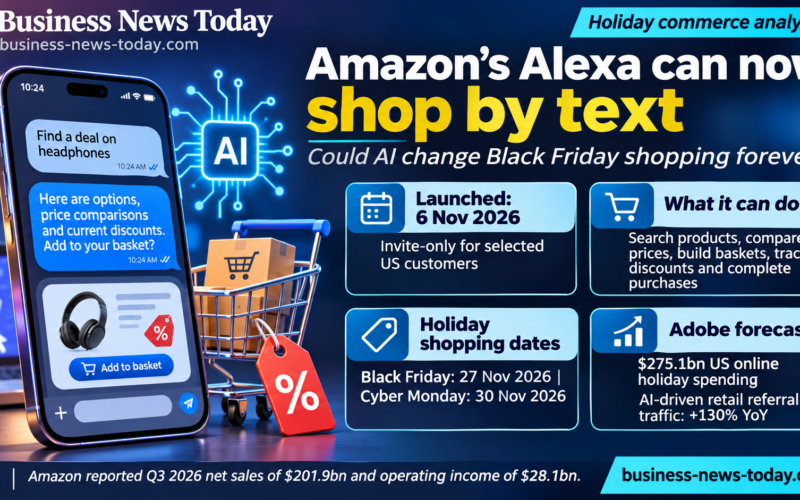
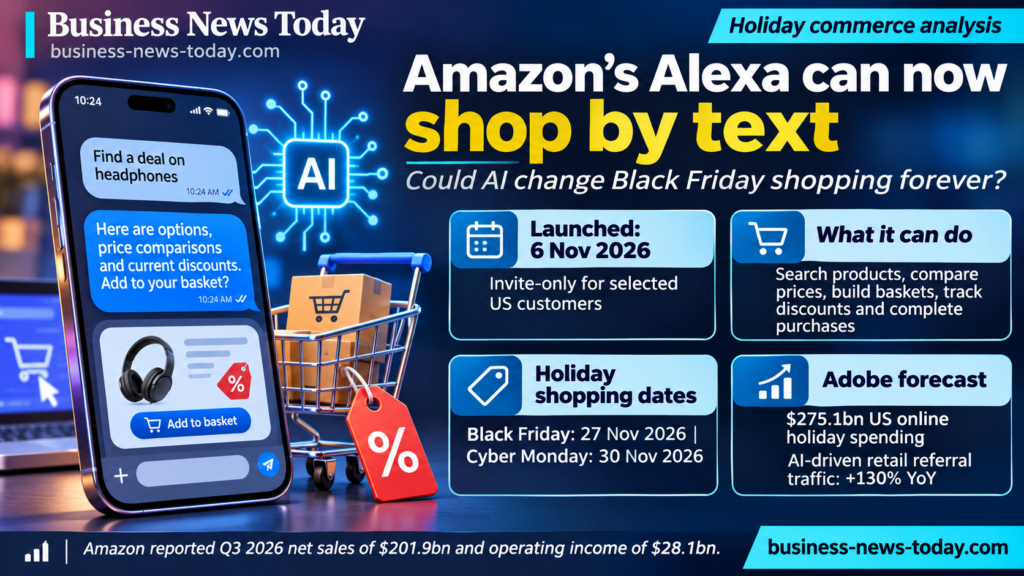
Amazon.com, Inc. (NASDAQ: AMZN) has introduced text-message shopping through Alexa for Shopping, allowing selected customers in the United States to search for products, compare prices, create shopping baskets, track discounts and complete purchases without opening a shopping application. Launched on 6 November 2026, the invitation-only service arrives just weeks before Black Friday and Cyber Monday, potentially changing how consumers discover products and decide what to buy during the holiday season.
The development represents more than another artificial intelligence feature added to an existing online marketplace. Amazon is attempting to reduce the steps between recognising a shopping need and completing a purchase, while extending its influence over product discovery beyond its own retail inventory. With Adobe forecasting a 130% year-on-year increase in AI-driven referral traffic to US retail websites during November and December, the timing highlights how rapidly conversational shopping is becoming part of the competitive landscape.
How does Amazon’s new Alexa text-message shopping service work?
Alexa for Shopping now allows invited US customers to communicate with Amazon’s shopping assistant through ordinary mobile text messages. Instead of manually searching for products, opening individual listings and comparing specifications, consumers can describe what they need and receive recommendations through a conversation. The assistant can also add selected products to a shopping basket and complete purchases with the customer’s approval, making it possible to handle multiple shopping tasks through a single messaging interface.
A customer preparing for Thanksgiving, for example, could send Alexa a photograph of a recipe and request the ingredients needed to prepare the meal. The assistant can identify relevant grocery products, assemble a shopping basket and respond to subsequent requests to add or change items. Similarly, someone shopping for Christmas gifts could describe a recipient’s interests, provide a budget and request recommendations that meet a particular delivery requirement.
The service also supports repeat purchases, allowing consumers to request products they previously ordered without manually locating those items in their purchase history. Customers can ask for household essentials, create gift lists, check delivery progress and request recommendations based on earlier shopping activity. Amazon says the assistant can remember preferences shared by shoppers, making future conversations more personalised as users interact with the system.
Importantly, the experience is designed to extend beyond the initial text conversation. Amazon is introducing continuity between text messaging, its shopping website, mobile application and compatible Alexa devices, enabling customers to resume a shopping task through another interface. This could prove particularly valuable for consumers who begin researching products while travelling or working but prefer to review their final choices on a larger screen.
Who can use Alexa for Shopping by text, and is it available to everyone?
Amazon began introducing the text-message feature to a small group of invited customers in the United States on 6 November 2026. Selected users receive an invitation to activate the service, accept the relevant terms and connect their mobile phone number before interacting with the shopping assistant. Once activated, the service appears as an Alexa Shopping contact, allowing customers to submit requests through their existing messaging interface.
The company plans to expand access to millions of additional US customers over the following weeks, although it has not announced a definitive date for nationwide availability. Customers who have not received an invitation can register their interest through Amazon’s official Alexa for Shopping announcement page. The broader shopping assistant is already accessible through Amazon’s website and shopping application for eligible US users, but the new text-message functionality remains subject to the invitation-based rollout.
The geographic distinction is important for consumers outside the United States. Amazon has not announced an equivalent international rollout schedule for this particular texting feature, meaning shoppers in the United Kingdom, Canada, Australia and India should not assume that access is immediately available in their markets. Availability of other Alexa services or Amazon shopping features does not necessarily establish eligibility for text-message purchasing.
Can Alexa really identify the best Black Friday deals in 2026?
One of the most commercially significant capabilities is Alexa’s ability to monitor product prices and notify shoppers when particular items become cheaper. Consumers can request alerts for headphones, electronics, household appliances or other products they are considering, potentially reducing the need to repeatedly search retail websites. Amazon also says the assistant can examine up to a year of product price history, offering additional context when customers assess promotional claims.
That functionality could become especially useful during Black Friday 2026, which falls on 27 November, and Cyber Monday on 30 November. Retailers increasingly introduce seasonal promotions well before the main shopping weekend, making it more difficult for consumers to determine whether an advertised discount represents a meaningful saving. Access to previous selling prices can help shoppers distinguish between a genuine reduction and an offer that appears attractive primarily because of a higher reference price.
However, automated price comparisons should not be treated as definitive proof that a product represents the lowest available price. Product variations, third-party sellers, shipping charges, promotional eligibility and regional availability can all influence the final amount paid. Consumers comparing expensive purchases should still examine the exact model number, warranty, delivery conditions and final checkout price before authorising a transaction.
The strongest practical use case may therefore be combining AI-assisted discovery with independent verification. Alexa can reduce the time required to research several alternatives, while consumers retain responsibility for deciding whether a particular product meets their requirements. For high-value electronics and appliances, that distinction could make the difference between a convenient purchase and an expensive mistake.
Why is Amazon extending AI shopping to products sold by other retailers?
Amazon’s text-shopping announcement follows another significant development introduced on 4 November 2026: the launch of its Shop Direct Merchant Workspace. The new self-service platform allows eligible retailers to connect their product catalogues to Amazon’s shopping environment, potentially making merchandise available for discovery even when the products are not sold through Amazon’s conventional marketplace. The initiative extends the company’s role from operating an online retail platform towards becoming a broader gateway for product searches across the internet.
Through Shop Direct, customers can encounter products offered by independent retailers while searching on Amazon or interacting with Alexa for Shopping. Depending on the product and merchant’s participation, shoppers may be redirected to the retailer’s own website to complete a transaction or use Amazon’s Buy for Me functionality. The latter allows Amazon’s purchasing agent to handle an eligible transaction on the external merchant’s website after the customer confirms the relevant details.
For smaller retailers, the opportunity is substantial but not without complications. Connecting product information to Amazon could expose specialist brands to customers who would otherwise never discover their websites, particularly when consumers are searching for unusual gifts or niche merchandise. However, reliance on a powerful intermediary for discovery could also make merchants more dependent on recommendation algorithms and purchasing interfaces they do not control.
The development introduces an additional competitive dimension for traditional search engines and online marketplaces. Rather than searching separately across several websites, consumers may increasingly expect a shopping assistant to identify suitable products regardless of where they are sold. If that behaviour becomes widespread, retailers could find themselves competing for visibility inside conversational recommendations rather than relying entirely on conventional product-search rankings.
How fast is AI-assisted shopping growing ahead of Christmas 2026?
Adobe’s September 2026 holiday shopping forecast provides important context for Amazon’s latest expansion. The research projects US online holiday spending of $275.1 billion between 1 November and 31 December 2026, representing a 6.7% increase from the previous year. Adobe also expects artificial intelligence-generated referral traffic to retail websites to increase by approximately 130% year on year during the holiday period.
Those projections suggest that artificial intelligence is becoming increasingly relevant to how consumers research purchases, although the referral statistic does not measure transactions completed directly by autonomous shopping agents. Adobe’s data focuses on shoppers arriving at retail websites through AI-related referrals, making it an indicator of changing discovery behaviour rather than proof that AI assistants are replacing established checkout channels. The distinction matters when assessing how quickly the commercial opportunity may develop.
Amazon has separately reported that more than 400 million customers used Alexa for Shopping over the preceding 12 months, with customer interactions increasing 570% year on year. These figures indicate substantial engagement with its shopping assistant, although they do not isolate the performance of the newly introduced text-message channel. Amazon’s next challenge will be demonstrating whether easier access leads to greater purchasing frequency, improved customer retention or a higher share of seasonal spending.
The company’s broader financial performance provides an additional backdrop. Amazon reported third-quarter 2026 net sales of $201.9 billion, an increase of 12% year on year, while operating income reached $28.1 billion. Continued investment in artificial intelligence across retail, cloud infrastructure and customer services indicates that conversational commerce forms part of a larger technology strategy rather than an isolated holiday experiment.
Could sponsored recommendations influence what Alexa suggests shoppers buy?
Artificial intelligence shopping creates a potentially valuable new advertising environment, particularly when consumers request product recommendations shortly before making purchases. Industry publication Digiday reported on 6 November that sponsored product advertisements are expected to appear within Alexa’s shopping text conversations, initially without additional charges to participating advertisers. The report also distinguished these sponsored recommendations from purchases automatically completed by the assistant, which were described as remaining advertisement-free.
For consumers, this raises an important question about how products are selected and presented. A recommendation generated by an AI assistant may appear personalised and objective, but commercial placement can influence which products receive attention. Shoppers should therefore distinguish sponsored merchandise from other recommendations and examine the underlying price, specifications and suitability rather than assuming that the first suggested product is automatically the strongest option.
For brands, conversational advertising could create opportunities to reach buyers at a particularly valuable moment in the purchasing journey. Traditional sponsored search results compete for clicks on a page, whereas a shopping assistant may present a smaller collection of recommendations within a personalised conversation. The potential commercial value of securing visibility in that environment could increase if consumers become comfortable making purchases with fewer steps.
However, the longer-term advertising model remains uncertain. Amazon has not established that sponsored recommendations in text-message shopping will generate stronger conversion rates than conventional retail advertisements, nor has it disclosed a mature pricing structure for this particular channel. The distinction between promising commercial possibilities and demonstrated financial performance will become important as retailers evaluate future advertising expenditure.
What should shoppers check before allowing Alexa to complete a purchase?
Convenience is the central attraction of AI-assisted purchasing, but consumers should continue reviewing important transaction details before approving an order. These include the exact product model, seller identity, quantity, final price, delivery charges, expected arrival date and applicable return conditions. The safeguards become particularly relevant when an assistant is interpreting broad requests that could match several different products.
Customers should also understand how personalisation works and consider what shopping preferences or other information they are comfortable sharing with the assistant. Alexa’s ability to remember earlier requests and purchasing habits could improve recommendations, but it also makes privacy settings and account security increasingly important. Shoppers should activate the feature only through Amazon’s legitimate invitation and account-verification process rather than responding to unsolicited messages that claim to provide early access.
For Black Friday purchases, one practical approach is to use Alexa for initial research and price monitoring while retaining final control over the transaction. Price alerts and product comparisons can save time, but the final purchasing decision should still consider whether the selected item is genuinely needed and whether comparable alternatives offer better value. Automation is most useful when it reduces unnecessary effort without eliminating informed judgement.
What does Amazon’s AI shopping push mean for retailers and investors?
Amazon’s latest announcement introduces a strategic opportunity that extends beyond the immediate holiday season. If consumers increasingly begin shopping through AI-generated recommendations, the businesses controlling those recommendation systems could gain greater influence over product discovery, purchasing decisions and customer relationships. Amazon is positioning Alexa for Shopping to perform that role while integrating external merchants through Shop Direct, potentially extending its reach across a larger portion of digital commerce.
Investor sentiment has remained sensitive to Amazon’s broader operating performance and investment requirements rather than responding exclusively to individual shopping-product announcements. Amazon shares closed at $259.30 on 6 November 2026, declining 0.35% during the session, although they were approximately 7.9% above their 30 October closing level. The recent share-price movement cannot be attributed specifically to the text-shopping launch, and investors will need stronger evidence of commercial adoption before assessing its incremental contribution to revenue or profitability.
For online retailers, the more immediate implications concern product information, customer acquisition and visibility. Accurate descriptions, detailed specifications, dependable inventory feeds and transparent delivery information may become increasingly important as AI assistants handle more of the comparison process. Merchants with incomplete product data could struggle to communicate their advantages effectively when customers depend on automated recommendations instead of visiting individual product pages.
Will AI shopping replace traditional online shopping?
Amazon’s introduction of text-message purchasing does not mean conventional online shopping is disappearing. Many consumers will continue to prefer browsing websites, examining photographs, reading independent reviews and comparing products manually, particularly when making expensive or highly personal purchases. The new functionality instead offers a different route for completing familiar shopping tasks, especially routine replenishment, gift research and price monitoring.
The longer-term significance lies in how quickly shoppers become comfortable delegating decisions and transactions to automated systems. Amazon’s immediate challenge will be expanding access, maintaining accurate recommendations and demonstrating that the technology consistently delivers convenience without compromising consumer confidence. The 2026 holiday season will provide an early opportunity to observe that transition, although meaningful conclusions will require evidence extending beyond the initial invitation-only launch.
For consumers preparing for Black Friday and Christmas, the practical message is straightforward: AI shopping assistants can help identify products, monitor prices and simplify purchases, but they do not eliminate the need to compare actual value. For retailers, the strategic question is considerably larger. As shopping conversations begin replacing some traditional searches, the competitive advantage may increasingly belong to businesses whose products are not merely available online but are easily discovered, accurately understood and confidently recommended by artificial intelligence.
Discover more from Business-News-Today.com
Subscribe to get the latest posts sent to your email.