


Alimentation Couche-Tard Inc. (TSX: ATD) has agreed to launch a voluntary tender offer for all issued and outstanding shares of Poland’s Żabka Group S.A. (WSE: ZAB) at PLN 32.00 per share, valuing the target at approximately PLN 32.62 billion, equivalent to about US$8.6 billion. The Canadian convenience and mobility group announced the transaction on July 31, 2026, and confirmed it as the largest acquisition in its history. Shareholders representing roughly 57 percent of Żabka’s issued capital, including CVC Capital Partners and Partners Group, have signed hard irrevocable undertakings to tender their shares to the offer, which will be implemented through wholly owned subsidiary Circle K Polska sp. z o.o. The deal doubles Europe’s share of Couche-Tard’s combined store network to about 60 percent and shifts the group further away from fuel toward digitally enabled convenience retail. It also opens a European antitrust review and a minority-shareholder dynamic that will determine whether the deal closes on the December 2026 timeline management has guided, and at the price currently on the table.
Why does the proposed $8.6 billion Żabka acquisition mark the largest strategic bet in Alimentation Couche-Tard’s history?
For a group whose long-term identity has been built on repeated bolt-on acquisitions across North American and European convenience networks, the Żabka transaction represents a qualitative shift. Couche-Tard has previously pursued much larger deals, including the abandoned attempt to acquire Seven & i Holdings Co. and the earlier bid for Carrefour SA that French authorities blocked in 2021, but neither reached completion. The Żabka transaction, in contrast, arrives with a controlling shareholder block already committed, a fully financed cash offer, and a defined closing timetable targeting December 2026.
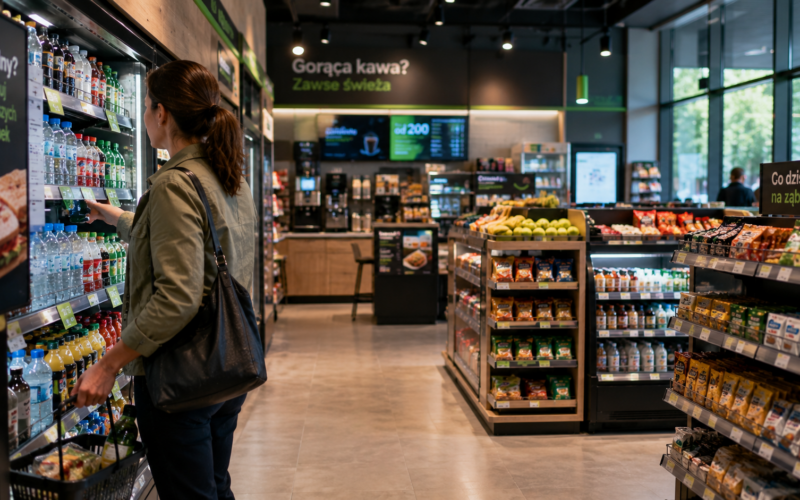
The scale of the commitment is also different from prior in-market consolidation. Żabka is not a fuel retailer being folded into an existing Circle K network. It is a majority-franchised convenience platform operating more than 13,000 outlets at end-June 2026, complemented by unmanned Żabka Nano stores, the Maczfit prepared-meal business, the Dietly meal-solution marketplace, and eGrocery brands Jush! and Delio, alongside a store network in Romania trading under the Froo brand. Couche-Tard is therefore acquiring not only a large physical footprint but a digital and logistics ecosystem that its own network does not yet replicate at comparable scale.
The strategic tension is straightforward. Couche-Tard is buying a business already close to the top of its addressable market in Poland and has framed the transaction as a template for exporting Żabka’s capabilities across its global network. Whether that thesis translates into durable value depends on how much of Żabka’s operating model is transferable outside Central Europe.

How does the Żabka combination reshape Couche-Tard’s European footprint against Seven & i and 7-Eleven?
The combined group would operate approximately 30,300 stores, with Europe rising from roughly 30 percent of the base to about 60 percent. Illustrative pro forma last-twelve-month combined revenue would be approximately US$83.9 billion with adjusted EBITDA of roughly US$7.8 billion, corresponding to an adjusted EBITDA margin of about 9.3 percent, before any synergies. That contrast between a low-single-digit fuel-heavy margin base and Żabka’s much higher standalone margin structure is central to the rationale. Żabka reported approximately US$7.4 billion in revenue and US$1.1 billion in adjusted EBITDA for the twelve months ended March 31, 2026, alongside about US$0.3 billion in net profit, implying an EBITDA margin close to 15 percent.
Competitively, the deal repositions Couche-Tard in the European convenience race that Seven & i Holdings has been trying to expand into. Couche-Tard walked away from its own bid for Seven & i in July 2025 after protracted talks, and Seven & i had itself explored Żabka without securing a transaction. The Circle K owner has now secured the Central and Eastern European asset that its Japanese rival was linked to only days before, entrenching its lead in one of Europe’s fastest-growing consumer markets. Poland’s economy grew 3.6 percent in the last full calendar year, and Żabka’s own trading footprint has expanded materially since its Warsaw listing in October 2024.
What do the deal terms, the CVC-Partners Group irrevocables and the PLN 32.00 tender price actually secure for Couche-Tard?
The offer price of PLN 32.00 per share values the equity at approximately PLN 32.62 billion. Widely quoted US-dollar figures range from US$8.6 billion, using Couche-Tard’s own reference exchange rate of 0.265 USD per PLN, to approximately US$8.7 billion at spot rates around the announcement. The economic value is the same, but the reported number varies depending on the FX assumption, and any published comparison should identify the reference used.
The irrevocable undertakings covering approximately 57 percent of Żabka’s shares are the most important structural feature of the offer. They come from CVC Capital Partners and Partners Group, the private equity sponsors that took Żabka public in October 2024, and are described as “hard” undertakings, meaning they cannot be withdrawn if a competing bid emerges. That significantly reduces the likelihood of an interloper, though it does not eliminate the possibility of pressure on price from the remaining minority holders. The transaction is unanimously supported by Żabka’s key executive managers, further reinforcing the alignment on the sell side.
Because the offer is a voluntary tender, the achieved acceptance rate will determine whether Couche-Tard secures full ownership immediately or continues to trade Żabka on the Warsaw Stock Exchange for a period after closing. Executive Alex Miller told the analyst call that the group would use the period through the December 2026 close to work through integration priorities, including whether to keep Żabka listed. That optionality is real, but it also implies that the definitive integration path is not yet settled.
Why does the debt-financed structure and the 3.0 times pro forma leverage matter for Couche-Tard’s investment case?
Couche-Tard intends to fund the transaction through fully committed debt facilities. J.P. Morgan is acting as lead arranger, with National Bank of Canada Capital Markets and The Bank of Nova Scotia as joint bookrunners. Management guided to pro forma net debt to adjusted EBITDA of approximately 3.0 times at closing, with the intention to return to the company’s internal leverage framework range by the second year after completion. The company said the transaction is not expected to affect its credit rating.
The financing profile is important for three reasons. First, at 3.0 times leverage the combined group retains room for continued bolt-on acquisitions and its share-repurchase programme, which the Toronto Stock Exchange renewed in July 2026 for up to 74,194,410 common shares. Second, an all-debt structure preserves upside for existing shareholders because there is no equity dilution, and the transaction is expected to be immediately accretive to the adjusted EBITDA margin and accretive to earnings per share from the second year after closing. Third, a debt-financed deal ties the return profile to Żabka’s ability to deliver its projected EBITDA base while Couche-Tard services the incremental interest cost, which increases the sensitivity of the investment case to Central European consumer conditions and Polish zloty exchange rate movements.
For fiscal 2026, ended April 27, 2026, Couche-Tard reported revenue of approximately US$76.5 billion and full-year EBITDA of US$7.0 billion, up 18.2 percent year on year. That baseline provides significant recurring cash generation from which to deleverage, but it also means the group is layering its largest ever transaction onto a business that has been executing through pressure on fuel margins and same-store traffic across several of its markets.
What execution and integration risk sits behind the $250 million synergy target across a 30,300-store combined base?
Couche-Tard has identified approximately US$250 million in cost and revenue synergies, expected to be fully achieved by the third year after closing. Alex Miller told analysts the synergies would start “very low” and accelerate, and characterised the target as conservative with upside. The route to those synergies runs through both procurement and network capabilities, including Żabka’s own supply chain, which the target uses to supply more than 99 percent of the goods sold across its network. That verticalised model contrasts with the more distributor-reliant supply structure of much of Couche-Tard’s existing footprint and is one of the assets management said it wants to learn from rather than dismantle.
The integration risk therefore has an unusual shape. Rather than a conventional buyer absorbing a smaller franchise, Couche-Tard is describing a two-way transfer where Żabka’s digital tooling, unmanned-store formats and prepared-meal capabilities are candidates for wider deployment across Circle K markets. That framing carries potential upside, but it also implies coordination complexity across dozens of national operations, and the synergy target is small relative to the deal size, at less than 3 percent of the transaction value and roughly 3.2 percent of combined pro forma adjusted EBITDA. In practical terms, the synergies alone are unlikely to determine the transaction’s return profile. The larger driver will be whether Żabka continues to grow revenue and adjusted EBITDA at anything like its recent trajectory once inside a much larger parent.
How does the European Commission, UOKiK and Romanian FDI regulatory pathway shape the December 2026 close timeline?
Regulatory conditions are the most immediately visible obstacle. The offer is subject to receipt of merger control approval or the expiry of applicable waiting periods, either by the European Commission or by Poland’s Prezes Urzędu Ochrony Konkurencji i Konsumentów (UOKiK), depending on which authority takes jurisdiction. Foreign direct investment approval is also required from Romania’s Comisia pentru examinarea investițiilor străine, given Żabka’s Froo store network there.
The competitive overlap between Circle K and Żabka in Poland is limited, because Couche-Tard’s Polish presence is centred on Circle K fuel and forecourt stores rather than the franchised urban convenience format that defines Żabka. That factual pattern supports a first-phase clearance case, but it does not guarantee one. Any inquiry into supplier concentration, franchisee terms, private-label positioning or consumer data handling could still lengthen the process, and the group’s earlier experience with the European Commission and with French authorities during the Carrefour attempt is a reminder that outcomes are not procedural.
The December 2026 close timeline is realistic only if the primary competition review remains within phase one and the Romanian FDI approval is granted without extended review. Any move into phase two would push the completion into 2027, which would in turn extend Couche-Tard’s period of elevated leverage and defer the accretion profile management has guided.
What could reported minority-shareholder pressure to raise the bid mean for the final price Couche-Tard actually pays?
The 43 percent of Żabka shares outside the CVC, Partners Group and management block form the swing constituency of the offer. Because this is a voluntary tender rather than a squeeze-out mechanism, the minority holders retain the ability to refuse the PLN 32.00 offer if they consider it insufficient. Bloomberg reported that the Couche-Tard chief executive expected some Żabka shareholders to press for a higher bid during the tender window, an outcome that would not be unusual in a Central European voluntary tender structure at a premium level that some institutional holders may argue understates Żabka’s growth optionality.
RBC Capital Markets analyst Irene Nattel described the transaction as both “bold” and “measured”, noting that a successful close would meaningfully advance Couche-Tard’s long-term growth objectives, while flagging that questions remained around regulatory process, timeline and precise financial impact. The commercial risk for Couche-Tard is therefore twofold. If minority-holder pressure forces an increase to the offer price, the additional cost falls straight onto the debt-financed transaction envelope, modestly extending the deleveraging path and marginally diluting the return profile. If, on the other hand, the offer clears without a price uplift, Couche-Tard secures a controlling position in one of Europe’s most digitally advanced convenience retailers at what management already characterised as an attractive multiple relative to peer transactions.
The transaction values Żabka at roughly 7.8 times trailing adjusted EBITDA on the group’s own reference numbers. That is materially below the multiples paid in comparable European convenience or grocery consolidation deals, though it reflects the market context of a listed Polish retailer whose share register was already dominated by two large financial sponsors seeking an exit route. The final price paid, and the acceptance level achieved, will together determine whether Couche-Tard closes its biggest ever deal at the disclosed valuation or at a modestly higher one.
What should investors watch as Couche-Tard moves toward the Żabka tender offer close and the second half of 2026?
- Alimentation Couche-Tard has agreed to a voluntary tender offer for Żabka Group at PLN 32.00 per share, valuing the target at approximately PLN 32.62 billion or US$8.6 billion, and confirmed the transaction as its largest acquisition to date.
- CVC Capital Partners, Partners Group and key executive managers, together holding about 57 percent of Żabka shares, have signed hard irrevocable undertakings to tender, materially reducing the risk of a competing bid.
- The combined group would operate approximately 30,300 stores, with Europe rising from roughly 30 percent to about 60 percent of the network and pro forma revenue at around US$83.9 billion on adjusted EBITDA of about US$7.8 billion.
- Couche-Tard will fund the transaction through fully committed debt facilities arranged by J.P. Morgan with National Bank of Canada Capital Markets and The Bank of Nova Scotia, guiding to pro forma net debt to adjusted EBITDA of approximately 3.0 times at closing with no expected rating impact.
- Management has identified approximately US$250 million in cost and revenue synergies achievable by year three, characterised as conservative with upside, with immediate adjusted EBITDA margin accretion and earnings per share accretion from year two.
- The offer requires merger control approval or waiting-period expiry from the European Commission or Poland’s UOKiK, alongside Romanian FDI clearance, and management is targeting completion by December 2026.
- Żabka’s digital and logistics stack, including Żabka Nano unmanned stores, Maczfit, Dietly, Jush! and Delio, is a central part of the strategic rationale and could be exported into other Circle K markets over time.
- Bloomberg reported that the Couche-Tard chief executive expected some minority Żabka holders to seek a higher offer, and the achieved acceptance level and any price adjustment will determine the final transaction cost.
- Couche-Tard’s fiscal 2026 base of US$76.5 billion in revenue and US$7.0 billion in EBITDA provides significant deleveraging capacity, but the deal ties incremental returns to Central European consumer conditions and to Polish zloty movements.
- The next measurable proof points are the regulatory decisions from Brussels or Warsaw and Bucharest, the tender acceptance rate, any adjustment to the offer price, and Couche-Tard’s first-quarter fiscal 2027 result expected in early September 2026.
Discover more from Business-News-Today.com
Subscribe to get the latest posts sent to your email.