




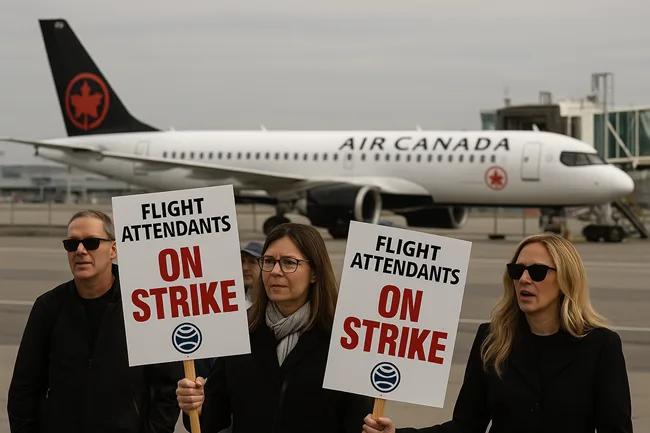
Air Canada (TSE: AC) has halted nearly all mainline and Air Canada Rouge operations after more than 10,000 flight attendants represented by the Canadian Union of Public Employees (CUPE) launched a strike at 12:58 a.m. ET on Saturday. The walkout, one of the largest labor disruptions in the airline’s modern history, has grounded the majority of flights at the height of the summer travel season, impacting well over 100,000 passengers per day. Regional affiliates such as Jazz Aviation and PAL Airlines are maintaining limited services, but the skeleton schedule covers only a fraction of the airline’s domestic and transborder network.
Air Canada began canceling flights earlier in the week as talks with the union collapsed, seeking government-directed arbitration to avert a walkout. By Friday night, the carrier confirmed that a “phased wind-down” of operations was underway and warned customers that cancellations would cascade into the weekend. Federal Jobs Minister Patty Hajdu urged both sides to find common ground, but negotiations broke down before the strike deadline.
Why did Air Canada suspend nearly all flights after attendants walked off the job at midnight?
The carrier said that halting mainline operations was necessary to provide certainty for customers and protect safety during the disruption. Over 600 flights had already been pre-emptively canceled, and officials acknowledged that the scale of the stoppage left no realistic way to maintain normal operations. With Air Canada Rouge also grounded, the network hit extends across domestic, U.S., and international routes, crippling Canada’s largest airline at the busiest point of the year.
The strike is centered on demands for pay during all hours worked, including ground and boarding duties that CUPE estimates cost attendants about 35 unpaid hours per month. Union leaders argue that decades of unpaid boarding time amount to systemic under-compensation, while Air Canada has countered that it offered wage increases of up to 38% over four years, with top hourly rates as high as C$94 and new ground-pay provisions. The union insists those figures exaggerate the effective raise and mask structural inequities.
What immediate options are available to stranded passengers, and how much compensation is Air Canada required to provide?
For passengers holding tickets, the options are limited. Air Canada has said customers may rebook on future flights, including on other airlines where available, or request a refund. However, with transatlantic and North American capacity already tight in mid-August, alternate itineraries are scarce. The airline has also stated that meal and hotel accommodations will not be provided, citing labor disruptions as an event outside of its control.
Industry experts caution that even if a deal is struck quickly, resuming full operations could take days. Aircraft and crews must be repositioned, and airports will need to recalibrate schedules and resources. Analysts estimate it may take up to a week before operations normalize after such a large-scale disruption.
Why did negotiations collapse, and what role does government arbitration play in the dispute?
The airline had formally requested binding arbitration earlier in the week under the Canada Labour Code, arguing it had proposed a market-leading package and that Ottawa’s intervention was necessary to protect travelers. CUPE rejected the proposal, claiming arbitration would silence workers and lock in the status quo on unpaid ground time.
Political considerations add complexity. The government faces pressure from passengers and tourism operators to restore normal service but risks alienating labor groups if it imposes a settlement. Both parties have dug in on public messaging: the union frames the dispute as a fight against “historic unpaid work,” while the airline emphasizes its pay proposals as sustainable and competitive.
How severe is the network impact if only regional partners like Jazz Aviation and PAL Airlines continue flying?
In normal August conditions, Air Canada and Rouge serve about 130,000 passengers daily. With both units halted, the remaining Express flights cover only a small portion of that demand. Key hubs such as Toronto Pearson, Montreal Trudeau, and Vancouver International face severe disruption, particularly for U.S.-bound travelers who rely on Air Canada’s hub connectivity.
Cargo services, tour operations, and Aeroplan loyalty accrual are also affected. While Star Alliance partners may absorb some overflow traffic, capacity limitations and congested airports make substitution difficult. Simply put, the regional partners cannot sustain the airline’s national role during the strike.
How is the stock market likely to react when trading resumes, and what sentiment is shaping investor outlook?
Air Canada shares last closed at about C$19.77 on Friday, August 15, before the strike began. The stock has traded in the high teens through August amid headlines about potential lockouts and work stoppages. Analysts warn that extended cancellations will hit third-quarter revenue, raise unit costs, and damage consumer trust.
At the same time, some market observers believe a settlement that introduces ground-pay clarity without runaway wage inflation could strengthen labor relations and service quality long term. When markets reopen, traders will weigh immediate operational losses against the prospect of a quick settlement.
What are the realistic scenarios for a resolution, and how soon could flights return to the skies?
Both sides face strong incentives to settle quickly. For CUPE, codifying pay for boarding and other ground duties is a matter of principle and precedent. For Air Canada, the summer travel peak is too important for revenue to risk prolonged paralysis. A framework deal recognizing ground pay while phasing in wage increases could give both parties a political and financial win.
Even with an agreement, industry veterans expect operational chaos to linger for days, with displaced crews, aircraft, and passengers slowing recovery. For now, the strike remains Canada’s most disruptive airline labor stoppage in decades, with no clear end in sight.
Why a framework deal within days is more likely than a protracted standoff
Full shutdowns during peak travel seasons are rarely sustainable. Political urgency, mounting passenger anger, and the airline’s reputational risk combine with the union’s high-visibility demands to create powerful pressure points. Air Canada’s willingness to offer ground pay and headline wage increases has narrowed the gap. That leaves timing, valuation, and implementation as the final hurdles.
If Ottawa maintains pressure but stops short of compulsory arbitration, both sides could secure partial victories in a framework deal. CUPE could claim to have ended unpaid ground work, while Air Canada could stabilize its cost outlook and restart flights. The operational restart will still be messy, but the optics of leaving tens of thousands of passengers stranded daily are untenable. That urgency is likely to drive a settlement sooner rather than later.
Discover more from Business-News-Today.com
Subscribe to get the latest posts sent to your email.


