

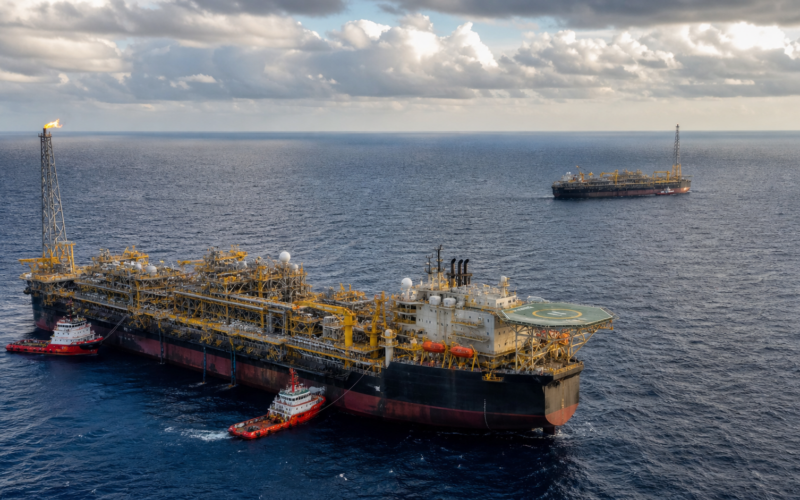
The Agogo oil field has emerged as one of the most consequential upstream developments in West Africa in the current decade, anchoring Angola’s effort to arrest a years-long production decline and signalling that deepwater Lower Congo Basin still has commercial life ahead of the energy transition. Operated by Azule Energy in Block 15/06 offshore Angola, the field forms the production core of the broader Agogo Integrated West Hub, which combines the Agogo and Ndungu reservoirs under a dual FPSO architecture targeting peak output of 175,000 barrels of oil per day. With first oil from the new Agogo FPSO achieved on 29 July 2025, just 29 months after final investment decision, and Ndungu full field start-up confirmed in February 2026, the project has now moved from execution to ramp up, becoming the central reference point for Angola’s near-term production trajectory and a test case for how integrated hub developments can compress timelines in mature deepwater basins.
What is the Agogo oil field and why does it matter for Angola in 2026
The Agogo oil field is a deepwater oil discovery located in Block 15/06, in the Lower Congo Basin offshore Angola, approximately 180 kilometres from the country’s coast. The reservoir lies in water depths ranging between 800 and 1,700 metres, with the producing intervals concentrated in Lower and Upper Miocene sandstones in a sub-salt diapir setting. Initial discovery occurred in March 2019 with the Agogo-1 wildcat well, drilled around 20 kilometres west of the existing Ngoma FPSO that anchors the West Hub production area. Initial in-place estimates of around 650 million barrels of light oil were subsequently revised, and the Agogo and Ndungu fields combined are now estimated to hold approximately 450 million barrels of recoverable reserves.
The strategic importance of the Agogo oil field rests on three pillars. First, it is the largest greenfield oil project to come online in Angola in nearly a decade, providing meaningful new barrels in a country that has seen output drift from peaks above 1.8 million barrels per day to current levels closer to 1.1 million barrels per day. Second, it is the centrepiece of operator Azule Energy’s growth plan toward 250,000 barrels of oil equivalent per day of equity production. Third, the project’s design, which integrates a pilot offshore carbon capture system and full electrification, sets a technical benchmark for emissions-aware deepwater development at a time when investors are scrutinising the carbon intensity of new long-cycle oil projects.

Who operates the Agogo oil field and what is the ownership structure of Block 15/06
The Agogo oil field is operated by Azule Energy through its wholly owned Angolan subsidiary, holding a 36.84 percent participating interest in Block 15/06. Azule Energy is itself a 50/50 independent joint venture between BP and Eni, formally established on 1 August 2022 by combining the two majors’ Angolan upstream businesses. The other Block 15/06 partners are Sonangol E&P with 36.84 percent and SSI Fifteen Limited with 26.32 percent. SSI Fifteen is a vehicle in which Sinopec International holds the underlying interest, giving China’s state-owned oil major an indirect economic stake in the project.
The ownership structure has been stable through the Agogo Integrated West Hub development cycle, with no farm-ins or divestments affecting Block 15/06 itself. However, the broader Azule Energy portfolio has continued to evolve. In December 2025, Azule Energy entered into a sale and purchase agreement to divest its interests in Blocks 14 and 14K to Etu Energias for up to 310 million dollars, including deferred contingent payments, with completion expected in mid-2026. Operatorship of the Agogo field has remained with Eni’s Angolan subsidiary throughout the development phase, reflecting Eni’s historical role as the discoverer and lead developer of Block 15/06 since the 2006 to 2011 exploration campaigns that delineated the East and West hubs.
What is the production capacity of the Agogo oil field and how has output evolved
The Agogo oil field’s production capacity has scaled in two distinct phases. Early production began in January 2020, just nine months after discovery, through a subsea tieback to the existing Ngoma FPSO, a converted Very Large Crude Carrier operating in the West Hub area with oil processing capacity of 100,000 barrels per day, gas handling of 115 million cubic feet per day, and water injection of 120,000 barrels per day. Initial output was approximately 10,000 to 20,000 barrels per day, designed to monetise the discovery quickly while full-field development was sanctioned.
The full development phase added the new Agogo FPSO, which began operations on 29 July 2025. The Agogo FPSO has an oil processing capacity of 120,000 barrels per day, gas injection capacity of 230 million standard cubic feet per day, and water injection capacity of 120,000 barrels per day. Combined, the Agogo and Ngoma FPSOs are designed to deliver peak production of 175,000 barrels per day from the Agogo and Ndungu fields. Following the start of Ndungu full field production on 18 February 2026 with oil flowing from three production wells, the project entered its ramp up phase toward that 175,000 barrel per day plateau, with peak output guided for 2027 according to Eni’s investor disclosures. The field plan involves 36 new wells in total, comprising 21 producers and 15 injectors, supporting reservoir pressure maintenance and recovery factor optimisation across the dual FPSO complex.
What infrastructure and export pathways support the Agogo field development
The Agogo oil field is monetised through a fully marine export model typical of Angolan deepwater developments. Crude is processed, stored, and offloaded directly from the FPSOs to shuttle tankers, with no fixed pipeline infrastructure required to shore. The subsea production system supporting the Agogo Integrated West Hub includes approximately 100 kilometres of rigid flowlines, 100 kilometres of flexible flowlines, and 100 kilometres of umbilicals, connecting the new well clusters to both the Agogo FPSO and the existing Ngoma FPSO. Reusing the Ngoma facility, which has been on station since 2015 after SBM Offshore converted it from the FPSO Xikomba, materially reduced project capital costs and shortened the schedule.
The Agogo FPSO itself is a converted vessel built at the Cosco Shipping Heavy Industry shipyard in Shanghai and operated by Yinson Production under a 15-year firm charter with a five-year extension option, valued at approximately 5.3 billion dollars in total contract value. The unit features fully electric topside and marine systems, a closed flare system, hydrocarbon blanketing, combined cycle power generation, and the first pilot post-combustion carbon capture and storage unit installed on an FPSO globally. These technologies are designed to reduce operational carbon emissions by approximately 27 percent. Combined with carbon offset projects under implementation, the Agogo FPSO is positioned as the first FPSO in Angola to fully offset operational emissions, a feature that strengthens the project’s long-term licensing position with European partners and lenders.
When was the Agogo oil field discovered and what are the key development milestones
The Agogo oil field development timeline reflects an unusually compressed deepwater execution. The field was discovered in March 2019 with the Agogo-1 wildcat well. First oil through the Ngoma FPSO tieback was achieved in January 2020, only nine months after discovery, which Eni cited as a time-to-market record for deepwater developments at the time. The early production phase used the operator’s “Developing While Appraising” methodology, allowing further appraisal drilling and reservoir characterisation to continue alongside commercial production.
The full-field development reached final investment decision in February 2023, supported by 7.8 billion dollars of contract awards announced concurrently. The Agogo FPSO sailed from China in early 2025, made a technical stop at Walvis Bay in Namibia on 8 May 2025, and arrived in Angolan waters on 15 May 2025. First oil from the Agogo FPSO followed on 29 July 2025, delivered ahead of the schedule set at sanction. According to Eni, the project came online roughly a year faster than the industry average for deepwater developments of similar scale. The Ndungu full field start-up on 18 February 2026 marked the next major milestone, with peak output now expected to be reached during 2027.
Which companies won contracts for the Agogo Integrated West Hub project
The 7.8 billion dollar contract package awarded by Azule Energy in February 2023 distributed work across most of the leading offshore service companies operating in the Atlantic basin. Yinson Production, through its Yinson Azalea Production and Yinson Azalea Operações Angola entities, secured the FPSO supply, charter, and operations and maintenance contract worth approximately 5.3 billion dollars over the firm 15-year term, with potential extension to 20 years.
Saipem received the engineering, procurement, construction, and installation contract for rigid pipe-in-pipe flowlines and related subsea structures in April 2023, building on Saipem’s earlier work on the phase one Agogo development in February 2020. Saipem deployed its FDS2 dynamically positioned laying vessel for the installation work, and the Saipem 12000 drill ship has subsequently been used by the operator for exploration drilling in Block 15/06, including the Algaita-01 exploration well in early 2026.
Subsea 7 was awarded a contract covering flowlines and risers, while TechnipFMC secured a parallel scope for risers and flowlines, splitting the substantial subsea pipeline workscope between the two specialists. Baker Hughes received a major subsea production system contract covering trees, manifolds, and associated equipment. Aker Solutions was awarded the dynamic and static subsea umbilicals contract, covering engineering, manufacturing, and delivery of approximately 36 kilometres of umbilical infrastructure, with Aker Solutions characterising the win as sizeable in the 500 million to 1.5 billion krone range. MAN Energy Solutions was subcontracted by Yinson Production in June 2023 to supply 11 compressor trains for the Agogo FPSO, comprising nine centrifugal trains for gas production, gas injection, gas lift, and export, plus two screw compressor trains. The contract package was significant for Angola’s local content footprint, with the project expected to contribute around 5.6 billion dollars in value to national industry by 2044 and create approximately 1,400 jobs across hubs such as the Petromar Ambriz Yard.
What are the regulatory, geopolitical, and environmental considerations affecting Agogo
The regulatory framework governing the Agogo oil field operates under Angola’s revised upstream regime, with the Agência Nacional de Petróleo, Gás e Biocombustíveis acting as the national concessionaire since its establishment in 2019. The Agogo FPSO is the first new FPSO to be sanctioned and brought online under the ANPG concessionaire model, providing a reference case for how the regulator coordinates with international operators on greenfield project approvals. The fiscal regime for Block 15/06 sits within Angola’s production sharing contract framework, with incremental production incentives under Decree 8/24 and exploration provisions under Decree 5/18 supporting near-field appraisal and tieback economics.
Geopolitically, Angola exited the Organisation of the Petroleum Exporting Countries in early 2024, removing OPEC quota constraints on its production growth. This change strengthens the commercial logic for Agogo’s ramp up, since incremental barrels are no longer subject to managed-output ceilings. The project also operates against the backdrop of Angola’s broader hydrocarbon export dependency, with crude oil revenues remaining the dominant component of state finances and foreign exchange earnings.
Environmentally, the Agogo development carries an unusually heavy emissions-mitigation specification by deepwater standards. The pilot carbon capture and storage unit, full electrification of topside and marine systems, and combined cycle power generation collectively position the project as a test case for how new oil developments can be reconciled with European partner climate commitments. For BP and Eni, this emissions architecture matters because both companies face investor and regulatory pressure on the carbon intensity of new long-cycle developments, particularly those reaching first oil after 2025. There has been no significant public opposition or legal scrutiny affecting the project to date, and the deepwater location reduces direct environmental interaction with coastal communities.
How does the Agogo oil field affect operator earnings and Angola’s national supply
For BP and Eni, the Agogo oil field provides direct production and earnings visibility through Azule Energy. Each parent company holds a 50 percent equity interest in Azule Energy, and Azule Energy in turn holds 36.84 percent of Block 15/06, giving BP and Eni each an effective 18.42 percent net interest in Agogo production. With peak output of 175,000 barrels per day expected in 2027, the project alone could contribute over 30,000 barrels per day net to each parent at plateau, a meaningful contribution to BP and Eni’s upstream production books in a portfolio context where both majors are managing the balance between cash-generative legacy fields and lower carbon investments.
For Azule Energy as a standalone entity, the Agogo Integrated West Hub is the cornerstone of its production growth path. Azule Energy reported production of approximately 220,000 barrels of oil equivalent per day with a target of around 250,000 barrels of oil equivalent per day by 2026, and the Agogo and Ndungu ramp up is the principal lever delivering that increase. Azule Energy holds 18 licenses including one in Namibia, operates 11 of them, and is also a participant in Angola LNG, providing a diversified revenue base around the Agogo cash flow anchor.
For Angola, Agogo is the single most important project in the country’s effort to stabilise national oil output. Combined with the start-up of the New Gas Consortium’s Quiluma field in 2026, the Cabinda refinery commissioning in 2025, and the planned 200,000 barrel per day Lobito refinery in 2027, Agogo anchors a broader national strategy to grow upstream output while expanding domestic refining capacity. Within global supply, Agogo’s barrels arrive at a moment when the market is absorbing geopolitical disruption from the 2026 Iran war and tighter sanctions on alternative West African and Latin American flows, giving Angolan light sweet crude a more competitive position with European and Asian refiners.
What are the latest developments and operational updates on Agogo in 2026
The most consequential 2026 development is the Ndungu full field start-up on 18 February 2026, with three production wells flowing into the Agogo Integrated West Hub system. This milestone, achieved roughly six months after the Agogo FPSO first oil, accelerates the project’s path toward its 175,000 barrel per day peak. Joseph Murphy, Chief Executive Officer of Azule Energy, confirmed that the Agogo Integrated West Hub continues ramping toward full production potential, with both Agogo and Ndungu contributing.
In parallel, Azule Energy and Eni announced a significant exploration success in the Algaita-01 well, located approximately 18 kilometres from the Olombendo FPSO in the East Hub of Block 15/06. The Algaita-01 well was spudded on 10 January 2026 by the Saipem 12000 drill ship in 667 metres of water depth, and drilling was completed on 26 January 2026. Preliminary estimates indicate oil in place of approximately 500 million barrels in Upper Miocene sandstones with strong petrophysical properties. The proximity of Algaita-01 to existing production infrastructure substantially enhances the development case, since a tieback to the Olombendo FPSO would replicate the cost-light approach used to bring early Agogo production online via Ngoma. Algaita-01 marks the fourth significant hydrocarbon discovery for Azule Energy since the start of 2025, following the Gajajeira-01 gas find in Block 1/14 and the Volans-1X and Capricornus-1X discoveries in Namibia’s Orange Basin.
For BP, the Algaita-01 result was framed by Gordon Birrell, Executive Vice President for Production and Operations, as part of a strong hopper of opportunities supporting BP’s upstream growth ambitions. BP announced 12 discoveries globally in 2025, and Azule Energy contributions are increasingly central to that pipeline. The combined effect of the Agogo ramp up, the Ndungu start-up, and the Algaita-01 discovery is to extend the production life of Block 15/06 well beyond the original West Hub plan and to support Azule Energy’s case for sustained free cash flow generation through the late 2020s.
What is the long-term outlook for the Agogo oil field and Block 15/06
The long-term outlook for the Agogo oil field rests on three reinforcing drivers. First, reserve life is supported by 450 million barrels of combined Agogo and Ndungu reserves, drawing down at a peak rate of 175,000 barrels per day, which implies a multi-decade production tail before secondary recovery and infill drilling considerations. Second, Block 15/06 has produced over 300 million barrels from the Ngoma and Olombendo FPSOs since first oil in 2014, and the addition of a third FPSO with the Agogo unit creates an integrated three-FPSO complex capable of absorbing further tieback discoveries such as Algaita-01. Third, the Lower Congo Basin remains an active exploration frontier for Azule Energy, with continued near-field drilling expected to identify additional satellite tiebacks suitable for development through the existing infrastructure.
The principal risks to the long-term trajectory are reservoir behaviour during ramp up, the durability of the carbon capture pilot at scale, and the broader oil price environment supporting continued investment in West African deepwater versus alternative basins such as Namibia and Guyana. For BP and Eni, the project’s cash flow profile is sensitive to Brent realisations, although the relatively low operating cost base of an FPSO-based development with reused infrastructure provides resilience down to oil prices well below current levels.
Within the energy transition context, Agogo represents a significant test of whether new long-cycle oil projects can be developed with sufficient emissions-mitigation credentials to remain compatible with European major capital allocation discipline. The combination of full electrification, combined cycle power, and pilot carbon capture sets a precedent that subsequent Azule Energy and Angolan deepwater developments will be measured against. If the carbon capture pilot performs at design intent during the early years of operation, it strengthens the technical case for FPSO-mounted CCS as a standard feature of future deepwater FPSOs in the Atlantic basin. If performance falls short, the project still delivers meaningful production volumes, but the broader emissions narrative for Angolan deepwater development becomes harder to sustain. Either outcome will shape how Block 15/06 evolves through the remainder of this decade and into the next phase of Angolan upstream activity.
Discover more from Business-News-Today.com
Subscribe to get the latest posts sent to your email.