




AeroVironment, Inc., listed on the Nasdaq Stock Market as AVAV, reported record fiscal 2026 revenue of $1.98 billion after the BlueHalo acquisition transformed the drone manufacturer into a broader defence technology group spanning autonomous systems, space, cyber and directed energy. Fourth-quarter revenue increased 133% to $641.6 million, while annual bookings reached $2.7 billion and funded backlog climbed to $1.2 billion. The scale of the expansion was substantial, but acquisition accounting, weaker service margins and a $240.7 million goodwill impairment pushed the company to a full-year net loss of $265.1 million. Fiscal 2027 guidance points to further revenue growth towards $2.23 billion, although adjusted earnings expectations indicate that integration and margin recovery will remain central investor concerns. AeroVironment shares closed at $190.89 on July 2 after gaining nearly 40% across five trading sessions, showing that the market welcomed the results while still valuing the company far below its 52-week peak.
The results illustrate both sides of AeroVironment’s transformation. The company has gained scale, technology breadth and access to defence programmes that were previously outside its traditional unmanned-aircraft business. At the same time, the balance sheet, share count and cost structure now look very different from those of the smaller company that entered fiscal 2026.
Why did AeroVironment’s fiscal 2026 revenue surge while GAAP profitability deteriorated?
AeroVironment’s annual revenue increased 141% from $820.6 million to $1.98 billion, making fiscal 2026 the strongest sales year in the company’s history. Product revenue more than doubled to $1.42 billion, while contract-services revenue expanded to $561.5 million from $127.9 million.
The growth was not matched by GAAP profitability. AeroVironment recorded an operating loss of $311 million and a net loss of $265.1 million, compared with operating income of $40.8 million and net income of $43.6 million in fiscal 2025.
The largest single factor was a $240.7 million goodwill impairment associated primarily with the Space reporting unit. The company had previously recognised a substantial impairment after a stop-work order affected the Satellite Communication Augmentation Resource programme, known as SCAR.
Acquisition-related amortisation and purchase-accounting expenses also weighed heavily on reported earnings. AeroVironment added businesses containing intellectual property, customer relationships and other intangible assets that must be amortised over time, producing recurring non-cash charges.
The contrast between GAAP and adjusted results is therefore unusually wide. AeroVironment reported full-year adjusted earnings of $3.31 per diluted share and adjusted EBITDA of $286.1 million, compared with the $5.40 GAAP loss per share.
Adjusted EBITDA almost doubled from $146.4 million, but the adjusted EBITDA margin declined from approximately 17.8% to 14.5%. The company became much larger and generated considerably more adjusted profit in absolute terms, yet each dollar of revenue produced less adjusted EBITDA than in the previous year.
That distinction matters because investors cannot assess fiscal 2026 by looking only at revenue growth or only at the GAAP loss. The company’s operating platform strengthened, but the acquisition introduced costs, impairments and lower-margin revenue that reduced the quality of the headline expansion.

How much of AeroVironment’s fourth-quarter growth came from BlueHalo and other acquisitions?
BlueHalo closed on May 1, 2025, meaning fiscal 2026 included a full year of contribution from the acquired business. AeroVironment also completed the acquisition of Empirical Systems Aerospace in March 2026, adding further engineering and aerospace-development capabilities late in the year.
Together, BlueHalo and Empirical Systems Aerospace contributed $282.3 million to fourth-quarter revenue. That represented approximately 44% of AeroVironment’s quarterly sales.
The acquisitions therefore explain a substantial portion of the 133% year-over-year growth. However, the remaining business still generated roughly $359 million during the quarter, well above the prior-year total of $275.1 million.
This indicates that AeroVironment was not relying entirely on purchased revenue. Demand for loitering munitions, unmanned aircraft and autonomous defence systems continued to support the legacy portfolio.
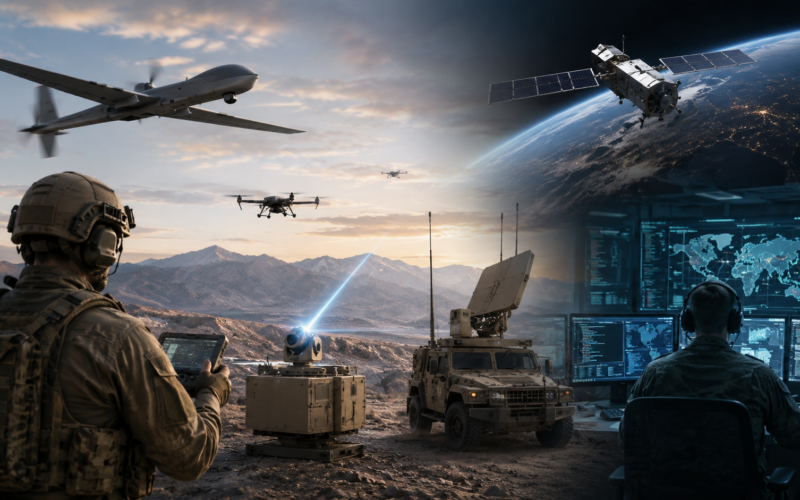
The strategic benefit lies in the combination of technologies. AeroVironment previously had strong positions in small unmanned aircraft and Switchblade loitering munitions. BlueHalo added counter-drone systems, electronic warfare, cyber capabilities, space communications and directed-energy weapons.
The expanded portfolio allows AeroVironment to compete for integrated programmes rather than individual products. A military customer seeking reconnaissance drones, precision strike, counter-UAS detection, command software and electronic defence can now purchase more of that architecture from one contractor.
That opportunity also increases management complexity. AeroVironment must combine engineering teams, contract systems, financial controls, manufacturing sites and customer relationships across businesses that were previously separate.
The revenue contribution proves the acquired assets are economically substantial. Fiscal 2027 will test whether AeroVironment can create organic growth and cross-selling rather than simply reporting another year of acquisition-supported scale.
What does AeroVironment’s negative fourth-quarter service margin reveal about execution risk?
Fourth-quarter gross profit increased 102% to $202.6 million, but gross margin declined to 31.6% from 36.5%. The direction of the margin movement is more important than the absolute increase in gross profit.
Product sales generated $211.8 million of quarterly gross profit on revenue of $499 million, representing a healthy product gross margin of approximately 42.4%.
Contract services recorded a gross loss of $9.2 million on revenue of $142.7 million. That implies a negative service gross margin of approximately 6.4%.
A negative service margin means the company spent more delivering those services than it recognised in associated revenue during the quarter. Purchase accounting contributed to the result, but programme mix and execution also matter.
Service contracts can carry lower margins than product deliveries, particularly when they involve development work, engineering labour, testing or cost structures that have not yet reached stable production scale. They may still lead to valuable product orders, but investors need evidence that losses are temporary rather than structural.
The full-year picture was less severe but still showed pressure. Service gross margin was approximately 7.9% for fiscal 2026, compared with about 23.7% in the previous year.
Product gross margin also declined, moving from approximately 41.6% to 32.2% for the full year. Acquired programme mix, amortisation and scaling costs reduced profitability across both revenue categories.
AeroVironment’s gross margin for the full year fell to approximately 25.3% from 38.8%. The company generated more gross profit in absolute dollars, but revenue expanded much faster than gross profit.
Fiscal 2027 guidance implies that management expects margin improvement at the adjusted EBITDA level. Reaching that goal will require better service economics, disciplined pricing, supply-chain control and stronger utilisation of the enlarged operating base.
Does AeroVironment’s $2.7 billion bookings total support the fiscal 2027 revenue outlook?
AeroVironment recorded $2.7 billion in bookings during fiscal 2026, producing a book-to-bill ratio of 1.4. A ratio above one indicates that new orders exceeded revenue recognised during the year.
Funded backlog reached $1.2 billion at April 30, compared with $726.6 million one year earlier. The latest backlog equals approximately 61% of fiscal 2026 revenue and provides a meaningful base for the next financial year.
Funded backlog is particularly valuable because it represents contract value supported by appropriated customer funding. It is more reliable than a broader opportunity pipeline or an unfunded contract ceiling.
The backlog does not cover the entire fiscal 2027 revenue target. AeroVironment must still convert additional orders, exercise contract options and complete expected awards during the year.
Management expects fiscal 2027 revenue of $2.125 billion to $2.225 billion. The midpoint of $2.175 billion implies growth of approximately 10% from fiscal 2026.
That represents a major slowdown from the 141% increase reported in fiscal 2026, which is unsurprising because the company will now compare against a full year containing BlueHalo revenue.
The more relevant test will be whether AeroVironment can deliver double-digit growth after normalising for acquisitions. Success would indicate that the enlarged business is benefiting from genuine market demand rather than merely a changed consolidation perimeter.
The newly awarded $500 million U.S. Army counter-drone contract could create another source of orders through June 2029, but the figure is a contract ceiling rather than funded backlog. Revenue will emerge only as the Army places specific orders.
Investors should therefore focus on funded backlog progression and quarterly bookings. Contract ceilings attract attention, but funded task orders pay suppliers.
Can AeroVironment improve earnings and cash flow while continuing to invest in defence growth?
Fiscal 2027 guidance calls for net income of $8 million to $24 million, which would represent a return to GAAP profitability after the fiscal 2026 loss.
Adjusted EBITDA is expected to reach $305 million to $325 million. At the midpoint, the implied adjusted EBITDA margin is approximately 14.5%, broadly unchanged from fiscal 2026.
This suggests that management expects additional revenue and adjusted profit but is not yet forecasting a major margin expansion. The guidance reflects a business still absorbing acquisitions, investing in capacity and carrying substantial amortisation.
Adjusted earnings guidance of $3.02 to $3.34 per diluted share is below fiscal 2026 adjusted earnings of $3.31 at the midpoint. This was one of the more cautious elements of the outlook.
The expected decline is partly influenced by the enlarged share count. AeroVironment had approximately 50.6 million shares outstanding at April 30, up from 28.3 million one year earlier.
The BlueHalo transaction and subsequent equity financing substantially diluted existing shareholders. Investors now own a smaller percentage of a much larger business.
Cash conversion also requires attention. AeroVironment used $78.4 million of cash in operating activities during fiscal 2026, compared with a modest $1.3 million outflow in the previous year.
Working capital expanded alongside revenue and acquisitions. Accounts receivable, unbilled receivables and inventory all increased materially, reflecting the larger operating base and the timing of government contract payments.
Capital expenditure rose to $62.5 million from $19.5 million. That investment can support production growth, but it added to cash consumption during the year.
The company ended April with $377.3 million of cash and $255 million of short-term investments. Long-term debt stood at $729 million, leaving AeroVironment with approximately $97 million of net debt after including short-term investments.
The balance sheet is therefore not distressed, but it has become more leveraged and acquisition-heavy. Goodwill and intangible assets totalled approximately $3.42 billion, representing close to 60% of total assets.
Those assets reflect the strategic value paid for BlueHalo and other acquisitions. They also increase the risk of further impairments if programmes underperform or anticipated revenue fails to materialise.
Why did AeroVironment stock rebound nearly 40% despite conservative earnings guidance?
AeroVironment shares closed at $136.68 on June 25, near the bottom of the company’s 52-week range. The stock then advanced to $190.89 by July 2, producing a five-session gain of approximately 39.7%.
The largest move came on June 30, the first trading session after the earnings release, when the stock gained 18.8%. Shares rose another 4.5% on July 1 and 10.7% on July 2.
The rebound reflected several factors. Fourth-quarter revenue and adjusted earnings exceeded market expectations, funded backlog reached a record level and the company presented fiscal 2027 guidance that confirmed continued revenue growth.
The separate $500 million U.S. Army counter-drone contract also strengthened sentiment by providing evidence that AeroVironment’s broader portfolio can win large procurement vehicles.
The rally should be understood in the context of the preceding decline. Even after reaching $190.89, the stock remained approximately 54% below its 52-week high of $417.86.
AeroVironment was only about 41% above its 52-week low of $135.20. The latest rally therefore recovered part of a substantial valuation collapse rather than taking the stock into uncharted territory.
The shares were approximately flat across the preceding four-week period despite the dramatic five-day move. This illustrates how quickly defence technology sentiment had deteriorated before the earnings rebound.
Analyst reactions remained broadly constructive but reflected wide disagreement over fair value. Updated price targets around the earnings period ranged from the mid-$100s to above $300, showing that forecasts depend heavily on margin recovery and contract conversion assumptions.
At approximately $9.5 billion of market capitalisation, AeroVironment was valued at roughly 4.4 times the midpoint of fiscal 2027 revenue guidance. The valuation remains demanding for a company guiding to low double-digit growth and modest GAAP earnings.
Investors are paying for strategic positioning in autonomous weapons, counter-drone technology, space systems and electronic warfare. AeroVironment must show that those markets produce durable cash flows, not merely impressive addressable-market slides.
How does AeroVironment’s expanded portfolio strengthen its competitive defence position?
AeroVironment now operates through two principal segments. Autonomous Systems generated $492.4 million of fourth-quarter revenue, while Space, Cyber and Directed Energy contributed $149.2 million.
Autonomous Systems remains the larger earnings engine. It includes unmanned aircraft, loitering munitions, ground systems and other autonomous platforms.
The Space, Cyber and Directed Energy business provides access to programmes involving satellite communications, laser weapons, counter-UAS, electronic warfare and classified technologies.
The combined portfolio gives AeroVironment exposure to several of the fastest-growing defence procurement priorities. Military customers are increasing spending on inexpensive autonomous systems, layered counter-drone protection and resilient space communications.
The company’s size also places it in a useful competitive middle ground. AeroVironment is larger and more experienced than many defence startups but remains more focused on emerging technologies than diversified primes such as Lockheed Martin Corporation or RTX Corporation.
That position can make AeroVironment an attractive acquisition partner, subsystem provider or prime contractor for specialised programmes.
However, the company increasingly competes with much larger organisations that possess deeper balance sheets, established lobbying networks and long-standing positions on major weapons platforms.
AeroVironment must defend its advantage through speed, product performance and manufacturing responsiveness. Becoming a larger contractor should not result in the slower decision-making that smaller defence technology companies often criticise.
International demand could provide another growth engine. Conflicts have increased awareness of loitering munitions, drones and counter-drone systems across NATO, Europe, the Middle East and the Indo-Pacific.
Export growth carries approval, security and customer-financing risks. AeroVironment will need to expand production while complying with U.S. export controls and protecting sensitive technologies.
What risks could undermine AeroVironment’s fiscal 2027 defence growth strategy?
Programme concentration remains a major risk. Large defence awards can create rapid growth, but stop-work orders, budget changes or procurement delays can remove expected revenue with little notice.
The SCAR programme demonstrated that exposure clearly. Changes affecting one space programme contributed to a major goodwill impairment and intensified concerns about the quality of the acquired portfolio.
U.S. government funding is another variable. Continuing resolutions, shutdowns and changing military priorities can delay contract awards or prevent unfunded ceilings from converting into orders.
Supply-chain capacity could also limit growth. AeroVironment needs electronic components, propulsion systems, optics, batteries, radio-frequency equipment and specialised materials across its product range.
Rapid scaling can increase inventory and receivables faster than cash collections. Fiscal 2026 operating cash outflow shows that revenue growth does not automatically translate into liquidity.
Integration remains the central corporate risk. AeroVironment must retain acquired employees, align business systems and remove duplicated costs without weakening the innovation culture that made BlueHalo attractive.
Margins will determine whether the acquisition creates shareholder value. A company can double revenue and still disappoint investors if cost growth absorbs the additional gross profit.
Valuation risk is equally important. The stock’s rebound indicates that expectations have recovered quickly. Any future revenue miss, programme delay or margin disappointment could produce another sharp correction.
The defence market is supportive, but it is not forgiving. Government customers demand delivery, investors demand cash flow and neither group is especially moved by explanations involving integration complexity.
What should AeroVironment investors watch during fiscal 2027 after the BlueHalo transformation?
The first measure will be organic revenue growth. AeroVironment needs to demonstrate that the legacy business and acquired operations can expand without another large acquisition.
The second measure will be gross margin, particularly within contract services. A return to positive and improving service margins would support the argument that fourth-quarter weakness was temporary.
The third measure will be operating cash flow. Investors should look for working-capital stabilisation and evidence that funded backlog converts into customer payments.
The fourth measure will be bookings and funded backlog. AeroVironment must replace recognised revenue with new orders to sustain its growth trajectory beyond fiscal 2027.
The fifth measure will be progress on major programmes, including counter-UAS, space communications and loitering munitions. Task orders under the $500 million Army contract would provide a visible catalyst.
Investors should also monitor share dilution and capital allocation. The company has sufficient strategic opportunities without needing another transformative acquisition immediately.
Fiscal 2026 proved that AeroVironment can become a much larger defence contractor. Fiscal 2027 must prove that the enlarged company can become a consistently profitable and cash-generative one.
Key takeaways on AeroVironment’s fiscal 2026 results and $AVAV outlook
- AeroVironment’s fiscal 2026 revenue increased 141% to a record $1.98 billion after the BlueHalo acquisition transformed the company’s scale and portfolio.
- Acquisitions contributed $282.3 million, or approximately 44%, of fourth-quarter revenue, showing that purchased growth remained a major factor.
- Full-year adjusted EBITDA almost doubled to $286.1 million, but the adjusted EBITDA margin declined to approximately 14.5%.
- GAAP results included a $240.7 million goodwill impairment, contributing to a net loss of $265.1 million.
- Fourth-quarter service gross margin turned negative, highlighting integration, programme-mix and contract-execution risks.
- Fiscal 2026 bookings of $2.7 billion and funded backlog of $1.2 billion provide meaningful visibility into the next financial year.
- Fiscal 2027 revenue guidance implies growth of roughly 7.5% to 12.6%, far below fiscal 2026 growth as acquisition comparisons normalise.
- AeroVironment expects to return to GAAP profitability, but adjusted earnings guidance remains cautious and does not imply immediate margin expansion.
- AVAV shares gained almost 40% over five sessions but remained approximately 54% below their 52-week high.
- The central fiscal 2027 test will be whether AeroVironment can convert defence demand and backlog into stronger margins, operating cash flow and sustainable organic growth.
Discover more from Business-News-Today.com
Subscribe to get the latest posts sent to your email.


