AeroVironment, Inc. (NASDAQ: AVAV) has received a US$51 million U.S. Army delivery order for additional Switchblade 600 Block 2 loitering munitions, providing a follow-on procurement for a next-generation weapons system that received its first major Army order only six months earlier. The award also includes Switchblade 600 Block 1 systems for a Foreign Military Sale to an unidentified U.S. ally.
The new order sits under the Army’s existing five-year, US$990 million Indefinite Delivery, Indefinite Quantity contract for Lethal Unmanned Systems awarded in August 2024. Its US$51 million value equals approximately 5.2% of that contract ceiling, but the more important signal is repeat procurement rather than the percentage itself.
In February, the Army awarded AeroVironment US$186 million for Switchblade 600 Block 2 and Switchblade 300 Block 20 systems. The two publicly disclosed 2026 delivery orders therefore total US$237 million, although they cover different mixes of Switchblade products and should not be interpreted as a complete accounting of capacity remaining under the wider IDIQ.
Why is a $51m follow-on Switchblade order more important than a first-time procurement?
Initial defence orders can represent experimentation, urgent operational requirements or limited introduction of a new system.
Repeat orders provide a different type of evidence.
The February US$186 million procurement was the Army’s first order for AeroVironment’s next-generation Switchblade product line, including the Block 2 version of Switchblade 600. The August award follows after that initial commitment and specifically calls for additional Block 2 systems.
That progression suggests Switchblade 600 is moving further from developmental adoption toward an established procurement programme.
AeroVironment says Switchblade 600 has been fielded across more than 20 brigade combat teams since 2025 and that hundreds of U.S. soldiers have been trained to operate and employ the system.
Fielding across multiple brigades creates potential for recurring demand that extends beyond initial weapon procurement. Training, replenishment, upgrades, spares and future variants can all become part of the lifecycle of a widely deployed weapons system.
The company has not disclosed how many munitions are included in the US$51 million order, so a unit price cannot be calculated reliably.
That prevents a precise comparison of quantity with the February award, but it does not change the direction of procurement: the Army has returned for more systems.
How does the $51m award fit inside the Army’s $990m Lethal Unmanned Systems contract?
The US$990 million IDIQ establishes a maximum contract framework rather than a guaranteed payment to AeroVironment.
Individual delivery orders convert portions of that ceiling into funded work as the Army defines quantities, product configurations and delivery schedules.
The latest US$51 million award therefore has materially greater financial certainty than the unused portion of the headline US$990 million contract ceiling.
AeroVironment also received approximately US$55 million of initial Switchblade-related work under the broader contract structure in 2024, supporting the U.S. Army and Foreign Military Sales customers including Lithuania, Romania and Sweden.
The February 2026 order then represented a major step upward at US$186 million and introduced the newer Switchblade 600 Block 2 and Switchblade 300 Block 20 configurations into Army procurement.
The August US$51 million follow-on adds another layer without exhausting the five-year framework.
That is one advantage of an IDIQ for AeroVironment. Once the contractual vehicle exists, the Army can place subsequent orders without negotiating an entirely new procurement framework each time.
The commercial opportunity therefore depends on how frequently customers convert the ceiling into actual delivery orders.
What is different about Switchblade 600 Block 2?
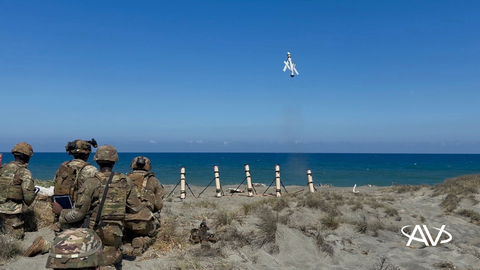
Switchblade 600 is a long-range loitering munition designed to give ground units precision-strike capability against high-value and armoured targets without requiring a crewed aircraft or conventional artillery system to remain exposed near the target.
AeroVironment describes Block 2 as a next-generation configuration with upgrades to autonomy, resilience and lethality for contested multi-domain operations. The system is also ruggedized for maritime and other demanding operational environments.
The February procurement was significant because it represented the Army’s first purchase of the next-generation Switchblade line and included an explosively formed penetrator payload designed to improve effectiveness against armour.
That differentiates the system from lighter loitering munitions primarily intended for personnel or less protected targets.
The Army can consequently use the Switchblade family across different tactical requirements, from portable systems operated at small-unit level to longer-range munitions capable of engaging more heavily protected targets.
AeroVironment’s commercial advantage is not merely that it sells a drone. It supplies an integrated precision weapon with launch, command, sensor and munition technology that already has an established operational base.
Why does the Foreign Military Sale component matter?
The August order includes Switchblade 600 Block 1 systems for an unidentified U.S. ally.
AeroVironment has not disclosed the customer or the value attributable specifically to the Foreign Military Sale, meaning the entire US$51 million should not be assumed to represent direct U.S. Army consumption.
That distinction is commercially positive in another respect.
The U.S. procurement structure provides AeroVironment with access to allied demand through the Foreign Military Sales process, allowing countries to obtain a system already supported within the U.S. defence procurement framework.
Previous Switchblade awards have included allied customers such as Lithuania, Romania and Sweden, while other countries have publicly pursued Switchblade capabilities.
International adoption can expand production volumes and diversify demand beyond the U.S. defence budget.
It can also strengthen interoperability among allied forces using similar systems, potentially increasing the attractiveness of common training, software and logistics.
The current release does not identify the ally, so any attempt to infer the customer would go beyond the disclosed facts.
Can AeroVironment manufacture Switchblade quickly enough if repeat orders accelerate?
Manufacturing capacity is increasingly part of the investment story.
AeroVironment explicitly linked the latest order to expansion of its Switchblade production capacity and efforts to shorten delivery schedules.
That becomes more important as orders move from relatively small operational quantities toward broader fielding.
Weapons such as loitering munitions are consumable by design. Unlike reconnaissance aircraft that may remain in service for years, a Switchblade used in combat does not return for another mission.
Large inventories therefore require continuous manufacturing, while active operations can create replenishment demand.
AeroVironment’s challenge is to increase production without compromising reliability or building excess fixed capacity that becomes underutilized if procurement slows.
The company is simultaneously expanding across autonomous aircraft, counter-UAS systems, space, cyber and other defence technologies, making capital allocation across manufacturing programmes increasingly important.
How significant is $51m for AeroVironment financially?
The latest order is material but not transformative on its own for a company that has grown rapidly through both organic demand and acquisitions.
Its significance becomes clearer in combination with the US$186 million February order.
Those two disclosed 2026 Switchblade procurements total US$237 million, nearly one-quarter of the US$990 million maximum IDIQ ceiling. Again, that comparison does not mean exactly 24% of the contract has been consumed because the broader framework includes other delivery activity and configurations, but it demonstrates the scale of publicly announced procurement momentum this year.
The August award also arrives only days after AeroVironment announced a US$100 million investment in a new unified Southern California campus, part of a broader effort to expand manufacturing and engineering capacity.
That juxtaposition is strategically useful.
AeroVironment is investing significant capital before future orders are fully visible, while awards such as the new US$51 million procurement provide evidence that demand is continuing to materialize.
The best indicator will be not any single order but the cadence of follow-ons.
The Army’s first next-generation Switchblade procurement arrived in February. Six months later, another Block 2 order has followed, alongside an allied purchase.
That repeat behaviour is what turns a US$51 million announcement from a routine defence order into evidence that Switchblade 600 is becoming a more institutionalized part of U.S. and allied long-range precision-strike inventories.
Discover more from Business-News-Today.com
Subscribe to get the latest posts sent to your email.