




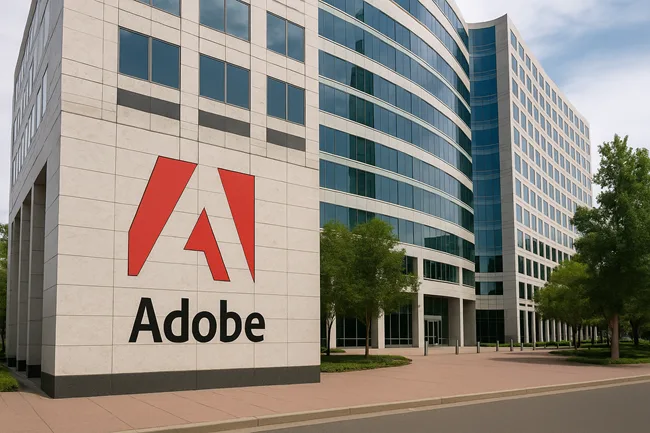
Adobe Inc. (NASDAQ: ADBE) closed out fiscal year 2025 with record financial results, reporting $23.77 billion in revenue and $10.03 billion in operating cash flow. The company also hit a new high in Annualized Recurring Revenue (ARR), ending the year at $25.20 billion, while recalibrating that base to $25.66 billion entering FY2026 due to favorable foreign exchange impacts. Looking ahead, Adobe is guiding for total revenue of up to $26.10 billion in fiscal year 2026, targeting over 10 percent growth in ARR and a strong expansion of AI-first offerings across its Creative Cloud, Document Cloud, and Experience Platform businesses.
Chief Executive Officer Shantanu Narayen stated that Adobe’s performance reflects the company’s central role in the global AI ecosystem. By blending proprietary generative AI capabilities with strong partner integrations, Adobe is positioning itself as an operating layer for creative productivity, marketing orchestration, and business documentation in the agentic web era.
How is Adobe turning AI-powered creativity into recurring revenue at scale?
Adobe’s execution in 2025 demonstrates how deeply generative and agentic AI have been integrated across its product stack. Its proprietary Firefly platform led the charge, now embedded in Photoshop, Illustrator, Premiere Pro, and Adobe Express. Firefly usage soared, with generative credit consumption tripling quarter over quarter, and first-time Firefly subscriptions doubling within the same period. Firefly Image 5 brought enhancements such as native 4-megapixel resolution and advanced prompt-based editing, further boosting uptake.
Adobe also differentiated its AI monetization strategy through Firefly Credit Add-ons, offering tiered usage that scales with demand. Different models and media types consume varying credit amounts, creating a pricing model that rewards high-value usage.
In parallel, Adobe introduced agentic capabilities by modularizing key application functions through its Model Context Protocol. This allows PDF editing, image enhancement, and creative workflows to be executed not only within Adobe apps, but across external conversational platforms like ChatGPT and Microsoft Copilot. Adobe’s long-term goal is to enable seamless intent-to-execution experiences—where content creation and modification can happen across any AI-driven interface, not just in native software environments.
Why is Adobe pivoting to ARR and customer group-based reporting from FY2026?
Beginning in fiscal year 2026, Adobe will shift its financial reporting framework to emphasize two metrics: subscription revenue by customer group and total company ARR growth. The previous Digital Media and Digital Experience segment metrics will remain available as supplemental disclosures, but strategic focus will now rest on the evolving consumption patterns of its two core customer blocks—Business Professionals & Consumers and Creative & Marketing Professionals.
In FY2025, the company posted $22.80 billion in customer group subscription revenue, reflecting 12 percent year-over-year growth. Creative & Marketing Professionals alone contributed $16.30 billion, while Business Professionals & Consumers added $6.50 billion. This structure aligns more directly with how Adobe sees generative AI expanding use cases across different customer categories. Subscription offerings are no longer strictly tied to legacy product lines, but increasingly blend AI agents, Firefly models, and creative orchestration capabilities across multiple application surfaces.
By centralizing its guidance around ARR and customer group revenue, Adobe is also making it easier for investors to track the expansion of its AI-influenced and AI-first monetization pathways.
What is Adobe’s strategy for enterprise AI adoption and digital experience orchestration?
The Digital Experience business continues to serve as Adobe’s enterprise front end for marketing and customer engagement workflows. In FY2025, the segment posted $5.86 billion in revenue, including $5.41 billion from subscriptions. The platform’s capabilities are anchored in Adobe Experience Platform (AEP), which processed over 35 trillion segment evaluations and 70 billion profile activations per day during the year.
Enterprise appetite for AI-enhanced marketing orchestration is accelerating. In 2025, Adobe released six new AEP-powered agents, enabling automation across campaign design, optimization, and audience targeting. Demand for AEP and native applications grew over 40 percent year over year, while the company added a record number of enterprise customers with more than $10 million in ARR.
Adobe also rolled out several flagship AI-first offerings in the fourth quarter. Adobe Brand Concierge enables brands to configure their own AI agents to guide consumer decisions through immersive and conversational experiences. This comes alongside Adobe LLM Optimizer and Sites Optimizer, which help companies adapt their content for visibility across large language model-driven search platforms.
GenStudio, Adobe’s enterprise-grade content supply chain solution, also saw strong momentum. It now spans everything from content ideation to activation, and its ARR grew over 25 percent in FY2025, supported by modular AI automation services such as Firefly Foundry and Firefly Services.
What does the Semrush acquisition reveal about Adobe’s competitive AI search strategy?
In November 2025, Adobe announced a $1.9 billion all-cash acquisition of Semrush Holdings. The deal is expected to close in the first half of FY2026, pending regulatory approval. Semrush brings robust capabilities in search engine optimization, keyword analytics, and more recently, generative engine optimization—a fast-growing area as brands look to optimize visibility in AI-powered discovery environments.
Adobe views the integration as complementary to its existing Experience Cloud stack, enabling marketers to shape how their brands are discovered across LLMs, voice assistants, and agentic browsers. The acquisition will also give Adobe deeper access to behavioral data, analytics, and traffic attribution insights that could be integrated into the AEP stack, boosting automation and personalization outcomes.
Importantly, Adobe expects the acquisition to have minimal non-GAAP EPS impact in the first year post-close and to become accretive thereafter. This suggests that the company is not only preserving its earnings trajectory, but actively investing in expanding its dominance in the AI marketing infrastructure space.
What guidance has Adobe provided for FY2026—and how are investors reacting?
Adobe has set ambitious but credible targets for FY2026, starting with total revenue guidance of $25.90 billion to $26.10 billion and a total ending ARR growth of 10.2 percent. This equates to approximately $2.6 billion in net new ARR, the highest beginning-of-year guide Adobe has ever issued.
Business Professionals & Consumers subscription revenue is expected to reach between $7.35 billion and $7.40 billion, while Creative & Marketing Professionals are forecasted to deliver $17.75 billion to $17.90 billion. On the bottom line, Adobe is projecting GAAP earnings per share between $17.90 and $18.10, with non-GAAP EPS guidance of $23.30 to $23.50.
For the first quarter of FY2026, Adobe has guided to revenue between $6.25 billion and $6.30 billion, with non-GAAP EPS between $5.85 and $5.90. The company is targeting a 47 percent non-GAAP operating margin, continuing to demonstrate disciplined cost control despite ongoing investments in product innovation and AI platform scale.
Investor sentiment appears broadly constructive. The company repurchased approximately 30.8 million shares in FY2025 and has $5.90 billion remaining under its current authorization. Its ability to scale margin, grow ARR, and invest in inorganic expansion through deals like Semrush, all while maintaining double-digit earnings growth, is likely to remain attractive to institutional shareholders focused on durable cash flows.
What are the key takeaways from Adobe’s FY2025 performance and FY2026 roadmap?
- Adobe achieved a record $23.77 billion in FY2025 revenue, with over $10 billion in operating cash flow and 11 percent ARR growth.
- The company exited FY2025 with $25.20 billion in ARR, and a revalued base of $25.66 billion heading into FY2026 due to currency tailwinds.
- Generative AI product adoption is accelerating, with Firefly, Express, and Acrobat AI leading credit-based monetization strategies across all customer groups.
- Adobe is restructuring its financial reporting to focus on customer group subscription revenue and total ARR growth, reflecting its platform transition to AI-first workflows.
- Enterprise adoption of Adobe Experience Platform and GenStudio is driving high-value ARR gains, with AEP-native application revenue growing over 40 percent year over year.
- Adobe’s $1.9 billion acquisition of Semrush Holdings signals a strategic push into AI-driven brand visibility and generative engine optimization.
- FY2026 guidance includes revenue of up to $26.10 billion, non-GAAP EPS of up to $23.50, and a 10.2 percent ARR growth target.
- Share buybacks continue, with over $11.9 billion returned to shareholders in FY2025 and a healthy authorization buffer remaining for FY2026.
Discover more from Business-News-Today.com
Subscribe to get the latest posts sent to your email.