ACWA Power Company (Tadawul: 2082) has moved one of Saudi Arabia’s most ambitious privately financed tourism infrastructure systems into commercial operation, beginning the 25-year concession for an approximately $1.84 billion off-grid utilities platform serving The Red Sea destination.
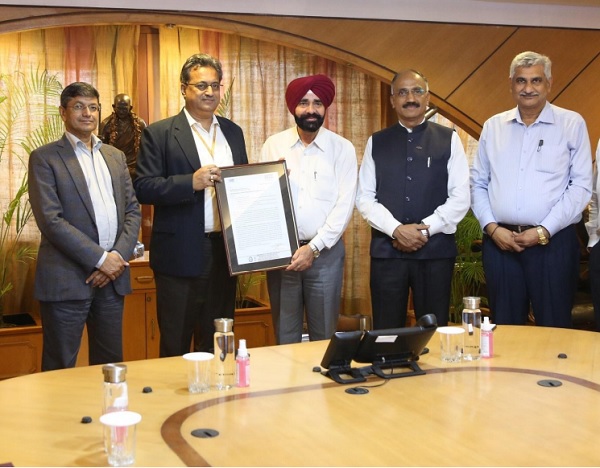
The Project Commercial Operation Date has been formally signed between Marafiq Red Sea for Energy Company, the project company led by ACWA Power alongside SPIC Huanghe Hydropower and Saudi Tabreed, and The Red Sea Utilities Company, a subsidiary of Red Sea Global.
Commercial operation represents a materially different milestone from construction completion of individual assets. The integrated system is now contractually operating across renewable electricity, potable water, wastewater treatment, district cooling and waste management, serving Red Sea Global’s operational hotels, Red Sea International Airport, logistics facilities, electric-vehicle fleet, staff village and other community infrastructure.
At the centre of the system are 340MWac of solar photovoltaic generation and 1,227MWh of battery energy storage, which ACWA Power describes as the world’s largest off-grid battery installation. Unlike a grid-connected renewable project that can draw electricity from a national network when solar production falls, The Red Sea has been structured to operate without a grid connection.
How was the $1.84 billion Red Sea utilities project financed before reaching operation?
The project reached financial close in 2022 with approximately $1.33 billion of senior debt from Saudi and international lenders against total investment of about $1.84 billion.
On a simple comparison of the disclosed figures, senior debt represented roughly 72% of total project investment. That calculation does not describe the precise final capital structure after construction adjustments, but it demonstrates how heavily the project relied on long-term project finance rather than equity funding alone.
That bankability matters because lenders were being asked to finance far more than a conventional solar farm.
The concession combines power generation, large-scale battery storage, desalinated water, wastewater, district cooling and waste services inside a tourism development that itself needed to ramp gradually. Debt providers therefore had to assess not merely renewable-resource risk but the broader operating and contractual framework supporting multiple utilities.
The Project Commercial Operation Date now shifts the risk profile.
Construction and commissioning risk fall materially once the full system is operational, while long-term availability, operating costs, maintenance and demand growth become increasingly important over the 25-year concession.
SEPCO III, through the Shandong Tiejun consortium, engineered and constructed the utilities platform, while ACWA Power Operations will provide long-term operation and maintenance aligned with the concession period.
Why are 340MW of solar and 1,227MWh of batteries important for an off-grid tourism destination?
The battery is not an optional balancing asset at The Red Sea. It is fundamental to the project architecture.
Solar generation is concentrated during daylight hours, while hotels, airport systems, cooling plants, water infrastructure and community facilities need electricity around the clock. Without access to Saudi Arabia’s national electricity grid, the development needs enough stored energy and system redundancy to keep essential services operating after sunset.
The disclosed battery capacity equates to about 3.6MWh of storage for every MWac of installed solar capacity. That ratio should not be interpreted as the battery’s discharge duration because ACWA Power has not disclosed the storage system’s maximum power output in the latest announcement, but it illustrates the unusually large energy-storage component relative to the solar plant.
The integrated approach also allows utilities to interact.
Water treatment, cooling and other infrastructure can potentially schedule some energy-intensive operations around renewable generation, while battery storage can support demand outside those periods. That is commercially different from operating each utility as a fully independent asset.
ACWA Power says the existing infrastructure has been sized for initial demand and can be expanded as additional phases of The Red Sea development become operational.
That scalability will matter because building the entire future utility requirement before hotels and other assets open would create underutilised capacity, while building too little would constrain the destination’s expansion.
Why does the 25-year concession matter more than the headline battery size?
Infrastructure investors earn returns from contracted cash flows over time, not from winning records for equipment size.
The Red Sea project gives the consortium a 25-year operating period covering several essential utilities. That potentially creates a long-duration revenue stream tied to services required regardless of day-to-day tourism trends, although exact tariff structures and project returns are not publicly detailed in the latest announcement.
This makes the commercial-operation certificate arguably more consequential than the original construction announcement.
A project under development consumes capital and carries schedule risk. An operating concession begins the phase in which the asset is expected to generate contractual cash flow and demonstrate whether engineering assumptions translate into actual availability and operating economics.
ACWA Power also says the completed system could avoid approximately 600,000 tonnes of carbon dioxide annually when operating at full capacity.
That is a company estimate rather than an independently measured historical reduction because the project has only now entered full commercial operation. Actual environmental performance will depend on utilisation, renewable output, storage cycling and the amount of conventional energy that would otherwise have been required.
The next evidence should therefore come from sustained operations rather than design specifications.
Did ACWA Power shares react when the Red Sea project reached commercial operation?
There was little evidence of a major market revaluation.
ACWA Power shares traded around SAR190.7 at the September 6 close, broadly flat from SAR190.8 on September 3 before the Saudi weekend. The stock was also only modestly below its August 31 close of SAR191.9.
That muted response is understandable.
The Red Sea project has been known for years, financed since 2022 and progressively commissioned as the destination developed. Reaching formal commercial operation materially lowers project execution risk, but it does not suddenly introduce the entire $1.84 billion investment into ACWA Power’s valuation.
The stock also remains inside a wide 52-week range of roughly SAR149 to SAR253, meaning company-level sentiment is being shaped by a much larger portfolio spanning renewable power, desalination, conventional generation, storage and green hydrogen.
For investors, the more interesting question is whether The Red Sea becomes a reference asset that helps ACWA Power win similar integrated off-grid utility concessions elsewhere.
Could The Red Sea become a replicable model for other large developments?
That may ultimately be the project’s most important commercial consequence.
Large tourism zones, mining operations, industrial developments and remote communities frequently need several utility services at the same time. Traditionally, those services can be tendered as separate power, water, cooling and waste contracts.
The Red Sea model packages them into a long-term integrated concession supported by renewable generation and storage.
Replicating that structure elsewhere would allow ACWA Power to compete for a larger share of infrastructure spending around each development rather than restricting itself to a power-generation asset.
It could also deepen customer relationships because replacing an operator responsible for electricity, water, cooling and waste is far more complicated than replacing a supplier responsible for one isolated service.
The challenge is complexity.
Integrated projects expose the operator to several technical systems simultaneously, and failure in one utility can affect the others. Expansion also needs to keep pace with destination growth without leaving expensive assets underused.
The September 6 milestone therefore closes one chapter and opens the more important one.
ACWA Power and its partners have finished building and commissioning an approximately $1.84 billion utilities platform large enough to run a major tourism destination without a grid connection. The next 25 years will determine whether the model is merely technologically impressive or commercially repeatable.
Discover more from Business-News-Today.com
Subscribe to get the latest posts sent to your email.