Accenture plc (NYSE: ACN) has invested in Aera Technology through Accenture Ventures, strengthening its position in the fast-emerging market for AI-enabled supply chain decision intelligence. The investment brings together Aera Technology’s agentic decision intelligence platform with Accenture’s supply chain consulting, technology implementation and enterprise AI capabilities. The move is strategically relevant because global companies are still struggling to move from fragmented planning systems to real-time, semi-autonomous decision-making across procurement, logistics, inventory, finance and operations. For Accenture, the deal also adds another layer to its broader reinvention strategy at a time when Accenture stock remains under pressure compared with its 52-week high, making execution in high-value AI services more important than ever.
Why is Accenture investing in Aera Technology for AI-enabled supply chain decision intelligence now?
Accenture’s investment in Aera Technology is not a conventional software partnership dressed up as an AI story. It is a move into one of the most operationally painful areas of enterprise transformation, where companies have invested heavily in planning tools, enterprise resource planning systems, data lakes and dashboards, but still rely on human teams to reconcile conflicting signals when disruption hits.
The timing matters because supply chains have moved from being back-office efficiency engines to board-level risk systems. Consumer goods companies face demand volatility. High-tech companies are navigating inventory cycles and component availability. Life sciences companies must manage regulated, time-sensitive distribution networks. Mining and oil and gas companies operate across capital-intensive, globally exposed supply chains where delays can quickly turn into cost inflation. Accenture’s decision to align with Aera Technology suggests that the next phase of supply chain AI will be judged less by how much data companies can collect and more by how quickly they can convert that data into trusted action.
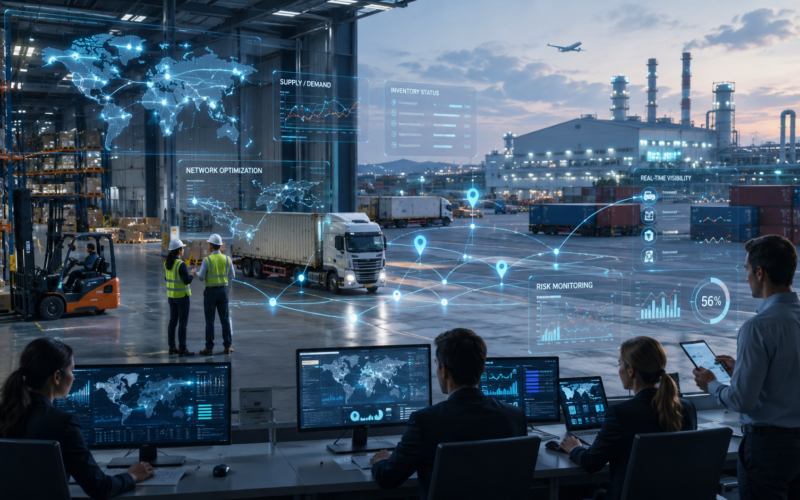
Aera Technology’s platform sits in the decision layer rather than merely the analytics layer. The company’s technology combines AI agents, a decision data model and real-time orchestration engines that can monitor business conditions, recommend actions, execute decisions and learn from outcomes. That distinction is important. Enterprises have no shortage of alerts. The harder problem is determining which alert matters, which department owns the response, what trade-off is acceptable and whether the system can act without creating a bigger mess elsewhere. In enterprise AI terms, this is where the fun ends and governance begins.

How could Aera Technology strengthen Accenture’s enterprise AI and supply chain consulting model?
For Accenture, Aera Technology expands the firm’s ability to sell supply chain transformation as an operating model change rather than a one-time technology implementation. Consulting firms have long helped clients redesign supply chain networks, select planning platforms, integrate enterprise systems and improve working capital efficiency. Agentic decision intelligence potentially pushes that model deeper into continuous operations, where Accenture can help clients configure, govern and scale AI-led decision workflows over time.
That is strategically attractive because autonomous supply chain adoption is still early. Accenture’s own research cited in the announcement indicates that while a quarter of surveyed companies have begun moving toward autonomy, median maturity across supply chain activities remains only 16 percent on a scale where 100 percent represents full autonomy. That gap creates a large advisory and implementation opportunity. It also creates a credibility test. Companies will not hand over pricing, inventory allocation, procurement or production decisions to AI agents simply because a slide deck says “autonomous.”
The commercial opportunity for Accenture lies in building the human oversight, auditability and cross-functional governance needed to make decision automation acceptable inside large enterprises. Aera Technology brings the decision intelligence engine. Accenture brings the systems integration muscle, industry domain knowledge and change management capacity required to embed that engine into complex global companies. That combination could be useful in sectors where decision latency is expensive, but blind automation is even more dangerous.
What does The Hershey Company’s involvement signal about real-world supply chain AI adoption?
The Hershey Company’s role in the announcement gives the investment more weight than a typical venture partnership. The confectionery and snacks business is highly exposed to demand swings, seasonal planning, commodity cost pressure, retail channel complexity and logistics disruption. If AI-enabled decision-making can help identify potential supply chain problems before they occur, as The Hershey Company indicated, the value proposition becomes practical rather than theoretical.
The involvement of a major consumer goods company also shows where early adoption may be strongest. Consumer goods supply chains are decision-heavy environments. Companies must constantly balance service levels, cost-to-serve, promotions, inventory availability, production capacity and customer commitments. These are not abstract optimization problems. They affect shelf availability, margin protection and retailer relationships.
However, the Hershey example also underlines the implementation challenge. AI-enabled decision-making must work across messy enterprise realities, including imperfect master data, legacy planning tools, human overrides, supplier constraints and changing commercial priorities. The more decisions a system recommends or executes, the more important it becomes to know why the system acted, what assumptions it used and when humans should intervene. Aera Technology’s pitch around transparency and learning from outcomes is therefore not a nice extra. It is central to whether enterprises will trust the model.
Why does agentic decision intelligence matter for global supply chains beyond simple automation?
Agentic decision intelligence matters because supply chain disruption is rarely caused by one isolated variable. A weather event, port delay, supplier shortfall, commodity price move or demand spike can quickly cascade across procurement, manufacturing, logistics, customer service and finance. Traditional systems often identify parts of the problem, but humans still have to stitch together the response across departments that may each optimize for different targets.
The promise of agentic decision intelligence is that AI agents can continuously monitor changes, evaluate trade-offs and trigger actions across enterprise workflows. In theory, that could reduce manual firefighting and improve response speed. In practice, it could also force companies to clarify how decisions are made, who owns exceptions and which objectives matter most when trade-offs collide. That may be the hidden value of this category. It does not just automate decisions. It exposes weak decision architecture.
For Accenture’s clients, the potential upside is resilience, lower cost-to-serve and better service reliability. For Accenture, the opportunity is to position itself as a bridge between enterprise AI ambition and operational execution. Many companies already know they need AI in supply chain. Far fewer know how to redesign decision rights, governance and workflows so AI can act without turning operations into a very expensive science experiment with dashboards.
How should investors read Accenture stock sentiment after the Aera Technology investment?
Accenture stock context matters because the market is currently separating credible AI monetization from broad AI messaging. Accenture Class A shares closed around $179.24 on May 22, 2026, after a gain during the session, but the stock remains well below its 52-week high of more than $320. That gap reflects broader investor caution around consulting demand, discretionary technology spending and the pace at which AI-driven services can offset pressure in traditional transformation budgets.
The Aera Technology investment is unlikely to move Accenture stock on its own, especially because financial terms were not disclosed. Investors will care less about the size of this specific investment and more about whether it helps Accenture convert AI demand into repeatable, high-margin enterprise programs. Supply chain decision intelligence fits that test better than many generic AI announcements because it is tied to measurable business outcomes such as inventory reduction, service-level improvement, working capital efficiency and cost-to-serve optimization.
A neutral reading suggests that the investment is strategically sound but not automatically valuation-changing. The upside case is that Accenture can use Aera Technology to deepen client relationships in industries where supply chain complexity is a recurring budget priority. The risk is that adoption cycles remain slow because autonomous decision-making requires data readiness, organizational trust and governance maturity. In other words, the story is promising, but the spreadsheet will still ask for proof.
What could this investment mean for competitors in consulting, enterprise software and supply chain technology?
Accenture’s investment raises the competitive bar for consulting peers and enterprise software vendors. Large technology services firms such as International Business Machines Corporation, Cognizant Technology Solutions Corporation, Tata Consultancy Services Limited, Infosys Limited and Capgemini SE are all trying to frame AI as an enterprise transformation engine rather than a productivity add-on. Supply chain is one of the most credible battlegrounds because it offers visible pain points, cross-functional complexity and clear return-on-investment metrics.
Enterprise software vendors may also face pressure if decision intelligence platforms become the active layer above existing planning and transaction systems. Companies have invested heavily in enterprise resource planning, supply chain planning and analytics platforms. Aera Technology’s model does not necessarily replace those systems. It could sit across them, turning fragmented signals into orchestrated decisions. That makes the category strategically interesting because control of the decision layer can influence which systems become central and which become background plumbing.
For Accenture, the risk is partner complexity. The company works across major cloud, enterprise software and AI ecosystems. Adding a decision intelligence platform into client environments requires careful positioning so it complements existing investments rather than creating another integration layer. Clients will not welcome “one more platform” unless it reduces decision friction. The pitch has to be brutally practical: fewer manual escalations, faster response times, better outcomes and governance that auditors can live with.
Can Accenture and Aera Technology turn autonomous supply chains into a scalable enterprise model?
The success of the Accenture and Aera Technology collaboration will depend on whether autonomous supply chain decision-making can move from isolated use cases into scalable operating models. Early wins may come from areas such as demand-supply balancing, inventory reallocation, procurement exceptions, logistics rerouting and service-level protection. These are domains where delays are costly and decision patterns repeat often enough for AI systems to learn.
The harder challenge is scaling across business units, geographies and functions. A supply chain decision is rarely only a supply chain decision. It can affect revenue recognition, customer commitments, production schedules, supplier negotiations and cash flow. That means implementation must include finance, commercial teams, operations leaders, compliance functions and information technology teams. Accenture’s role could be decisive here because agentic AI adoption is as much an organizational redesign problem as a software deployment problem.
The broader industry signal is clear. The next phase of supply chain digitization is moving beyond visibility. Visibility tells companies what is happening. Decision intelligence tells them what to do next. Autonomous execution determines whether the system can act fast enough to matter. Accenture’s investment in Aera Technology is a bet that enterprises are ready to move along that curve, but only if automation remains explainable, governed and tied to measurable business value.
Key takeaways on Accenture’s Aera Technology investment and the future of AI-enabled supply chains
- Accenture’s investment in Aera Technology strengthens its position in agentic AI for supply chain decision intelligence, a category that targets real-time enterprise actions rather than passive analytics.
- The partnership is strategically relevant because many global companies still operate supply chains through fragmented tools, manual handoffs and slow cross-functional decision cycles.
- Aera Technology gives Accenture a stronger decision-layer capability across supply chain, procurement, finance and operations workflows.
- The Hershey Company’s involvement suggests that practical enterprise adoption is already emerging in consumer goods, where volatility, service levels and cost-to-serve pressures are constant.
- For Accenture, the investment supports a higher-value consulting model built around continuous AI-enabled operations rather than one-off technology implementation.
- For clients, the main value proposition is faster decision-making under human oversight, especially in sectors exposed to demand swings, logistics disruption and supplier risk.
- The main execution risk is organizational trust, because enterprises will require transparency, governance and auditability before allowing AI agents to execute important decisions.
- Accenture stock remains well below its 52-week high, so investors may view the deal as strategically positive but still dependent on broader proof of AI monetization.
- Competitors in consulting and enterprise software may need to respond with stronger decision intelligence capabilities as AI shifts from insight generation to operational execution.
- The larger market signal is that supply chain AI is moving from visibility and dashboards toward autonomous decision orchestration, where the winners may be those who can combine software, governance and industry execution.
Discover more from Business-News-Today.com
Subscribe to get the latest posts sent to your email.