

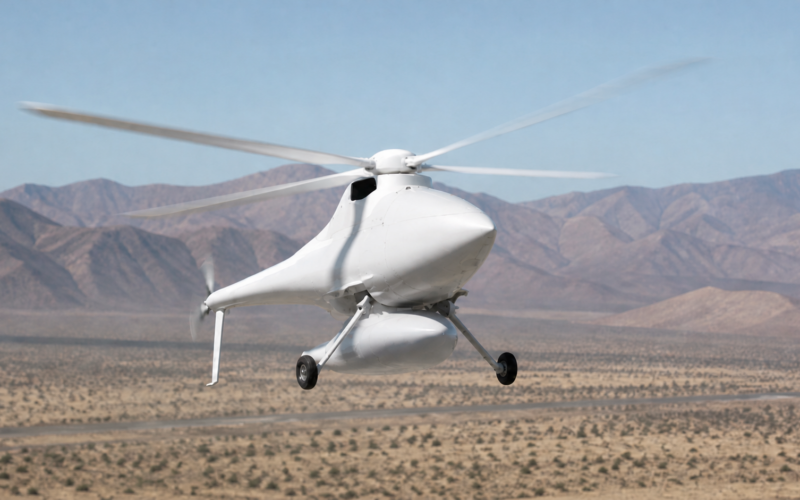
The A160 Hummingbird unmanned rotorcraft remains one of the most technically ambitious vertical lift programs ever undertaken in the United States, and one of the most consequential failures. Conceived by rotorcraft designer Abe Karem at Frontier Systems in the late 1990s and later acquired by Boeing, the A160 Hummingbird was built around a single bet that conventional helicopter aerodynamics could be replaced by a variable-speed rotor capable of adjusting its revolutions per minute in flight. That bet produced an unmanned helicopter that demonstrated record-breaking endurance and altitude. It also produced a program that the United States Army terminated in 2012 before a single unit reached operational deployment. More than a decade later, the lessons of the A160 Hummingbird continue to shape how Boeing, Bell, and Sikorsky approach autonomous rotorcraft design, including the Collaborative Transformational Rotorcraft concept Boeing unveiled at AUSA 2025.
What was the A160 Hummingbird and why did it matter?
The A160 Hummingbird, carrying the United States military designation YMQ-18A, was an autonomous unmanned aerial vehicle helicopter designed for persistent intelligence, surveillance, reconnaissance, target acquisition, communications relay, and precision resupply missions. It was 35 feet long with a 36-foot rotor diameter and a gross weight of roughly 2,500 pounds. Its strategic importance lay in the performance envelope it promised. Conventional military helicopters typically operate at fixed rotor speeds and ceilings around 20,000 feet with endurance measured in single-digit hours. The A160 Hummingbird was designed to fly at altitudes up to 30,000 feet, hover out of ground effect at 15,000 feet, carry payloads of up to 2,500 pounds, and remain airborne for up to 20 hours without refueling. The A160 rotor included blades whose stiffness and cross-section varied along their length, with a low-loading rigid hingeless design that allowed rotor RPM to change between 140 and 350 using a two-speed transmission. This technique, called optimum speed rotor technology, was invented by Abe Karem. The premise was that a helicopter operating at the most efficient rotor speed for any given altitude, weight, and airspeed would fly farther, hover higher, and burn less fuel than any rotorcraft built around fixed-speed assumptions.
Within the broader unmanned aerial vehicle landscape of the 2000s, the A160 Hummingbird occupied a unique position. Fixed-wing platforms such as the General Atomics Predator delivered long endurance but required runways and could not hover. Conventional unmanned helicopters such as the Northrop Grumman MQ-8 Fire Scout offered vertical takeoff and landing but with endurance and altitude limitations typical of helicopter aerodynamics. The A160 Hummingbird was positioned to bridge that gap by combining rotorcraft flexibility with fixed-wing-class endurance. That positioning is why DARPA, the United States Army, the United States Navy, the United States Special Operations Command, and the United States Marine Corps all funded or evaluated the platform across more than a decade.

Who operated the A160 Hummingbird program and what was the ownership structure?
The A160 Hummingbird program passed through three principal organizational stages. Development of the Hummingbird was initiated for DARPA by Frontier Aircraft in 1998. From 2003, both the United States Army and the United States Navy shared in funding the project. In May 2004, Frontier Systems was acquired by Boeing and integrated into Boeing Phantom Works, and later into the Advanced Systems group of Boeing Integrated Defense Systems. Boeing’s acquisition of Frontier Systems gave it exclusive rights to use the optimum speed rotor technology in unmanned aerial vehicles, a critical intellectual property position that the company has continued to retain.
Funding responsibility rotated across multiple United States Department of Defense customers as the program matured. The Defense Advanced Research Projects Agency, known as DARPA, served as the original sponsor and remained involved for more than a decade. The United States Army Aviation Applied Technology Directorate became a co-sponsor, the United States Naval Air Systems Command, known as NAVAIR, contracted directly for production air vehicles, and the United States Special Operations Command, known as SOCOM, took delivery of seven prototypes for evaluation. The United States Marine Corps Warfighting Laboratory ran the Immediate Cargo Unmanned Aerial System demonstration that pitted the A160 Hummingbird against the Kaman K-MAX. The Department of Homeland Security and several unnamed foreign entities also expressed interest.
This dispersed sponsorship pattern is itself a key part of the A160 Hummingbird story. No single service ever assumed the program of record responsibility that would have moved the platform from technology demonstrator to fielded capability. When the United States Army declined to take responsibility for the program in 2003, DARPA retained it. That pattern repeated in 2011 and 2012 with the Navy and the Marine Corps, ultimately leaving the A160 Hummingbird without an institutional home capable of carrying it through operational fielding.
What was the production profile and capacity evolution of the A160 Hummingbird?
A160 Hummingbird production proceeded in distinct technical phases tied to powerplant evolution. The first prototype flew in January 2002 powered by a four-cylinder Subaru automotive engine. Boeing built four four-cylinder engine-powered examples, one of which was later converted into a six-cylinder configuration. Three six-cylinder A160s were then constructed, with a planned total of 12 turboshaft-powered units following. The transition from automotive piston engines to the Pratt and Whitney Canada PW207D turboshaft engine in 2007 marked the boundary between the A160 demonstrator and the A160T production-intent variant. The turboshaft conversion delivered the higher altitude ceilings and longer endurance figures that defined the program’s most quoted specifications.
Performance milestones during the A160T flight test campaign were significant. On May 9, 2008, at Yuma Proving Ground in Arizona, the A160T demonstrated its ability to hover out of ground effect at 15,000 feet to meet its DARPA milestone, then surpassed it during the same flight by repeating the manoeuvre at 20,000 feet altitude. A week later, starting the night of May 14, the A160T demonstrated its un-refueled endurance capabilities with an 18.7-hour flight, landing with over 90 minutes of fuel still on board. This was recognised as the longest un-refueled flight of any rotorcraft, and the Fédération Aéronautique Internationale awarded Boeing the official endurance record in the 500 kilogram to 2,500 kilogram autonomously controlled UAV class. That FAI endurance record stood as the headline technical proof of the optimum speed rotor concept and remained a reference point in subsequent unmanned rotorcraft discussions.
By 2010, the A160 Hummingbird had completed United States Marine Corps cargo resupply demonstrations, delivering 2,500 pounds across two 150-nautical-mile sorties between simulated forward operating bases under fully autonomous control. The platform also underwent jungle environment testing in Belize in August 2010 with the Forester foliage-penetrating radar. Total production across all variants and sponsors remained limited to fewer than two dozen airframes, well below the volumes originally envisioned when SOCOM discussed acquiring 20 additional A160T units between 2012 and 2017.
The A160T’s hardware specification reflected the design choices that made the optimum speed rotor concept viable. The Pratt and Whitney Canada PW207D turboshaft delivered a continuous 426.7 kilowatts, equivalent to 572 shaft horsepower, with full authority digital engine control automating start sequences and fuel management. The engine measured 0.91 metres long and 0.56 metres high with a 0.55 metre diameter, and featured a single-stage centrifugal compressor, a reverse-flow combustor, and shrouded power turbines. The four-bladed main rotor and two-bladed tail rotor used hingeless semi-rigid carbon fibre blades with tapered stiffness, thickness, and chord ratios from root to tip, producing a flexible blade tip and a stiffer root that improved the lift-to-drag ratio while reducing vibration. The lower disc loading and lower tip speeds than conventional rotors of equivalent lift capability also produced the exceptionally low acoustic signature that made the platform attractive for covert intelligence, surveillance, and reconnaissance missions. The carbon fibre fuselage carried low radar and visual signatures by design, with a stabilising rectangular underfin, retractable wheeled landing gear providing 0.84 metres of ground clearance for sensor turret integration, and a large nose-mounted mission payload bay. Autonomous flight control software was developed and validated by Frontier Systems early in the program using a manned Robinson R22 helicopter as a testbed before migration to the A160 airframe, with global positioning system waypoint navigation and manual override available throughout the autonomous flight envelope.
How was the A160 Hummingbird configured for sensors, payloads, and mission integration?
The A160 Hummingbird’s airframe was designed around modular payload integration rather than a single mission profile. The fuselage retained the broad shape of the Robinson R22 helicopter that had inspired the predecessor Maverick UAV, with retractable landing gear added to accommodate large underbelly sensor pods. The most significant of those payloads was the Foliage Penetration Reconnaissance, Surveillance, Tracking, and Engagement Radar, abbreviated FORESTER, a 5.8-meter rotating ultra-high-frequency radar developed by Syracuse Research Corporation under a 13.3 million dollar contract awarded by the United States Army Communications-Electronics Command in 2004. FORESTER was designed specifically to scan through dense vegetation and was described as a hand-in-glove fit with the A160T airframe.
The A160 Hummingbird was also selected as the airborne host for the Autonomous Real-time Ground Ubiquitous Surveillance-Imaging System, abbreviated ARGUS-IS, under a 6.3 million dollar DARPA contract awarded to Boeing in October 2007. ARGUS-IS represented one of the highest-resolution wide-area motion imagery sensors ever developed and was central to the A160 Hummingbird’s planned 2012 Afghanistan deployment. Other integrated systems demonstrated during the program included the One System Remote Video Terminal, the Warfighter Information Network-Tactical, the Enhanced Position Location Reporting System, and Northrop Grumman’s Vehicle and Dismount Exploitation Radar known as VADER. SOCOM further explored arming the platform with Hellfire missiles, which would have required redundant flight controls and reinforced metal skin to support the launcher loads.
What was the development history and investment timeline of the A160 Hummingbird?
The A160 Hummingbird development timeline spans more than two decades and several distinct funding waves. Frontier Systems received initial DARPA contracts in 1998, with the first flight following in January 2002. In September 2003, DARPA awarded Frontier a 75 million dollar contract for the design, development, and testing of four A160s. Boeing’s acquisition of Frontier Systems closed in May 2004, and flight testing resumed under Boeing in September 2004 from the Southern California Logistics Airport at Victorville, California.
The mid-2000s saw multiple incremental contracts that kept the program funded through technical setbacks. In August 2005, Frontier Systems, by then a Boeing subsidiary, received a 50 million dollar contract from the Naval Air Warfare Center Aircraft Division to assess the military utility and affordability of a long-range vertical takeoff and landing UAV employing a wide variety of adaptable payloads. A November 2005 Boeing announcement confirmed the first flight with a six-cylinder Subaru gasoline engine, and the A160T turboshaft variant first flew on June 15, 2007. December 2008 brought confirmation that the A160T had successfully changed gears using its two-speed transmission in flight, a technical milestone funded under a 5 million dollar bridge contract between Boeing and DARPA.
The decisive contract awards came in late 2010. In December 2010, NAVAIR awarded a 29.9 million dollar contract to Boeing for two A160Ts and control systems. Kaman received a similar contract worth 46 million dollars. Those parallel awards set up the United States Marine Corps Cargo Resupply Unmanned Aerial System competition between the A160 Hummingbird and the Kaman K-MAX. The A160T also received a 14 million dollar Block II upgrade contract from the United States Army in March 2011 covering two YMQ-18A prototypes.
Crashes punctuated the development history at every stage. The original three-bladed prototype crashed twice during early flight testing. An A160T was lost on December 10, 2007 at Victorville when sensor data stopped updating to the flight computer. Another A160T crashed on July 28, 2010 at Southern California Logistics Airport after losing control during autorotation. A third A160T was lost during the Belize jungle radar tests in August 2010. The cumulative effect of these incidents, combined with vibration issues identified during the ARGUS-IS integration phase, eroded confidence in the program’s readiness for forward deployment.
Which companies won contracts for the A160 Hummingbird program?
Contract awards across the A160 Hummingbird lifecycle followed a pattern typical of DARPA-incubated programs that transition through multiple service sponsors. Frontier Systems held the original 1998 DARPA development contracts and the 2003 75 million dollar development award. After Boeing’s 2004 acquisition, contracts flowed through Boeing Phantom Works and subsequently Boeing Advanced Systems within Boeing Integrated Defense Systems, with Frontier Systems Incorporated retained as a contracting entity for several Department of Defense awards including the 30 million dollar NAVAIR procurement of December 2010 and the 14 million dollar Block II upgrade of March 2011.
Subsystem and sensor contracts were distributed across a wider supplier base. Pratt and Whitney Canada supplied the PW207D turboshaft engine that defined the A160T configuration. Syracuse Research Corporation developed the FORESTER foliage-penetrating radar under the original 2004 Army Communications-Electronics Command contract worth 13.3 million dollars. Northrop Grumman supplied the VADER ground moving target indicator radar evaluated for Afghanistan deployment. Wescam supplied electro-optical and infrared sensor systems flown on the predecessor Maverick UAV that informed A160 sensor integration.
Production work was based at Boeing’s Mesa, Arizona facility from March 2010, with flight testing operated continuously from the Southern California Logistics Airport at Victorville. This geographic distribution of design, production, and test infrastructure mirrored Boeing’s broader defense vertical lift footprint and provided the institutional capacity that, in principle, could have supported volume production had the program of record decisions gone differently.
What regulatory, geopolitical, and operational factors shaped the A160 Hummingbird outcome?
The A160 Hummingbird was developed during a period when United States military demand for persistent intelligence, surveillance, and reconnaissance over Iraq and Afghanistan was at its peak. That demand environment initially favored the platform’s endurance and altitude advantages. By the early 2010s, however, three structural factors converged against the program. The first was the maturation of competing platforms that addressed adjacent mission requirements at lower technical risk. The Northrop Grumman MQ-8 Fire Scout family progressed to the larger MQ-8C variant based on the Bell 407 airframe, displacing the A160 Hummingbird in the United States Navy’s vertical takeoff and landing unmanned aerial vehicle roadmap. The second was the parallel development of the Kaman K-MAX, which won the United States Marine Corps unmanned cargo resupply competition and deployed to Afghanistan in 2011. The third was the post-2011 Department of Defense budget compression that followed the Budget Control Act of 2011, which forced services to consolidate around proven program of record platforms rather than maintain multiple parallel demonstrators.
The terminal decision came in 2012. The A160 Hummingbird had been scheduled for deployment to Afghanistan with the ARGUS-IS sensor in June 2012. Just before deployment, the United States Army issued a stop-work order to Boeing, citing a high probability of continued technical and schedule delays and noting that costs and risks had increased significantly enough that program continuation was no longer in the best interest of the government. Vibration was among the issues identified. By December 2012, the United States Army Training and Doctrine Command had reviewed the requirement for a vertical takeoff and landing helicopter UAV for ISR missions and decided, because of budget constraints, not to continue pursuing it. No environmental or public opposition factors materially shaped the program’s trajectory. The decision was driven primarily by technical maturity, schedule risk, and budget allocation, not by geopolitics or regulation.
How did the A160 Hummingbird affect Boeing, the United States military, and the global UAV market?
For Boeing, the A160 Hummingbird represents both a technology asset and a strategic learning experience. The optimum speed rotor patents acquired with Frontier Systems remain in the Boeing intellectual property portfolio, and the program produced flight test data on autonomous rotorcraft control, high-altitude hover, and long-endurance vertical lift that has informed subsequent Boeing concepts. The cancellation also exposed limitations in Boeing’s ability to transition advanced technology demonstrators into programs of record without a strong service sponsor commitment, a lesson visible in the company’s later approach to the Future Attack Reconnaissance Aircraft, the MQ-25 Stingray aerial refueling unmanned aircraft, and the T-7 Red Hawk advanced trainer, all of which were structured around firmer customer commitments before significant private investment.
For the United States military, the A160 Hummingbird outcome reinforced a preference for evolutionary unmanned rotorcraft solutions based on existing manned airframes. The Northrop Grumman MQ-8C Fire Scout based on the Bell 407, the Lockheed Martin and Sikorsky MATRIX autonomy suite installed on the UH-60L U-Hawk, and the Sikorsky and Robinson Helicopter Company project to integrate MATRIX with the R66 Turbinetruck all reflect that evolutionary preference. The high-risk clean-sheet path that the A160 Hummingbird represented has not been repeated in the unmanned rotorcraft space at the Department of Defense level.
For the global unmanned aerial vehicle market, the A160 Hummingbird stands as a benchmark for what is technically achievable in autonomous rotorcraft endurance and altitude. The 18.7-hour FAI-recognised endurance record set in May 2008 stood as the headline benchmark for autonomous rotorcraft endurance for years, and the 20,000-foot hover-out-of-ground-effect demonstration remains a reference point in vertical lift capability discussions.
What are the latest developments connected to the A160 Hummingbird in 2026?
There are no active production, flight test, or operational programs involving the A160 Hummingbird airframe as of 2026. The platform was effectively terminated in 2012, with no service decision since to revive it. However, the technical and strategic legacy of the A160 Hummingbird continues to surface in current Boeing unmanned rotorcraft activity. At the Association of the United States Army 2025 annual meeting in Washington, on October 13, 2025, Boeing unveiled the Collaborative Transformational Rotorcraft, abbreviated CxR, a 5,000 to 7,000 pound unmanned tiltrotor concept featuring a single turboshaft engine driving two tilting prop-rotors and capable of speeds between 200 and 250 knots. Boeing officials describe the CxR as offering a combination of high-speed vertical lift performance with the low-speed agility typically associated with traditional helicopters. The CxR is not a derivative of the A160 Hummingbird, but it occupies the same conceptual space the A160 Hummingbird was designed to fill, namely a long-endurance autonomous vertical lift platform supporting manned rotorcraft in contested environments.
The broader 2025 and 2026 unmanned rotorcraft environment also reflects A160 Hummingbird-era lessons. The big three American rotorcraft manufacturers, Bell, Boeing, and Sikorsky, delivered a combined total of 199 military rotorcraft in 2025, a 13 percent increase over 2024. Boeing introduced its drone wingman concept for accompanying United States Army rotorcraft in October 2025. Sikorsky unveiled a tablet-controlled UH-60L helicopter, the U-Hawk, featuring the company’s MATRIX autonomy suite, and announced a joint project with Robinson Helicopter Company to integrate MATRIX with the R66 Turbinetruck. Bell’s Speed and Runway Independent Technologies design entry received the X-76 designation, clearing the way to build a high-speed demonstrator. Each of these initiatives addresses requirements that the A160 Hummingbird program was originally designed to meet.
What is the future outlook and long-term relevance of the A160 Hummingbird?
The A160 Hummingbird airframe itself has no operational future. Surviving prototypes are held as museum and reference assets, including the example on display at the Pima Air and Space Museum. The optimum speed rotor technology patents, however, remain commercially relevant. Abe Karem and his successor company Karem Aircraft continued to advance variable-speed rotor concepts after the A160 Hummingbird program ended, partnering with Northrop Grumman and Raytheon on a Future Attack Reconnaissance Aircraft design that was eliminated when the United States Army narrowed the FARA competition to Bell and Sikorsky in March 2020. The FARA program itself was cancelled by the United States Army on February 8, 2024 following a battlefield reassessment driven by lessons from the war in Ukraine. The variable-speed rotor remains a candidate technology for any future high-altitude long-endurance vertical lift requirement, particularly as autonomous flight controls have matured to the point where the complexity penalty of variable rotor speed is more easily managed than it was in the 2000s.
The longer-term relevance of the A160 Hummingbird lies in three areas. The first is as a cautionary case study in technology demonstrator transition, where impressive performance milestones did not translate into a program of record because no single service committed to operational fielding before competing platforms matured. The second is as a technical reference for what autonomous rotorcraft can achieve at the upper end of the endurance and altitude envelope, with the 18.7-hour record standing as a useful benchmark for years after it was set. The third is as part of the institutional memory that Boeing, DARPA, and the United States Army carry into current unmanned rotorcraft programs, including the CxR concept, the Future Long Range Assault Aircraft program, and the broader manned-unmanned teaming roadmap that defines the United States Army’s vertical lift modernisation strategy through the 2030s.
What could materially change the A160 Hummingbird’s trajectory at this stage is limited. The platform itself will not return to service. The technology it pioneered, however, may yet find application in next-generation autonomous rotorcraft, particularly if a future requirement emerges for a high-altitude long-endurance vertical lift capability that existing tiltrotor and conventional helicopter UAV designs cannot satisfy.
Discover more from Business-News-Today.com
Subscribe to get the latest posts sent to your email.