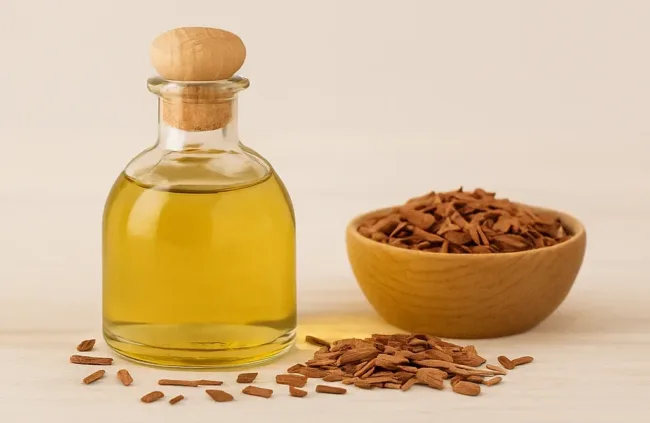
What is sandalwood oil and how is it extracted from the Santalum album tree for medicinal and aromatic use?
Sandalwood oil is a valuable essential oil derived from the heartwood of the Santalum album tree, an evergreen species belonging to the family Santalaceae. Commonly referred to as East Indian sandalwood, white sandalwood, or Chandan in India, it has been revered for centuries in medicine, perfumery, and cultural rituals. Its rich, warm aroma and therapeutic qualities have secured its place in both ancient healing traditions and modern wellness industries.
The Santalum album tree typically reaches a height of 10–12 meters and is native to the Indian subcontinent, though it also grows in regions of Malaysia and Southeast Asia. In India, large-scale cultivation takes place primarily in Karnataka and Tamil Nadu, where environmental conditions allow for high oil yield and optimal aromatic quality. Unlike many plants where essential oils are stored in specialized cells or glands, sandalwood oil is dispersed throughout the heartwood, requiring complete heartwood harvesting for extraction.
Harvesting usually occurs when the tree is between 15 and 20 years old, as older trees produce higher concentrations of oil. The bark is removed, the wood is chopped into small pieces, and the heartwood undergoes steam distillation. This process yields a pale yellow to nearly colorless viscous liquid that has an unpleasant taste but an exquisite fragrance that becomes richer and more mellow with age.
What are the main chemical constituents of sandalwood oil that give it its unique fragrance and therapeutic qualities?
The distinctive scent and medicinal potential of sandalwood oil are due to its complex chemical composition, dominated by two isomeric sesquiterpene alcohols: alpha-santalol and beta-santalol. These compounds are primarily responsible for its characteristic woody aroma and are also linked to its therapeutic effects, including anti-inflammatory, antimicrobial, and calming properties.
Other components found in smaller amounts include santalal, santene, santenone, teresantol, santalone, and santalene. Although these are present in lower concentrations, they contribute to the depth of fragrance and may have synergistic health benefits.

High-quality East Indian sandalwood oil typically contains 70–90% santalols, which is a key quality benchmark. Oils with a lower santalol content generally have a weaker aroma and reduced therapeutic value, which is why authenticity and origin play an important role in determining oil quality.
How has sandalwood oil been traditionally used in medicine and cultural practices across different regions?
Sandalwood oil has been a cornerstone in traditional medicine systems such as Ayurveda and Unani for centuries. Medicinally, it has been used in the symptomatic treatment of dysuria (painful urination) and to reduce urinary frequency in cases like bladder tuberculosis. These uses are linked to its mild anti-inflammatory and soothing effects on the urinary tract.
In Ayurveda, sandalwood paste—made by grinding the wood—is applied to the skin to reduce heat, inflammation, and rashes. It is considered cooling in nature and is also used for calming the mind during meditation and spiritual rituals.
Culturally, sandalwood has deep spiritual significance in Hinduism, Buddhism, and Jainism. Its paste is often applied to the forehead as a mark of devotion and purification. It is burned as incense in temples to create a serene and meditative environment. Beyond India, sandalwood was historically traded along spice and incense routes to China, the Middle East, and Europe, prized for its fragrance and preservative qualities.
How is sandalwood oil used in modern skincare, aromatherapy, and holistic health treatments?
In today’s wellness industry, sandalwood oil is valued for its skin-soothing, anti-aging, and antimicrobial properties. Dermatologists and cosmetic formulators use it in creams, lotions, and serums to help manage acne, reduce inflammation, and support skin hydration. Its antioxidant content may protect skin from free radical damage, helping to slow premature aging.
Aromatherapists employ sandalwood oil for its relaxing and grounding effects. Inhaling its aroma through diffusers or adding it to massage blends can help reduce stress and improve mental clarity. It is also used as a supportive therapy in palliative care settings, where its scent can promote relaxation and emotional comfort for patients.
In perfumery, sandalwood oil serves as an excellent fixative, enhancing the longevity of fragrance blends. Its ability to blend seamlessly with floral and spicy notes makes it a base ingredient in many luxury perfumes. It is also still widely used in incense production, continuing its legacy as a bridge between ancient rituals and modern relaxation practices.
What are the most common substitutes for East Indian sandalwood oil and how do they compare in quality and composition?
Due to its high market value and limited availability, East Indian sandalwood oil often faces substitution and adulteration. Australian sandalwood oil, obtained from Santalum spicatum (previously Eucarya spicata), is one substitute. It contains different compounds such as fusanols and generally has a less creamy and more earthy scent due to lower santalol content. While it shares some aromatic characteristics, its therapeutic effects may not be as potent.
Another substitute is West Indian sandalwood oil, derived from Amyris balsamifera of the Rutaceae family. Chemically distinct from true sandalwood, it is mainly valued for its fragrance-fixative qualities in perfumery rather than medicinal use.
Because of high costs, genuine sandalwood oil may also be diluted with fixed oils or synthetic fragrances, which can compromise both its aroma and its safety for therapeutic use. For this reason, authentic sandalwood oil should be sourced from trusted suppliers and stored in airtight containers away from light and heat to preserve its chemical integrity.
What precautions should be taken when using sandalwood oil for health and cosmetic purposes?
Sandalwood oil is generally considered safe when used appropriately, but as with all essential oils, dilution is important before applying it to the skin to prevent irritation. Individuals with sensitive skin should perform a patch test before regular use.
Ingesting sandalwood oil should only be done under the supervision of a qualified healthcare provider, as excessive intake may cause gastrointestinal upset or other adverse effects. Pregnant or breastfeeding women should seek medical advice before use.
Due to the prevalence of adulteration, buying from reputable suppliers is crucial to ensure the oil’s therapeutic value and safety. Pure sandalwood oil should have a high santalol content and a rich, lasting aroma without synthetic overtones.
Why does sandalwood oil continue to hold importance in modern health, beauty, and cultural traditions?
Sandalwood oil remains a rare example of an ingredient that harmoniously blends cultural heritage, sensory appeal, and scientifically recognized therapeutic value. From calming the mind in meditation halls to soothing irritated skin in dermatology clinics, it continues to serve diverse roles.
Its longevity in use is supported by its unique chemical composition—dominated by alpha- and beta-santalol—which gives it a depth of fragrance and a broad range of benefits. As interest in natural remedies, holistic wellness, and sustainable skincare grows, sandalwood oil retains its relevance, bridging the gap between ancient traditions and modern scientific validation.
Whether diffused in an aromatherapy session, incorporated into a luxury perfume, or applied in a medicinal preparation, sandalwood oil continues to be one of nature’s most prized aromatic treasures.
Discover more from Business-News-Today.com
Subscribe to get the latest posts sent to your email.