


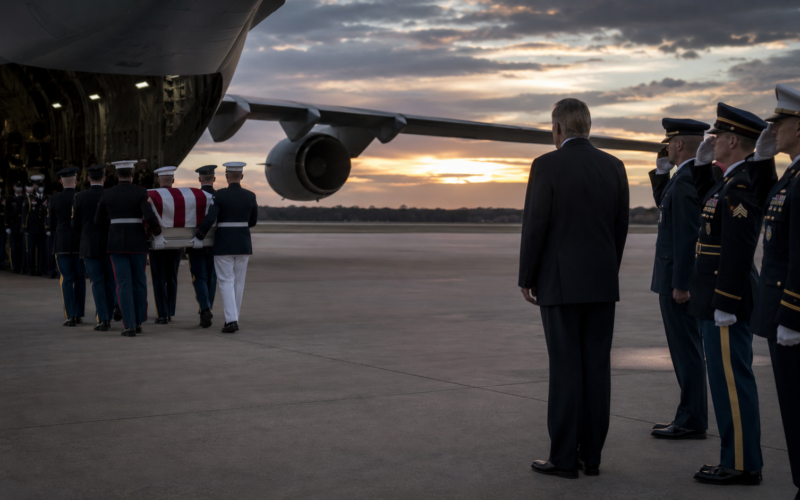
President Donald Trump attended the dignified transfer of four U.S. service members killed in the Iran war at Dover Air Force Base on July 22, 2026, bringing the human cost of the conflict directly into the center of the administration’s next military decision. The fallen service members returned in flag-draped transfer cases as Trump weighs whether to intensify strikes against Iran after months of fighting, oil disruption and mounting pressure on U.S. forces across the Middle East.
The moment matters because Trump is now confronting the same test that has shaped presidents in past wars: whether the mission remains worth the lives, money and political capital it is consuming. The Iran war began as a campaign to halt Tehran’s nuclear ambitions, defend regional partners and protect shipping routes, but it has increasingly become a war of attrition involving American casualties, higher energy prices, congressional scrutiny and public doubt over the endgame.
The four service members honored at Dover were 1st Lt. Tyler James Feehan, Staff Sgt. Michael Emmanuel Swinton, Sgt. Angel S. Rampersad and Pvt. Isabella Gonzales. Their deaths come as the administration considers more aggressive options, including expanded strikes on Iranian infrastructure, while also facing polling that shows deep public skepticism about whether the war is worth fighting. The ceremony at Dover did not end the policy debate, but it made the cost of every next decision harder to abstract.
Why the Dover ceremony changes the political weight of the Iran war
The Dover ceremony changes the political weight of the Iran war because it forces the administration to confront casualties not as numbers in briefings, but as families, names and national ritual. Presidents often speak of resolve in strategic terms, but dignified transfers make the cost of military action visible in a way that no policy memo can soften.
Trump has insisted that Americans are not against the war itself, only against high gasoline prices. That argument is becoming harder to sustain as casualties rise and the conflict lacks a clear public endpoint. Voters may support confronting Iran in principle, but support can weaken when the mission appears open-ended, costly and linked to higher prices at home.
The ceremony also undercuts any attempt to frame the war as low-cost pressure. The administration can point to military objectives and Iranian threats, but the return of fallen service members makes clear that U.S. troops are not operating from a position of risk-free distance. They are exposed in Jordan, Iraq, the Gulf and other parts of the region where Iran or aligned groups can strike.
This is why Dover becomes more than a solemn presidential duty. It becomes a marker in the political life of the war, the point at which the administration must explain not only why troops died, but why more troops should remain exposed if escalation continues.
How the American death toll is reshaping Trump’s war calculus
The American death toll is reshaping Trump’s war calculus because casualties create pressure from multiple directions at once. Military commanders may argue that Iranian attacks require stronger retaliation to protect U.S. forces. Families and lawmakers may ask why those forces remain exposed without a clearer strategy. Voters may wonder whether escalation will reduce risk or simply invite more retaliation.
The deaths honored at Dover followed attacks and incidents in Jordan and Iraq, adding to a broader toll that has grown during the conflict. The war has now killed more U.S. service members than the administration initially suggested would be likely, while hundreds more have been injured or affected by attacks across the region. That makes the conflict harder to describe as contained.
Trump’s public posture has mixed mourning with threats. He has warned that the United States could destroy Iranian bridges, power plants or other infrastructure if Iran continues attacking ships and U.S. interests. That message is meant to restore deterrence, but it also raises the question of whether each escalation will make U.S. troops safer or put them in greater danger.
The president’s dilemma is that restraint can look weak after U.S. deaths, while escalation can produce more targets for Iran and its allies. The deaths at Dover intensify both pressures. Trump is being pushed to respond forcefully, but every stronger response could make the next Dover ceremony more likely.
Why public support is becoming a strategic constraint
Public support is becoming a strategic constraint because wars become harder to sustain when voters no longer believe the costs match the goals. Recent national polling shows a large majority of Americans believe the Iran war is not worth fighting, while only a much smaller share says it is. That kind of gap matters because it limits how much political space the White House has for escalation.
The administration may argue that presidents must make national-security decisions even when polls are unfavorable. That is true, but public consent still affects congressional behavior, media coverage, military morale and allied confidence. A president fighting an unpopular war enters every escalation debate with less room for error.
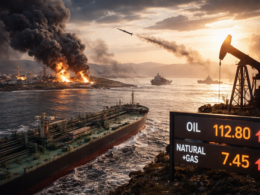
Gas prices are also shaping public opinion. The Iran war has pushed energy markets higher by threatening the Strait of Hormuz and now raising fears over Red Sea shipping through Bab al-Mandeb. When voters see fuel prices rise while service members are killed overseas, foreign policy and household affordability merge into one political problem.
That creates a difficult midterm environment for Republicans. Candidates defending Trump’s war strategy may face voters angry about both casualties and costs. If the White House cannot explain how the war ends, Democratic attacks will not need to be complicated. They can argue that Trump owns a conflict that is draining lives, money and family budgets without delivering a clear result.
How the Iran war is testing U.S. military posture across the Middle East
The Iran war is testing U.S. military posture because American forces are spread across a region where escalation can come from many directions. Troops in Iraq, Jordan, Kuwait, Saudi Arabia, the Gulf and nearby waters face risks from missiles, drones, militias and maritime threats. That distributed exposure gives Iran and its aligned groups multiple ways to impose costs.
The problem is not only battlefield danger. It is strategic overstretch. The United States may need to protect shipping in the Strait of Hormuz, respond to Houthi threats near Bab al-Mandeb, defend bases in the Gulf, support Israel, reassure Saudi Arabia and keep enough capacity for other global commitments. A war that began around Iran’s nuclear program now touches energy security, shipping lanes, regional deterrence and U.S. force readiness.
The Pentagon is also facing budget pressure. War costs are rising quickly, and emergency funding needs are becoming harder to separate from wider fiscal debates. If Congress is asked for more money while voters are already skeptical of the mission, the administration may face a tougher fight than it expected.
This is where the deaths at Dover connect to the larger war machine. Each casualty raises the moral stakes, but each new deployment, strike and naval escort also raises the operational stakes. The United States can escalate, but escalation has to be matched by a credible plan for protecting the troops who will bear the consequences.
Why Trump’s escalation options carry major risk
Trump’s escalation options carry major risk because Iran has several ways to respond without matching U.S. military power directly. Tehran can target shipping, threaten Gulf energy infrastructure, use drones and missiles against bases, activate allied groups or intensify cyber operations. That makes a simple punishment strategy difficult.
Expanded strikes on roads, bridges, power plants or nuclear-linked facilities may damage Iranian capabilities, but they could also broaden the war’s target set. If the United States attacks more civilian-adjacent infrastructure, Iran may frame the campaign as a wider assault on the country, making diplomacy harder and retaliation more likely.
The risk is especially high around energy infrastructure. Oil markets are already sensitive after disruptions around Hormuz and Houthi threats in the Red Sea. A larger U.S. strike campaign could push prices higher, creating immediate political consequences at home and economic consequences globally.
Trump’s advisers appear divided between those pressing for stronger military action and those still looking for a diplomatic path. That divide is not unusual in wartime, but the decision window is narrowing as casualties and costs accumulate. The longer the war continues without clear concessions from Iran, the more pressure grows for either a dramatic escalation or a serious push to end the conflict.
How Congress could respond to the rising casualties and costs
Congress could become more assertive as casualties rise and war costs mount. Lawmakers may demand briefings on the administration’s objectives, legal authority, troop exposure, casualty reporting and funding needs. Even members who support pressure on Iran may want clearer answers about what success looks like.
War powers questions are likely to intensify if Trump expands strikes against Iranian infrastructure or nuclear-linked facilities. The administration may argue that it has authority to defend U.S. forces and protect shipping, but a sustained multi-month war with significant casualties pushes the debate beyond immediate self-defense. Congress may ask whether the president is conducting a broader war without explicit authorization.
The funding debate could be equally important. Emergency war spending can move quickly when public support is strong, but the politics become more difficult when voters doubt the mission. If the Pentagon needs additional money while domestic programs face pressure and energy costs are high, lawmakers may attach conditions, reporting requirements or limits.
Republicans will face the hardest internal balance. Many will want to support Trump and appear tough on Iran, but they also must answer to voters concerned about costs and casualties. The Iran war could therefore become not only a foreign-policy fight between parties, but an internal test of how much congressional Republicans are willing to question a president from their own party.
Why the war’s endgame remains the central issue
The war’s endgame remains the central issue because military pressure without a defined political objective can become self-sustaining. The administration says it wants to stop Iran’s nuclear progress, protect shipping, deter attacks and force Tehran into better terms. But those goals are not the same as a clear exit strategy.
Iran has not yet made the concessions Washington wants. U.S. strikes have damaged targets, but they have not ended Tehran’s ability to retaliate. Maritime disruption continues, and U.S. troops remain exposed. That creates a cycle in which every Iranian response invites another American strike, and every American strike gives Iran another reason to resist.
A credible endgame would require diplomacy, inspections, security guarantees, sanctions decisions, maritime arrangements and regional buy-in. It would also require Trump to explain what compromise he would accept after months of conflict. Without that clarity, escalation can become easier than resolution because it offers immediate action without answering the harder political question.
The Dover ceremony sharpened that question. The families who lost loved ones are not only owed honor. They are owed a serious explanation of what their country is trying to achieve and how leaders intend to prevent more families from facing the same loss.
What should readers watch as Trump weighs the next Iran decision?
The administration’s military signals will reveal whether Trump is moving toward expanded escalation or using threats to pressure Tehran. New deployments, larger strike packages, warnings to commercial shipping or public orders to Central Command would suggest that the White House is preparing for a more aggressive phase. A stronger focus on mediation would suggest that the Dover moment may have reinforced the need for an exit path.
Congressional pressure will also matter. Hearings, war powers resolutions, funding conditions or demands for casualty transparency would show that lawmakers are no longer willing to leave the strategy entirely to the White House. If Republicans begin asking tougher questions, the political environment around the war could shift quickly.
Public opinion will be just as important. If gas prices remain high and casualties continue, the administration’s claim that Americans support the war may become increasingly difficult to defend. Voters may tolerate a short, decisive campaign more easily than a long conflict with unclear goals and rising costs.
The return of the fallen at Dover has turned Trump’s Iran decision into a more personal and politically dangerous moment. He can escalate and try to restore deterrence, or he can seek a path that reduces U.S. exposure before the war consumes more lives and resources. Either choice carries risk. What has changed is that the cost of delay is now visible in flag-draped cases, grieving families and a public increasingly unsure what the war is meant to achieve.
Key takeaways from Trump’s Dover ceremony and Iran war decision point
- Trump attended the dignified transfer of four U.S. service members killed in the Iran war at Dover Air Force Base on July 22, 2026.
- The fallen service members were 1st Lt. Tyler James Feehan, Staff Sgt. Michael Emmanuel Swinton, Sgt. Angel S. Rampersad and Pvt. Isabella Gonzales.
- Their deaths have sharpened the political and moral pressure on Trump as he weighs whether to intensify strikes against Iran.
- The Iran war has now killed 18 U.S. service members, according to Reuters, while hundreds more have been wounded or affected by attacks across the region.
- Trump has threatened stronger retaliation against Iran, including attacks on infrastructure, if Tehran continues targeting ships or U.S. interests.
- The administration faces a difficult choice between escalation that could restore deterrence and escalation that could expose more U.S. troops to retaliation.
- Public support for the war is weak, with recent polling showing a large majority of Americans believe the Iran war is not worth fighting.
- Rising oil and gasoline prices are turning the Iran war into a domestic affordability problem as shipping routes through Hormuz and the Red Sea come under pressure.
- Congress may increase scrutiny of Trump’s legal authority, military strategy, casualty reporting and war funding requests as the conflict continues.
- The central issue for the White House is whether it can define a credible endgame before the Iran war becomes a deeper military, economic and political liability.
Share this:
Discover more from Business-News-Today.com
Subscribe to get the latest posts sent to your email.