


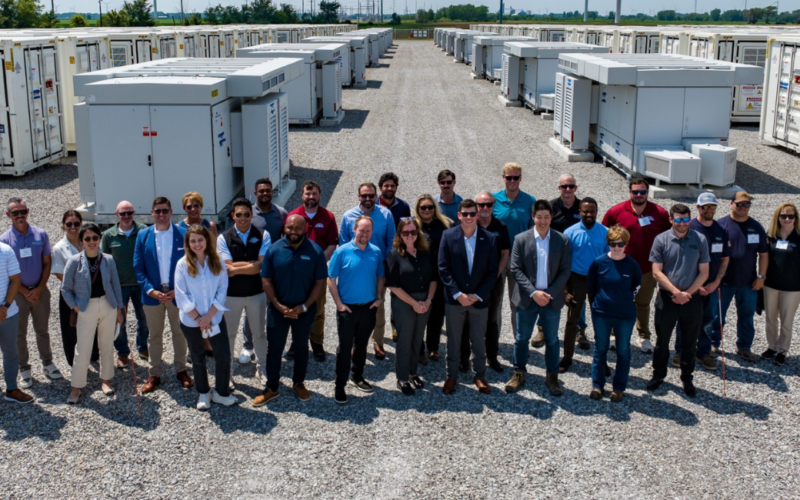
NextEra Energy, Inc. (NYSE:NEE), through NextEra Energy Resources, has started operations at the 200MW Century Oaks Energy Center in Huron County, Michigan, following a confirmed July 8 ribbon-cutting with Consumers Energy and local stakeholders. The battery energy storage facility is owned and operated by Century Oaks Energy Storage, LLC and represents an investment of more than $279 million. Century Oaks is designed to store electricity when supply is available and return power to the grid during periods of stronger demand, giving Michigan another flexible resource as electricity consumption and renewable penetration rise. The project created more than 300 construction jobs and is projected to generate approximately $34.9 million in tax revenue over its expected 30-year operating life. NextEra Energy shares closed at $87.10 on July 9, down 0.39% for the session, as investors treated the commissioning milestone as incremental support for the company’s storage strategy rather than a standalone valuation event.
Why does NextEra Energy’s Century Oaks battery matter for Michigan’s electricity grid?
Century Oaks matters because Michigan is moving from battery storage targets to operating infrastructure. State policy calls for 2,500MW of energy storage by the end of 2029, creating a clear requirement for utilities, independent developers and grid planners to bring large projects into service. A 200MW operating facility represents a meaningful contribution to that target and gives the state practical experience with the way utility-scale batteries interact with regional power markets and local communities.
The project also arrives as the Midcontinent Independent System Operator manages a power system undergoing rapid change. Coal units are retiring, renewable generation is expanding, electricity demand is evolving and extreme weather continues to test resource availability. Battery storage can respond quickly when supply and demand move out of balance, making it useful for reliability, reserve capacity and short-term grid flexibility.
Century Oaks should not be presented as a complete solution to Michigan’s power challenge. The announcement disclosed the project’s 200MW power capacity but did not specify its megawatt-hour energy capacity or operating duration. That information is important because a battery capable of delivering 200MW for one hour serves a different system function from one capable of sustaining the same output for four hours.
The strategic significance is therefore clear but conditional. Century Oaks adds dispatchable power capacity and operational flexibility, but its long-term system value will depend on duration, cycling strategy, market participation, availability and how effectively Consumers Energy integrates the asset into its resource portfolio.
How could Century Oaks support Consumers Energy during periods of higher electricity demand?
Consumers Energy serves nearly two million homes and businesses across Michigan, giving it a direct interest in resources that can respond quickly when demand rises or generation becomes less predictable. Century Oaks can charge when electricity is more readily available and discharge when the grid requires additional capacity. That capability can help reduce pressure during peak periods and provide another option alongside generation, demand management and imported electricity.
The value of storage is not limited to emergency conditions. Batteries can shift electricity from lower-value periods to higher-value periods, respond to short-term market signals and support system operators when supply conditions change faster than conventional generation can react. When deployed carefully, those services can improve grid performance and reduce the need to operate more expensive resources for brief demand peaks.
Consumers Energy’s relationship with Century Oaks also illustrates a wider utility procurement shift. Regulated utilities do not necessarily need to own every battery themselves. They can contract with independent infrastructure developers that finance, build and operate assets while delivering defined capacity or energy services to utility customers.
That model can transfer portions of construction and operating risk to the developer, although the utility must still ensure that the contract delivers reliable and affordable value. The customer benefit ultimately depends on the commercial structure, performance guarantees and cost recovery arrangements, not merely on the physical presence of battery containers.
What does the $279 million Century Oaks investment reveal about battery project economics?
The more than $279 million investment demonstrates that utility-scale battery storage has become a serious infrastructure category rather than a small technology experiment. Projects at this scale require land, grid interconnection, transformers, power conversion systems, control equipment, fire protection, civil works, software and long-term maintenance capability. The battery cells may receive most of the attention, but the wider balance-of-plant package determines whether the asset can operate safely and reliably.
The investment figure also shows why utilisation matters. A battery generates value through the services it provides over thousands of operating cycles. If the asset is underused, poorly optimised or restricted by market rules, the capital can earn weaker returns than expected. If it participates effectively across capacity, energy and ancillary-service opportunities, the same infrastructure can support several grid needs.
For NextEra Energy Resources, scale can create an advantage. The company can apply experience from a large portfolio of operating and contracted batteries to procurement, engineering, construction and optimisation. It can also spread technology evaluation and operating expertise across more projects than a developer entering the market with one isolated asset.
Scale does not remove project risk. Battery degradation, replacement requirements, insurance costs, safety standards and market-price compression can affect lifetime returns. The capital committed to Century Oaks therefore has to be judged through long-term operating performance, not just the satisfaction of cutting a ribbon without becoming tangled in it.
Why is Century Oaks important for NextEra Energy Resources’ expanding storage portfolio?
Century Oaks fits directly into NextEra Energy Resources’ current development strategy. In its latest quarterly update before the project entered operations, NextEra Energy Resources reported approximately 33GW of generation and storage projects in backlog after adding 4GW during the quarter. Battery storage accounted for approximately 1.3GW of those new additions, confirming that storage remains a current and expanding part of the business rather than a peripheral legacy activity.
The project also reinforces NextEra Energy Resources’ position as a developer that can move assets from origination through construction into operation. Pipeline size attracts attention, but project conversion creates revenue, customer relationships and operating data. Century Oaks adds another reference asset in the Midcontinent Independent System Operator region, where reliability concerns and renewable development are increasing the need for flexible resources.
Operational data from Century Oaks could inform future project design. NextEra Energy Resources can study charging patterns, dispatch performance, degradation, maintenance requirements and customer value under Michigan conditions. Those lessons may support future bids and help the company refine the commercial structures offered to utilities and large power customers.
The competitive implication is that storage markets may favour developers capable of combining project origination, balance-sheet access, construction management and operational optimisation. Smaller developers can still create valuable projects, but they may increasingly need institutional capital, utility partnerships or eventual asset sales to compete with platforms that can build at national scale.
How should investors interpret NextEra Energy stock sentiment after Century Oaks began operations?
NextEra Energy shares closed at $87.10 on July 9, falling 0.39% during the session. The stock was approximately 1.4% lower than its July 2 close, but roughly 2.7% higher than its June 9 close. The shares remained within a 52-week range of approximately $69.25 to $98.75, placing the stock below its annual high but materially above its low.
The muted reaction is reasonable because Century Oaks is meaningful as an individual project but modest relative to NextEra Energy’s overall scale. The company owns Florida Power & Light Company, operates a large competitive energy infrastructure portfolio and is pursuing substantial generation, storage and transmission investment across the United States. A 200MW battery strengthens the portfolio without transforming group earnings on its own.
Investor sentiment is also being shaped by factors that extend well beyond Century Oaks. Interest rates affect utility valuations and financing costs, electricity demand growth influences capital opportunities, and the company’s proposed combination with Dominion Energy adds a larger strategic consideration. The market is therefore unlikely to isolate one battery commissioning event from the wider capital allocation story.
The most relevant equity signal is execution consistency. NextEra Energy’s valuation depends partly on its ability to convert a large development backlog into contracted operating assets while preserving returns and credit quality. Century Oaks supports that case because it has entered service, but investors will require the same discipline across much larger volumes of projects.
Could Century Oaks become a model for meeting Michigan’s 2,500MW storage target?
Century Oaks can serve as a useful model because it combines private development capital, utility participation and local economic benefits. Michigan’s storage target requires far more than one project, and the state will need several development structures to reach 2,500MW. Independently owned facilities contracted to utilities are likely to form part of that mix alongside utility-owned batteries and storage paired with renewable generation.
The project’s local fiscal contribution may also influence future development. Century Oaks is projected to generate around $34.9 million in tax revenue over 30 years, creating a tangible benefit for schools, infrastructure and public services. More than 300 construction jobs added a shorter-term economic impact during development, although permanent operating employment will naturally be lower for an automated storage facility.
Host-community economics are becoming increasingly important as energy projects move closer to populated areas. Developers cannot assume that statewide reliability goals will automatically overcome local concerns about land use, safety, noise, emergency response or property impacts. Projects that communicate clearly and create visible community value may face a more workable development environment than projects relying only on technical necessity.
The model will still need refinement. Michigan must ensure that projects are located where they deliver grid value, meet strong safety requirements and do not overconcentrate infrastructure in communities with limited negotiating power. Century Oaks gives policymakers and developers an operating case study, but future approvals will depend on whether the benefits remain visible after construction crews leave.
What safety and operational risks must NextEra Energy manage at Century Oaks?
Battery safety is one of the most important issues affecting public confidence in utility-scale storage. Large lithium-ion installations require thermal monitoring, fire detection, suppression systems, separation standards, emergency response planning and continuous operating controls. A serious incident at one facility can influence permitting and public opinion across an entire region, even when other projects use different designs or operating practices.
NextEra Energy Resources must therefore treat safe operation as both an engineering obligation and a development strategy. Strong performance can help local authorities and emergency services become more comfortable with storage technology. Poor communication or inadequate incident preparation can undermine years of work across a wider project portfolio.
Operational reliability is equally important. The battery must be available when Consumers Energy and the regional system need it, while charging and discharging must be managed to protect cell life. Excessive cycling can accelerate degradation, but overly conservative operation can leave economic and reliability value unused.
Cybersecurity and software performance add another layer of risk. Modern batteries depend on digital control systems, communications and energy-management software. NextEra Energy Resources must protect those systems while ensuring that the asset responds accurately to market and grid instructions. A battery is physical infrastructure controlled by software, which means both parts must behave themselves at the same time.
How could rising renewable generation increase the long-term value of Century Oaks?
Storage becomes more useful as the timing of electricity supply diverges from the timing of demand. Solar generation is strongest during daylight hours, while residential demand can remain elevated into the evening. Wind production can be abundant during low-demand periods and weaker when consumption rises. Batteries can reduce that mismatch by moving electricity across time.
For Michigan, storage can also improve the usefulness of renewable generation connected across the wider Midcontinent Independent System Operator region. When renewable output exceeds immediate demand or transmission capacity, prices can fall and generation may be curtailed. A strategically located battery can absorb some of that electricity and release it when the system has greater need.
Century Oaks may therefore gain value as renewable penetration rises, but that outcome is not automatic. The project’s charging rights, interconnection limits, duration and market participation rules will determine how much renewable shifting it can perform. A battery located near constrained infrastructure may create different value from one positioned primarily to serve utility capacity needs.
The wider implication is that storage and renewable generation should increasingly be planned together, even when they are developed as separate projects. Building variable generation without flexibility can raise balancing and transmission costs. Building batteries without understanding future generation patterns can produce expensive assets in the wrong locations. The grid rewards coordination and has little sympathy for enthusiastic silos.
What competitive and policy lessons does Century Oaks offer the U.S. battery industry?
Century Oaks shows that the U.S. battery market is moving into an operating phase where developers must prove value across reliability, economics and community impact. Announced capacity is no longer enough. Utilities, regulators and local governments want projects that reach commercial operation, perform safely and produce measurable benefits.
The project also supports the case for storage as an alternative to some traditional grid investments. Batteries can often be deployed faster than new transmission corridors or large generating plants, making them useful when demand is rising quickly. They cannot replace every form of infrastructure, but they can defer certain upgrades, provide peak capacity and help manage short-duration imbalances.
Competition will intensify as more developers pursue utility contracts. NextEra Energy Resources brings scale, procurement capability and operational experience, while rivals may compete through lower costs, longer-duration technologies, more flexible commercial structures or stronger local development models. Technology providers will also face pressure to improve safety, energy density, degradation performance and supply-chain resilience.
Policy stability remains critical. Storage targets can create demand, but market rules must allow batteries to earn revenue for the services they provide. Regulators must also ensure that customers are not paying excessive costs for assets with poorly defined roles. Century Oaks strengthens Michigan’s storage base, but the state’s broader target will succeed only if procurement, planning and market design evolve together.
What are the key takeaways from NextEra Energy’s Century Oaks battery project?
- Century Oaks is a confirmed operating battery facility, not an early-stage proposal, memorandum or pre-construction pipeline asset.
- The 200MW project represents an investment of more than $279 million and contributes meaningfully toward Michigan’s 2,500MW storage target for 2029.
- Consumers Energy gains access to a flexible resource that can support peak demand, grid balancing and reliable service for its Michigan customers.
- The announcement did not disclose the project’s megawatt-hour capacity or duration, which limits analysis of how long Century Oaks can sustain maximum output.
- The facility reinforces NextEra Energy Resources’ current battery strategy after the business added approximately 1.3GW of storage to its backlog in the latest reported quarter.
- More than 300 construction jobs and approximately $34.9 million of projected tax revenue strengthen the project’s local economic case.
- NextEra Energy’s share-price reaction was muted because Century Oaks supports portfolio execution but is not large enough to reshape group valuation independently.
- Safety systems, battery degradation, software reliability, market optimisation and long-term maintenance will determine whether the project meets its economic potential.
- Century Oaks could become a development template for Michigan, but future projects will still need credible community benefits, grid justification and emergency-response planning.
- The central industry signal is that battery storage is moving from policy targets into physical infrastructure, where performance matters more than announced megawatts.
Share this:
Discover more from Business-News-Today.com
Subscribe to get the latest posts sent to your email.