





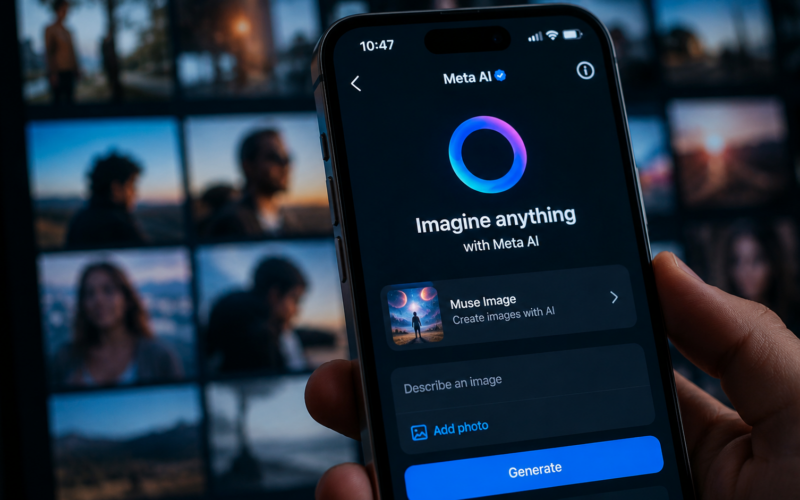
Meta Platforms, Inc. (NASDAQ: META) has withdrawn a Muse Image feature that allowed Meta AI users to generate images referencing photos from public Instagram accounts, only days after launch. The feature was automatically available unless users changed their settings, prompting criticism from users, performers and SAG-AFTRA over consent and digital replica risks. Meta Platforms acknowledged that the feature missed the mark and removed it, while retaining other Muse Image generation and editing capabilities. Meta Platforms shares closed at $669.21 on July 10, up 5.97% for the session and approximately 14.8% across five trading sessions, suggesting broader investor enthusiasm over the company’s AI infrastructure and product strategy outweighed the privacy reversal. The incident matters because it tests whether Meta Platforms’ rapid superintelligence product cycle can coexist with the consent standards required to protect users, creators and the advertising ecosystem.
Why does Meta’s rapid Muse Image withdrawal matter beyond one failed Instagram feature?
Muse Image was introduced on July 7 and the controversial public-account capability was removed by July 10. That unusually short product life suggests Meta Platforms underestimated how users would interpret the difference between publicly viewable content and content available for automated AI manipulation.
A public Instagram photograph can be seen, shared or commented on under the platform’s ordinary rules. Allowing another person to transform that photograph into an AI-generated scene creates a different category of use because it can change someone’s appearance, context, actions or implied endorsement. Users may reasonably believe that making an account public supports discovery without consenting to an unlimited digital-replica licence.
The speed of the reversal also raises questions about Meta Platforms’ internal risk controls. The company has described a structured review process intended to identify privacy, safety and regulatory issues before new products reach users. A feature removed within days after predictable consent objections suggests either that the risks were not identified, were identified but underestimated, or were accepted in pursuit of a faster launch.
None of those possibilities is reassuring for a company deploying AI across Facebook, Instagram, WhatsApp, wearables, advertising tools and personal assistants. The cost of a poorly designed feature increases when the same product philosophy is applied across platforms used by billions of people.
The withdrawal was therefore strategically sensible, but it should not be treated as evidence that the governance system worked perfectly. Removing a feature after public pressure is responsible incident response. Preventing an avoidable consent failure before launch would have been stronger product governance.
Why did Meta’s automatic availability model trigger a stronger backlash than the image technology itself?
The principal criticism focused on consent architecture rather than image-generation technology alone. Users objected to the capability being available by default and requiring them to find settings to prevent their public images from being referenced.
Opt-out systems generally favour adoption because many users do not know that a feature exists, do not understand the settings or do not take the time to change them. That produces a larger initial content pool for the company, but it weakens the claim that users made an informed choice.
An opt-in system would have created slower adoption but stronger legitimacy. Meta Platforms could have asked account holders whether their public images could be used as references, explained what generated outputs might contain and allowed users to withdraw permission easily. That structure would have reduced the number of eligible accounts while giving the company clearer evidence of consent.
The commercial temptation to use automatic availability is understandable. Generative AI products improve when users can access more content, create personalised outputs and share those results back into the platform. More creation can produce more engagement, which can generate more advertising inventory and strengthen Meta AI usage.
However, the short-term engagement benefit can be outweighed by trust damage. Users who believe their photographs may be repurposed without meaningful consent may restrict account visibility, share less content or move sensitive material away from the platform. A feature designed to increase creative participation can therefore reduce the willingness to supply the content that makes Instagram commercially valuable.
The design lesson is straightforward. Consent should not be treated as an obstacle that a settings menu can quietly solve. In consumer AI, consent is part of the product.
How do digital replica risks change Meta Platforms’ relationship with creators and performers?
Performers, influencers, artists and public-facing professionals have particular reasons to resist automatic AI use of their images. Their identity, face, voice and reputation can carry direct commercial value, while misleading generated content can create professional, contractual and personal harm.
An AI-generated image does not need to be technically perfect to cause damage. It may place a person in a political campaign, product promotion, explicit situation or fabricated event that never occurred. Even when clearly presented as creative content, repeated synthetic depictions can weaken the boundary between authentic and manipulated media.
SAG-AFTRA’s intervention matters because the union has been central to debates over digital replicas, performer consent and compensation. Its criticism showed that the feature was not being judged merely as a social-media novelty. It was being evaluated against emerging professional standards governing how identities may be reproduced by AI systems.
Meta Platforms also depends heavily on creators to generate culturally relevant content and maintain engagement. A product that alienates those creators can undermine the ecosystem supporting Instagram’s advertising business. The company therefore has both an ethical reason and a financial incentive to establish clearer controls.
Consent may also need to operate at several levels. A person might allow friends to create harmless stylised images while prohibiting commercial advertising, political use, adult content or public distribution. A single on-or-off switch may be too crude for the range of potential AI outputs.
Meta Platforms has the technical resources to build granular permissions, provenance signals, watermarking and reporting systems. The challenge is deciding whether those controls are treated as essential infrastructure or added only after criticism.
What does the reversal reveal about Meta Superintelligence Labs’ pressure to launch products quickly?
Muse Image was promoted as the first image-generation model from Meta Superintelligence Labs, giving the launch symbolic importance beyond its immediate features. Meta Platforms has committed enormous capital to AI models, computing infrastructure, custom chips and technical recruitment, creating pressure to demonstrate visible progress.
The company expects capital expenditure of between $115 billion and $135 billion during 2026. Investors accepting that level of spending will expect product releases, improved advertising systems, user growth and credible future revenue opportunities. Internal teams consequently face strong incentives to move quickly from research into consumer deployment.
Speed can be strategically valuable because model capabilities, developer preferences and user behaviour are changing rapidly. A company that waits for perfect certainty may lose distribution, talent and product relevance to faster competitors. Yet rapid deployment across social networks creates risks that do not exist in a controlled enterprise pilot.
Meta Platforms already has access to an extraordinary volume of personal content and social relationships. That gives its AI products a personalisation advantage, but it also means mistakes can affect real identities rather than anonymous test data. The company’s competitive strength and its governance exposure come from the same asset.
The Muse Image episode suggests that Meta Superintelligence Labs needs a launch process designed specifically for identity-sensitive features. Technical model evaluation is not enough. Product teams must examine consent, abuse pathways, creator economics, regulatory expectations and how ordinary users will interpret the feature.
A slower initial rollout to consenting participants could have produced useful data without creating the same backlash. In this case, Meta Platforms saved days by avoiding an opt-in launch and then lost the feature entirely. That is not speed. It is rework with a press cycle attached.
Why did Meta stock surge despite the privacy setback surrounding Muse Image?
Meta Platforms shares closed at $669.21 on July 10, rising 5.97% during the session. The stock gained approximately 14.8% from its July 2 close and about 17.2% from the June 10 closing price, while remaining roughly 16% below its 52-week high of $796.25.
The rally was driven mainly by wider enthusiasm around Meta Platforms’ AI strategy, including expectations that the company could monetise excess computing capacity, expand custom-chip production and generate new cloud-related revenue. The Muse Image withdrawal was therefore overshadowed by investor interest in larger infrastructure and platform opportunities.
This does not mean the market considers privacy irrelevant. It means investors do not currently expect one withdrawn feature to damage Meta Platforms’ advertising revenue, user base or near-term earnings materially. The company reported first-quarter revenue of $56.31 billion and an operating margin of 41%, giving it substantial financial capacity to absorb product mistakes.
The stock reaction also illustrates a difference between reputational risk and financial risk. A privacy controversy may weaken trust gradually without affecting the next quarter’s income statement. Markets often react more strongly when regulatory action, advertiser departures or user declines convert that reputational issue into measurable costs.
Meta Platforms’ current valuation therefore assumes that management can continue funding AI expansion while preserving the economics of Facebook and Instagram. The Muse Image incident does not disprove that assumption, but it exposes one route through which aggressive AI deployment could eventually threaten it.
Investors should watch whether the reversal remains isolated or becomes part of a repeated pattern. One product mistake is manageable. A series of consent failures could invite regulation, weaken creator relationships and make every future launch more expensive.
Could privacy regulators force opt-in consent for AI features using public social media content?
The controversy strengthens the policy argument that publicly accessible content should not automatically be treated as freely reusable for every AI purpose. Existing privacy, consumer-protection, publicity and biometric rules were not designed around generative models capable of creating unlimited synthetic variations of a person.
Regulators may increasingly distinguish between using public content to recommend posts and using it to generate new depictions of identifiable individuals. The second activity creates a greater risk of impersonation, harassment, reputational damage and misleading commercial use.
An opt-in requirement would reduce the amount of content available to AI systems but create clearer legal and ethical foundations. Platforms could still offer creative tools, provided users knowingly agree and retain practical control over how their identity is used.
Meta Platforms may argue that public content is already subject to broad platform terms and that users were offered settings to control participation. The backlash demonstrates that legal terms and user expectations are not always aligned. A platform can possess contractual permission while still violating the social understanding under which people shared their content.
The company also operates across jurisdictions with different definitions of consent, personal data and image rights. Building one permissive global feature may therefore create regulatory exposure in markets requiring stricter safeguards.
A more sustainable approach would establish the highest practical consent standard as the default architecture rather than designing a feature around the most permissive legal interpretation. That may slow deployment, but it reduces the cost of repeatedly redesigning products after regulators or users object.
How could the Muse Image failure affect Meta’s competition with OpenAI, Google and other AI platforms?
Meta Platforms is competing with OpenAI, Alphabet Inc.’s Google and other model developers for user attention, developer adoption and enterprise spending. Its main advantage is distribution through Facebook, Instagram, WhatsApp and Messenger, where AI features can reach billions of users without requiring them to install a separate service.
The Muse Image controversy shows that distribution also creates constraints. OpenAI can launch a standalone creative tool with its own permissions and user relationship. Meta Platforms must introduce AI inside networks containing years of personal content, social connections and established expectations about sharing.
Google faces similar challenges through Google Photos, YouTube and Android, while Apple Inc. must navigate access to private device data and personal media. The companies with the richest user context may offer the most personalised AI, but they also face the greatest consent burden.
Meta Platforms should not respond by becoming less ambitious. It should use its scale to build stronger identity protection than smaller competitors can provide. Verified consent, persistent content credentials, rapid takedown tools and restrictions on harmful categories could become competitive features rather than compliance expenses.
The rollback could also improve future products if it changes internal incentives. A system that rewards teams only for speed and usage will generate predictable governance failures. A system that measures consent quality, complaint rates and abuse prevention may produce slower launches but stronger long-term adoption.
AI competition will not be decided solely by benchmark scores. Trust will influence which tools people permit to access their photographs, conversations, contacts and daily behaviour. Meta Platforms has enormous distribution, but distribution without trust is merely a very efficient way to spread dissatisfaction.
What should Meta Platforms change before reintroducing Instagram-linked AI image features?
The first requirement is explicit opt-in consent. Users should actively choose whether their public photographs can be referenced, rather than discovering after launch that participation was enabled automatically.
The second requirement is granular control. Users may want to permit private creation by approved contacts while prohibiting public sharing, commercial use, political content or adult scenarios.
The third requirement is clear notification. A person whose image has been referenced should be able to see that an output was created, identify who generated it and request removal where appropriate.
The fourth requirement is durable provenance. Generated outputs should contain visible and machine-readable indicators showing that they were created or altered using AI. Those indicators should remain attached after downloading and reposting wherever technically possible.
The fifth requirement is stronger protection for minors and vulnerable users. Their images should not be available for third-party generation merely because an account or post is public.
The sixth requirement is creator-specific safeguards. Performers, artists and public figures need tools capable of preventing unauthorised commercial endorsements and deceptive replicas.
The seventh requirement is transparent risk testing. Meta Platforms should explain how a feature was evaluated for impersonation, harassment, sexualised content, fraud and misinformation before release.
The eighth requirement is phased deployment. New identity-sensitive capabilities should begin with consenting test groups and limited use cases before being extended across Instagram.
The ninth requirement is accountability. Meta Platforms should provide users with a simple reporting process and a meaningful remedy when generated content causes harm.
Muse Image may return in another form because the underlying creative demand is real. The next version will succeed only if Meta Platforms recognises that access to public photographs does not eliminate the need to ask permission.
What are the key takeaways from Meta’s Muse Image privacy reversal for AI governance?
- Meta Platforms withdrew the public Instagram account feature within days, showing that AI product speed cannot compensate for weak consent design.
- The central problem was automatic availability rather than image generation alone, because users had not made an explicit decision to participate.
- Publicly visible photographs are not necessarily understood by users as permission for third parties to create synthetic depictions.
- SAG-AFTRA’s criticism elevated the controversy from a consumer complaint into a broader debate over professional digital replica rights.
- The rollback raises questions about whether Meta Platforms’ internal AI risk-review process gives sufficient weight to foreseeable user expectations.
- Meta Platforms’ July 10 stock surge reflected wider AI infrastructure optimism rather than market approval of the withdrawn feature.
- The company’s advertising and creator ecosystem could be weakened if users respond to AI concerns by sharing less content or restricting account visibility.
- Regulators may increasingly require explicit opt-in consent for AI tools that generate new depictions of identifiable people.
- Meta Platforms can turn privacy controls into a competitive advantage through granular permissions, provenance and rapid remedies.
- Future Instagram-linked AI features will need to treat consent as part of the product architecture rather than a setting users must discover.
Share this:
Discover more from Business-News-Today.com
Subscribe to get the latest posts sent to your email.