

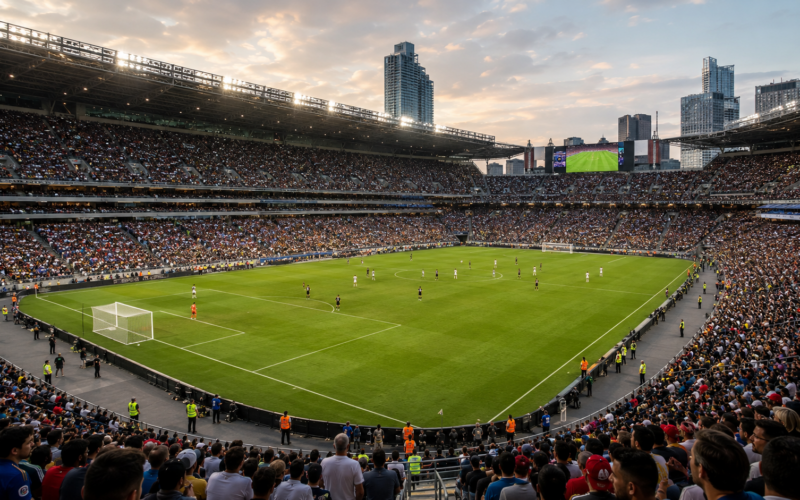
Erling Haaland scored twice during the final 11 minutes as Norway stunned Brazil 2-1 in their FIFA World Cup 2026 Round of 16 match at New York New Jersey Stadium in East Rutherford on Sunday, July 5, 2026. Haaland headed Norway in front in the 79th minute before striking again from outside the penalty area in the 89th.
Brazil had received the clearest opportunity of the opening half when Kristoffer Ajer’s challenge on Matheus Cunha resulted in a penalty following a video review. Bruno Guimarães took responsibility but produced a weak effort that Ørjan Nyland saved, allowing Norway to reach half-time level after Patrick Berg had earlier seen a goal disallowed for offside.
Ståle Solbakken transformed Norway’s attacking threat by introducing Oscar Bobb and Andreas Schjelderup at half-time. Schjelderup created both Haaland goals, while Nyland made four saves and produced a remarkable late intervention when a deflection threatened to loop into his own net.
Neymar converted a penalty in the tenth minute of stoppage time after Leo Østigård caught Casemiro during an aerial challenge, but Brazil had insufficient time to force extra time. Norway advanced to the quarter-finals for the first time and will face the winner of Mexico vs England at Miami Stadium on Saturday, July 11, at 5pm Eastern Time.
FIFA World Cup 2026 Brazil 1-2 Norway full match scorecard and key incidents
How did Norway begin with greater control despite entering as the knockout underdogs?
Norway did not approach Brazil as a team interested only in defending its penalty area. Solbakken’s side circulated possession patiently through Ajer, Heggem and Berge, forcing Brazil’s attacking players to spend extended periods without the ball.
That approach immediately unsettled Brazil. Berg appeared to place Norway ahead after a fast combination split the defensive line, but the move was ruled out because a Norwegian runner had moved offside.
The warning was significant. Norway had demonstrated that Brazil’s defence could be exposed through direct passing and coordinated movement before the five-time champions had established their own attacking rhythm.
Brazil’s response remained cautious. Vinícius occasionally found space on the left, but Martinelli, Cunha and Rayan struggled to combine around a Norwegian midfield that controlled both possession and the second balls.
Why was Bruno Guimarães allowed to take Brazil’s early penalty instead of Vinícius Júnior?
Brazil received the penalty after Cunha attempted to move beyond Ajer inside the area. The referee initially allowed the challenge to pass before a video review resulted in the spot kick.
Guimarães took responsibility despite Vinícius being the team’s most prominent attacking player. The midfielder attempted a delayed run-up but placed his finish too close to Nyland, who moved left and blocked the ball.
The decision to use Guimarães may have been based on Brazil’s penalty preparation and internal data rather than reputation. However, the execution created an immediate debate because Brazil had allowed its clearest opportunity to disappear without seriously stretching the goalkeeper.
The miss changed the emotional balance. Norway had already lost an early goal to offside but now understood that Brazil were equally capable of wasting a decisive moment.
How did Ørjan Nyland become as important as Erling Haaland to Norway’s victory?
Nyland’s penalty save was the defining intervention of the opening period, but his influence extended throughout the match. He remained composed behind a defence that occasionally allowed Brazil to enter shooting positions without losing its overall organisation.
Vinícius tested him late in the first half after finding room inside the penalty area. Nyland stayed low and prevented the shot from producing the breakthrough Brazil expected.
Endrick later forced another save following his introduction, while Rayan also directed an attempt towards the Norwegian goal. Nyland consistently avoided giving Brazil a simple rebound inside the six-yard area.
His most dramatic intervention came after Haaland’s opening goal. A heavily deflected Brazil effort looped towards the goal, forcing Nyland to scramble backwards and claw the ball against the post.
Without that save, Brazil could have equalised before Norway scored again. Haaland decided the result at the opposite end, but Nyland created the conditions that allowed the striker’s two goals to become historic.
Why did Brazil’s 2.75 expected goals exaggerate the quality of their attacking performance?
Brazil’s expected-goals total was heavily influenced by the two penalties, which together accounted for a substantial portion of the 2.75 figure. Open play produced far less consistent danger than the headline number suggested.
The strongest non-penalty chance fell to Endrick shortly after he replaced Cunha. Vinícius carried the ball into space and supplied the young striker, but the finish was blocked when Brazil needed greater composure.
Brazil attempted 14 shots but placed only four on target. Several efforts came from distance or after Norway had already recovered enough defenders to obstruct the route towards goal.
Norway generated only 0.84 expected goals but created the better finishing situations during the decisive phase. Haaland converted a difficult header and then scored from outside the penalty area, outperforming the statistical probability through elite execution.
How did Ståle Solbakken’s double half-time substitution transform Norway’s attack?
Norway reached the interval with greater possession but had not consistently connected Haaland with the players around him. Sørloth and Nusa worked hard, yet Brazil could isolate the centre-forward whenever Norway entered the final third.
Solbakken removed both players and introduced Bobb and Schjelderup. The substitutes offered greater movement between the lines and were more comfortable receiving in tight areas before accelerating towards Brazil’s defence.
Bobb carried possession through midfield and forced Brazil’s wide players to defend deeper. Schjelderup attacked more directly, combining with Haaland and repeatedly moving into positions from which he could cross or cut the ball back.
The adjustment gradually changed the match. Alisson denied Schjelderup in the 75th minute after Haaland protected possession and released him, providing the clearest warning before the opening goal.
Four minutes later, the same combination decided the contest.
How did Andreas Schjelderup create both goals after entering at half-time?
Schjelderup’s first assist came from the left after Norway moved Brazil’s defensive block towards the opposite side. The substitute lifted an accurate cross towards Haaland, who attacked the space above Gabriel Magalhães.
Haaland’s physical advantage became decisive. He rose powerfully, met the ball at its highest point and directed a forceful header beyond Alisson.
The second assist required a different quality. Schjelderup received during a transition and located Haaland near the edge of the penalty area rather than looking for another cross.
Brazil’s defenders failed to close the striker quickly enough. Haaland adjusted his body and drove a low shot across Alisson into the far corner, converting his second major opportunity.
Schjelderup completed the match with two assists and a shot on target. His performance demonstrated the value of Norway’s depth, because a player who did not start ultimately supplied both actions that eliminated Brazil.
Why did Haaland remain decisive despite being isolated for most of the match?
Brazil’s defensive plan focused heavily on preventing service towards Haaland. Gabriel and Marquinhos remained close to the striker, while Casemiro frequently dropped into the same central area.
The approach restricted Haaland’s touches but did not remove him from the match. His presence forced Brazil to maintain defensive concentration even when Norway appeared to be circulating possession harmlessly.
Haaland nearly scored from close range after an Ødegaard corner before creating Schjelderup’s saved opportunity. Those moments showed that the striker was becoming more involved as Brazil’s energy declined.
When the cross finally arrived in the 79th minute, Haaland needed only one clean aerial contact. His second goal required another single decisive action rather than a long sequence of involvement.
The brace took him to seven tournament goals, level with Lionel Messi and Kylian Mbappé in the Golden Boot race. More importantly, it demonstrated why limiting Haaland’s touches does not necessarily limit his influence.
Why did Neymar’s introduction fail to give Brazil sustained attacking control?
Neymar replaced Martinelli in the 67th minute and immediately attempted to receive between Norway’s midfield and defence. His technical ability gave Brazil a player capable of slowing possession and drawing defenders before releasing Vinícius or Endrick.
The introduction improved Brazil’s set-piece delivery and supplied more creativity around the penalty area. However, it also came during a phase when Norway had gained confidence and Brazil’s midfield control was weakening.
Norway scored 12 minutes after Neymar entered. Brazil then needed to chase the match against a team increasingly comfortable attacking the spaces left behind.
Neymar converted the late penalty and briefly created the possibility of a dramatic finish. He had already received a yellow card for a frustrated challenge on Ødegaard, reflecting the emotional pressure surrounding Brazil’s elimination.
The goal ultimately became a consolation rather than the beginning of a comeback. After the match, Neymar confirmed that he was retiring from international football, ending his Brazil career without the World Cup title he had pursued across four tournaments.
Why did Carlo Ancelotti’s cautious plan leave Brazil vulnerable during the final phase?
Brazil appeared reluctant to press Norway aggressively because doing so could have left Haaland, Nusa and Sørloth attacking an exposed defensive line. The caution was understandable but gradually allowed Norway to control possession and dictate the physical rhythm.
Ancelotti’s side waited for transitions through Vinícius rather than attempting to dominate the match through sustained pressure. That strategy produced several moments of danger but did not force Norway into continuous defensive work.
The substitutions increased Brazil’s attacking talent without restoring midfield authority. Endrick, Neymar and Danilo dos Santos entered, while Guimarães was later replaced by Éderson.
Norway continued completing passes and moving Brazil from side to side. By the time Schjelderup began finding space, Brazil’s defenders were physically tired and the midfield protection had become inconsistent.
The second Haaland goal exposed the problem completely. One of the world’s most dangerous finishers received near the edge of the area without an immediate challenge, despite Brazil needing an equaliser and knowing Norway would search for the transition.
What does Brazil’s earliest World Cup exit since 1990 mean for their rebuilding cycle?
Brazil had reached at least the quarter-finals at every FIFA World Cup since 1994. The defeat therefore represents more than the loss of one knockout match.
Ancelotti inherited a squad containing established veterans and a younger attacking generation, but the tournament did not produce the coherent identity required to win four knockout rounds. Brazil remained difficult to defeat without consistently controlling opponents.
The continued dependence on Casemiro, Danilo, Marquinhos and Neymar also created questions about succession planning. Several senior players may not remain central by the time qualification for 2030 begins.
Vinícius, Endrick, Rayan and other younger attackers provide a foundation, yet Brazil require more than individual talent. The midfield must become quicker, the pressing structure more coordinated and the attacking movement less dependent on isolated dribbles.
Brazil’s wait for a sixth World Cup will now reach at least 28 years. The next cycle must decide whether to continue Ancelotti’s emphasis on balance or rebuild around a more aggressive national identity.
Why is Norway’s victory one of the most important results in their football history?
Norway had never previously reached a FIFA World Cup quarter-final. Their last appearance before 2026 came in 1998, when they also defeated Brazil 2-1 during the group stage.
The new victory carried considerably greater significance because it eliminated the tournament’s most successful nation. Norway achieved the result through tactical control, squad depth, goalkeeping quality and the decisive finishing of their leading player.
Solbakken’s team also maintained their unbeaten historical record against Brazil. The result was not produced through desperate defending or an extended penalty shootout, but through a performance in which Norway held 66% possession.
The quarter-final qualification confirms that Norway’s emergence is broader than Haaland alone. Ødegaard controlled possession, Berge completed passes at exceptional volume, Nyland protected the goal and Schjelderup transformed the attack.
Haaland remains the central figure, but Norway reached the last eight because the team around him created an environment in which his elite finishing could decide the match.
What must Norway improve before facing Mexico or England in Miami?
Norway cannot assume Haaland will convert every difficult opportunity. Brazil’s penalties and Endrick chance showed that the match could have moved in a different direction before the striker’s late brace.
Solbakken’s side must protect the penalty area more carefully. Ajer’s challenge on Cunha and Østigård’s late contact with Casemiro produced two penalties, an unusually high number for a knockout match.
The next opponent will present contrasting possibilities. Mexico offer altitude-adapted intensity, coordinated pressing and the emotional momentum of a host nation, while England possess greater physical depth and several elite attackers.
Norway’s possession performance provides confidence against either team. Berge and Ødegaard showed they can control the ball under pressure, while Bobb and Schjelderup give Solbakken options to change the attacking shape.
Recovery will also matter. Norway’s quarter-final is scheduled for July 11, providing enough time to manage the physical effects of the humid New Jersey conditions before travelling to Miami.
How does Norway’s victory shape the FIFA World Cup 2026 quarter-final bracket?
Norway advanced from Match 91 and will face the winner of Mexico vs England in the quarter-final at Miami Stadium on Saturday, July 11. Kick-off is scheduled for 5pm Eastern Time.
Brazil were eliminated before the quarter-finals for the first time since Argentina knocked them out in the Round of 16 at the 1990 tournament. Their departure removes another former champion after Germany had already exited earlier in the knockout stage.
The quarter-final winner will advance to the semi-final at Atlanta Stadium on July 15. The opposing semi-finalist will come from the bracket containing Argentina, Egypt, Switzerland and Colombia.
Key takeaways from Brazil vs Norway at FIFA World Cup 2026
- Norway defeated Brazil 2-1 and reached the FIFA World Cup quarter-finals for the first time.
- Patrick Berg had an early Norway goal disallowed for offside.
- Brazil received a 14th-minute penalty after Kristoffer Ajer challenged Matheus Cunha.
- Ørjan Nyland saved Bruno Guimarães’ penalty and made four saves overall.
- Ståle Solbakken introduced Oscar Bobb and Andreas Schjelderup at half-time to increase Norway’s attacking movement.
- Schjelderup assisted both Norway goals after replacing Antonio Nusa.
- Erling Haaland headed Norway ahead in the 79th minute before scoring again from outside the area in the 89th.
- Haaland moved level with Lionel Messi and Kylian Mbappé on seven tournament goals.
- Neymar converted a 90+10-minute penalty but Brazil could not force extra time.
- Norway will face the winner of Mexico vs England at Miami Stadium on July 11.
Discover more from Business-News-Today.com
Subscribe to get the latest posts sent to your email.