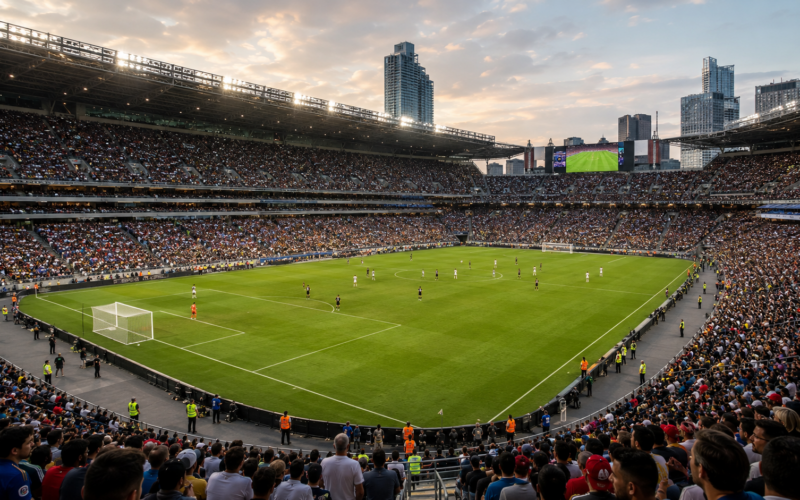
Harry Kane scored twice during the final 15 minutes as England came from behind to defeat DR Congo 2-1 in their FIFA World Cup 2026 Round of 32 match at Atlanta Stadium in Atlanta, Georgia, on Wednesday, July 1, 2026. Brian Cipenga had given DR Congo a seventh-minute lead before Kane equalised in the 75th minute and struck the winner in the 86th.
Cipenga’s first international goal arrived after Chancel Mbemba switched play over England’s defensive line and exposed an unmarked runner on the left side of the penalty area. The forward drove a low shot past Jordan Pickford at the near post, immediately changing the tactical and emotional direction of the knockout contest.
England created enough opportunities to respond before half-time, but Lionel Mpasi produced a succession of saves, Aaron Wan-Bissaka cleared Marcus Rashford’s effort off the goal line and Yoane Wissa struck the post at the opposite end. Kane also went down following contact with Mpasi inside the penalty area, but the referee awarded no penalty and the decision was not overturned.
Anthony Gordon transformed the match after replacing Rashford in the 61st minute. He created both Kane goals as England avoided elimination, advanced to the Round of 16 and secured a meeting with co-hosts Mexico at Mexico City Stadium on Sunday, July 5, while DR Congo’s historic FIFA World Cup 2026 campaign ended in Atlanta.
FIFA World Cup 2026 England 2-1 DR Congo full match scorecard and key incidents
How did DR Congo expose England’s defensive structure within seven minutes?
DR Congo did not approach the match as a team prepared to defend permanently around its own penalty area. Sébastien Desabre selected a four-player defence and attempted to stretch England across the full width of the Atlanta pitch.
The opening goal demonstrated the value of that approach. Mbemba received possession with enough time to lift a diagonal pass towards the left side of England’s penalty area, where Cipenga had moved into the space outside Djed Spence.
Spence was left attempting to monitor both Cipenga and Noah Sadiki after England’s central defenders had narrowed towards the ball. Noni Madueke did not recover quickly enough to protect the outside channel, allowing Cipenga to receive completely unmarked.
Pickford could still have prevented the goal, but Cipenga’s low strike travelled beneath the goalkeeper’s attempted intervention at the near post. England were therefore punished by a combination of poor defensive spacing, insufficient pressure on the passer and a goalkeeping error.
The goal also gave DR Congo the exact match they wanted. England were forced to construct attacks against an organised defensive block, while the African side could threaten through Cipenga, Wissa and Mbuku whenever possession changed hands.
Why did England take until the 30th minute to register their first attempt?
England controlled possession after falling behind but initially moved the ball too slowly across DR Congo’s defensive structure. Rice and Elliot Anderson received frequently in midfield, yet Desabre’s players protected the central route towards Bellingham and Kane.
DR Congo’s front line also attempted to screen Anderson, whose line-breaking passes had been central to England’s group-stage build-up. By denying him clean access to the attacking midfield zone, DR Congo encouraged England to circulate towards the flanks.
Madueke carried the greater threat on the right, but England’s early crosses were either blocked or cleared by Mbemba, Tuanzebe and Wan-Bissaka. Rashford offered width on the opposite side without consistently beating the first defender.
Bellingham’s 30th-minute header finally produced England’s first recorded attempt. Rice delivered from a deeper position and Bellingham attacked the space inside the penalty area, but Mpasi reacted sharply to push the effort away.
England’s delayed first shot reflected a team that had possession without immediate penetration. The passing was accurate, but DR Congo controlled the areas in which that possession occurred.
How did Lionel Mpasi and Aaron Wan-Bissaka protect DR Congo’s first-half lead?
Mpasi delivered one of the outstanding goalkeeping performances of the Round of 32. He made five saves across the match, with several arriving during England’s sustained pressure before half-time.
His first major intervention denied Bellingham’s header, but the most important defensive moment outside the goalkeeper came from Wan-Bissaka. Madueke created space on the right and England eventually worked the ball towards Rashford, whose close-range attempt appeared to be travelling into the net.
Wan-Bissaka recovered towards the goal line and blocked the shot before it crossed. The intervention preserved DR Congo’s advantage and demonstrated the concentration required to survive England’s increasing territorial control.
Mpasi then denied Bellingham again from Madueke’s delivery before preventing Kane from scoring at the back post. England entered half-time with four shots on target but no goal, largely because DR Congo’s goalkeeper repeatedly positioned himself correctly and reacted quickly.
The quality of Mpasi’s performance also allowed the defenders in front of him to remain aggressive. They could attack crosses and block shots knowing that the goalkeeper was dealing effectively with the opportunities that passed through the defensive line.
Why was Yoane Wissa’s shot against the post the match’s forgotten turning point?
DR Congo came within centimetres of doubling their lead shortly before half-time. Wan-Bissaka advanced on the right and delivered a low ball across England’s penalty area, where Wissa escaped his marker and redirected the cross towards goal.
The attempt struck the outside of the post. Had it travelled inside, England would have entered the interval two goals behind after conceding from DR Congo’s only two genuinely dangerous first-half attacks.
The miss became increasingly significant because England generated several chances immediately afterwards. Kane challenged Mpasi inside the penalty area, Bellingham forced another save and Kane was then denied from a Rice corner.
DR Congo therefore moved from nearly establishing a two-goal cushion to protecting a fragile single-goal lead. Their first-half plan had worked tactically, but Wissa’s failure to convert left England close enough for one successful attacking sequence to change the match.
It was DR Congo’s largest opportunity after Cipenga’s goal and accounted for most of their expected-goals total. Their threat declined considerably after the interval as England pushed them progressively deeper.
Should England have received a penalty following Harry Kane’s collision with Lionel Mpasi?
Kane reached a forward pass inside the penalty area and attempted to move around Mpasi before going to ground. Replays indicated contact between the goalkeeper and the England captain, but the referee decided that the incident did not justify a penalty.
The decision was not changed. No spot kick was awarded, and England were required to continue chasing the equaliser through open play.
The incident was important because it occurred immediately after Wissa had struck the post. England could have moved from the possibility of trailing 2-0 to receiving an opportunity to equalise within the same short sequence.
Rather than allowing frustration over the decision to dominate the second half, England continued building attacks. The penalty debate remained a major first-half incident, but it did not ultimately determine which team advanced.
For DR Congo, the decision represented another moment survived during a period of intense pressure. For England, it reinforced the need to create clearer openings rather than relying on a marginal refereeing judgment.
How did Anthony Gordon change England’s attacking geometry after replacing Rashford?
Thomas Tuchel introduced Gordon and Bukayo Saka together in the 61st minute. The change gave England two fresh wide players capable of attacking defenders directly and delivering earlier into the penalty area.
Gordon’s impact was particularly significant because his movement differed from Rashford’s. Rather than remaining close to the touchline and waiting to receive, he moved between Masuaku and Mbemba before making forward runs beyond DR Congo’s midfield.
England also altered the right side when Eze replaced Spence. Rice moved towards right-back, allowing Eze to operate higher and giving England another player between the lines.
The equaliser emerged from this altered structure. Rice moved the ball across the attacking phase towards Gordon on the opposite side, and the substitute lifted a measured cross towards Kane.
Kane escaped Tuanzebe’s marking, adjusted his body and directed a downward header towards the bottom corner. Mpasi reached the ball but could not prevent it from crossing the line.
Gordon became the first England player to record multiple goal involvements as a substitute in a FIFA World Cup match. His direct running, delivery and willingness to enter central areas gave England the attacking variation that had been missing.
Why did Harry Kane remain decisive despite spending long periods outside the match?
Kane had relatively few touches compared with England’s midfielders and wide players. DR Congo surrounded him with centre-backs and prevented England from finding him consistently during the first hour.
His influence nevertheless increased whenever the ball entered the penalty area. The equalising goal depended on his movement away from Tuanzebe and his ability to generate power while heading downwards.
The winner displayed a different part of Kane’s attacking range. Following Bellingham’s saved effort, Gordon helped England retain possession and found Kane near the edge of the penalty area.
The captain shifted the ball into shooting space while surrounded by defenders and drove a powerful right-footed finish into the upper part of the net. Mpasi, outstanding throughout the match, had no realistic opportunity to stop it.
Kane finished with five attempts and three shots on target while scoring from a personal expected-goals figure below 0.50. The numbers showed how elite finishing rather than repeated close-range chances decided the match.
His brace took him to 13 career FIFA World Cup goals, moving him above Pelé’s total of 12. Kane also became the first England player since Gary Lineker against Cameroon in 1990 to score twice in a FIFA World Cup knockout match.
Why did DR Congo’s defensive resistance finally collapse during the closing stages?
DR Congo defended 36 clearances and faced 43 attempted England crosses. That workload gradually reduced the team’s ability to move out of its own half and left fewer players available to support Wissa during transitions.
The defensive block remained organised for most of the match, but England’s substitutions increased the speed and variety of the attacks. Gordon could cross from the left, Saka carried from the right and Eze occupied central spaces around the penalty area.
Desabre attempted to refresh his side by introducing Elia, Bongonda and Edo Kayembe. The changes supplied energy but did not restore sustained possession, meaning DR Congo continued defending repeated attacking phases.
Once Kane equalised, the psychological and tactical conditions changed. DR Congo could no longer remain entirely committed to protecting the lead, while England increased pressure in pursuit of a winner before extra time.
Bellingham’s narrow-angle opportunity forced another Mpasi save, but DR Congo failed to clear the following phase securely. Gordon recovered possession, Kane found a small pocket inside the crowded penalty area and the captain punished the first opening offered.
The collapse was therefore not caused by a complete tactical failure. It resulted from accumulated defensive pressure, England’s superior bench options and one striker converting two moments that most players would not finish.
What did DR Congo prove during their first FIFA World Cup knockout appearance?
DR Congo entered the Round of 32 after drawing with Portugal, losing narrowly to Colombia and defeating Uzbekistan. Their progression marked an enormous improvement from the country’s only previous FIFA World Cup appearance as Zaire in 1974.
Against England, Desabre’s team demonstrated that its qualification was not accidental. The decision to use four defenders rather than a more conservative five-player line allowed Cipenga and Mbuku to attack the spaces beside England’s full-backs.
Mbemba led the defence and created the opening goal, Mpasi delivered an exceptional goalkeeping performance and Wan-Bissaka produced a crucial goal-line clearance. Wissa also remained a credible counterattacking threat until England established greater control.
DR Congo were eliminated, but they led one of the tournament favourites for 68 minutes and came close to entering half-time with a two-goal advantage. Their performance combined defensive discipline with enough attacking ambition to make England uncomfortable.
The primary lesson is that DR Congo must become better at retaining possession once opponents increase pressure. Their defenders cleared repeatedly, but the lack of a reliable outlet allowed England to begin another attack almost immediately.
Their tournament ended with one victory, one draw and two defeats, but the competitive level was far removed from the three losses and 13 conceded goals recorded in 1974.
What must England improve before facing Mexico at the Azteca Stadium?
England cannot afford another slow start against a Mexico side playing in familiar conditions before an overwhelmingly supportive crowd. Cipenga’s goal exposed communication problems between the full-back, centre-backs and recovering winger.
Mexico’s Quiñones offers precisely the type of direct movement that caused England difficulties in Atlanta. He attacks the space behind defenders, carries the ball powerfully and combines effectively with Jiménez around the penalty area.
England must also improve the speed of its early possession. The team completed more than 90% of its passes against DR Congo but waited until the 30th minute for its first attempt, demonstrating that technical security did not automatically produce attacking danger.
Gordon’s performance creates a selection question for Tuchel. His willingness to run behind defenders and his two assists provided a stronger balance on the left than England had during the opening hour.
The physical context will also change in Mexico City. England will move from the controlled indoor conditions of Atlanta Stadium to the altitude of Mexico City, where possession management and recovery between high-intensity actions will carry greater importance.
Tuchel’s side showed resilience and attacking depth, but the defensive errors and delayed tempo remain significant warnings. Mexico have won four consecutive matches without conceding at FIFA World Cup 2026 and will present a more confident opponent than the team England narrowly eliminated.
How does England’s victory shape the FIFA World Cup 2026 knockout bracket?
England advanced to face Mexico at Mexico City Stadium on Sunday, July 5, at 8pm local time. Mexico reached the Round of 16 after defeating Ecuador 2-0 through goals from Julián Quiñones and Raúl Jiménez.
The match brings together an England side that survived a major Round of 32 scare and a Mexico team that has won four consecutive matches without conceding. England possess greater attacking depth, while Mexico will carry familiarity with the venue, altitude and home support.
The winner will advance to a quarter-final against Brazil or Norway. That bracket position is confirmed, although the identity of the quarter-final opponent will not be known until their Round of 16 match is completed.
DR Congo were eliminated after their first FIFA World Cup knockout appearance. Their departure also ended the possibility of an African team facing Mexico in the Round of 16, with England instead travelling to the co-host nation for one of the competition’s most prominent fixtures.
Key takeaways from England vs DR Congo at FIFA World Cup 2026
- England defeated DR Congo 2-1 after trailing for more than an hour in Atlanta.
- Brian Cipenga scored his first international goal to give DR Congo a seventh-minute lead.
- Lionel Mpasi made five saves as DR Congo protected their advantage until the 75th minute.
- Aaron Wan-Bissaka cleared Marcus Rashford’s first-half attempt off the goal line.
- Yoane Wissa struck the post and missed the opportunity to establish a two-goal lead.
- Harry Kane’s first-half penalty appeal was rejected and not overturned.
- Anthony Gordon replaced Rashford and assisted both of Kane’s goals.
- Kane equalised with a header before scoring the 86th-minute winner from inside the penalty area.
- Kane reached 13 career FIFA World Cup goals and moved above Pelé on the historical scoring list.
- England advanced to face Mexico in Mexico City, while DR Congo were eliminated after their first FIFA World Cup knockout match.
Share this:
Discover more from Business-News-Today.com
Subscribe to get the latest posts sent to your email.