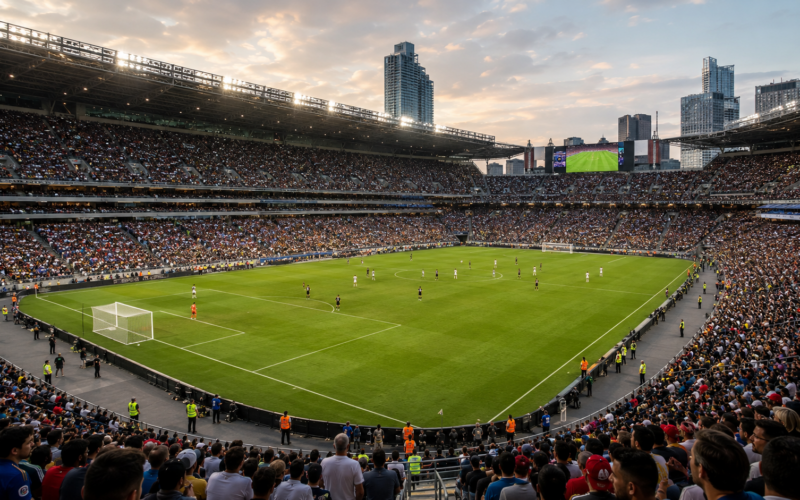
Erling Haaland scored an 86th-minute winner as Norway defeated Ivory Coast 2-1 in their FIFA World Cup 2026 Round of 32 match at Dallas Stadium in Arlington, Texas, on Tuesday, June 30, 2026. The victory carried Norway into the Round of 16 for the first time and delivered the country’s first win in a FIFA World Cup knockout match.
Antonio Nusa opened the scoring in the 39th minute after receiving Martin Ødegaard’s pass on the left. The winger moved onto his right foot and curled a precise finish beyond Yahia Fofana into the upper corner.
Substitute Amad Diallo equalised in the 74th minute after exchanging passes with Nicolas Pépé. Diallo moved past David Møller Wolfe and Sander Berge before driving a low finish beyond Ørjan Nyland.
Norway responded four minutes before the end of regulation time. Oscar Bobb released Patrick Berg inside the penalty area, and the midfielder delivered across goal for Haaland to convert from close range. Norway will now face Brazil at New York New Jersey Stadium on July 5, while Ivory Coast’s first FIFA World Cup knockout campaign ended despite a strong second-half performance.
FIFA World Cup 2026 Ivory Coast 1-2 Norway full match scorecard and key incidents
Why did Ivory Coast create the first dangerous openings without taking the lead?
Ivory Coast began with greater intensity and repeatedly attempted to isolate Norway’s full-backs. Yan Diomande attacked from the left, while Pépé received early passes on the opposite side and attempted to move inside onto his stronger foot.
Konan produced the first meaningful chance after advancing from left-back. He moved past the initial challenge and shot towards the near post, but his effort entered the side-netting rather than testing Nyland.
Diomande later switched play towards Pépé, who found space inside Norway’s penalty area. The forward failed to make clean contact, allowing the Norwegian defence to recover and clear.
Those openings demonstrated the threat in Ivory Coast’s wide positions, but the finishing lacked precision. Haaland and Norway required fewer opportunities because their forwards were more efficient when the decisive chances arrived.
The Elephants’ 14 attempts and 14 corners underline how frequently they reached attacking areas. Their elimination was not caused by an inability to advance, but by failing to convert territory into enough goals.
How did Norway recover after an uncomfortable opening 30 minutes in Dallas?
Norway began with Haaland, Ødegaard and Sørloth restored after several regular starters had been rested against France. The returning players did not immediately give Norway control because Ivory Coast pressed the midfield and attacked quickly after turnovers.
Sander Berge and Patrick Berg gradually improved their positioning. They began receiving closer to the defenders, helping Norway move beyond Franck Kessié, Ibrahim Sangaré and Christ Inao Oulai.
Sørloth also moved wider to provide a physical outlet against Konan and Guéla Doué. One of his crosses found Haaland, but the striker failed to direct the header cleanly towards goal.
That opportunity changed the rhythm. Norway started recovering second balls higher up the pitch, while Ødegaard found more space to influence attacks from the right-central area.
The breakthrough followed during Norway’s strongest spell. It was created not by an extended passing sequence, but by Ødegaard recognising that Nusa had space to attack one defender on the left.
Why was Antonio Nusa’s opening goal one of the match’s highest-quality moments?
Ødegaard moved possession towards Nusa in the 39th minute after Norway had drawn Ivory Coast’s midfield towards the opposite side. The winger received near the left corner of the penalty area with Doué positioned between him and the goal.
Nusa shaped as though he might continue towards the touchline before moving onto his right foot. The change of direction created the small shooting angle he required.
His curling effort travelled beyond Fofana’s reach and into the upper-right corner. The goalkeeper had positioned himself correctly but could not reach the precision of the finish.
The goal was Nusa’s only official shot of the match. It demonstrated why Norway value his directness alongside the physical presence of Haaland and Sørloth.
Nusa was booked during first-half stoppage time and eventually replaced in the 71st minute. His individual moment had nevertheless given Norway an advantage during a half in which Ivory Coast created several promising attacks.
Why did Erling Haaland remain peripheral despite Norway leading at half-time?
Ivory Coast defended Haaland through collective positioning rather than assigning one defender to follow him everywhere. Odilon Kossounou and Emmanuel Agbadou remained close together, while Sangaré dropped towards the defensive line when Norway attempted early crosses.
Haaland’s first significant opportunity came from Sørloth’s delivery, but his downward header lacked control. The striker later had a shot blocked after Nusa’s goal as Ivory Coast prevented him from receiving a clear view of Fofana’s net.
Norway’s attacking movements were often directed towards Nusa or Sørloth rather than through Haaland. This kept the striker away from the ball but ensured the defenders could not focus exclusively on him.
Haaland’s limited involvement did not reduce his importance. He continued occupying both centre-backs and waited for an opportunity in the six-yard area.
That patience became decisive in the 86th minute. The striker did not need repeated touches to determine the result because Norway’s substitute combination eventually created the close-range chance he had been seeking.
How did Amad Diallo transform Ivory Coast after entering in the 60th minute?
Emerse Faé introduced Diallo and Elye Wahi together after an hour, replacing Oulai and Ange-Yoan Bonny. The changes increased Ivory Coast’s attacking speed and moved an additional dribbler into positions around Norway’s penalty area.
Diallo first influenced the match defensively. Heggem reached a corner inside the six-yard box and directed an effort towards goal, but Diallo remained on the line and cleared before the ball crossed.
The intervention prevented Norway from taking a two-goal lead. It also gave Ivory Coast the opportunity to remain within one decisive attack of an equaliser.
Diallo then began combining with Pépé on the right. His ability to receive in narrow spaces forced Møller Wolfe and Berge into repeated defensive decisions.
The goal arrived only 14 minutes after Diallo entered. His contribution demonstrated that Ivory Coast had game-changing quality on the bench, while also creating the question of whether he should have started.
How did Amad Diallo create the 74th-minute equaliser from a difficult position?
Diallo exchanged a rapid one-two with Pépé near the right side of Norway’s penalty area. The pass returned to him as he moved inside Møller Wolfe.
Berge attempted to close the second route, but Diallo shifted his feet and created another shooting angle near the corner of the six-yard box. The space was narrow and Norway still had defenders between him and the far post.
Diallo opened his body and drove a low effort into the bottom-left corner. Nyland was unable to move across quickly enough because the shot travelled through a crowded area.
Pépé received the official assist, but most of the decisive work came after the return pass. Diallo beat two defenders and completed the attack without requiring another touch from a teammate.
The equaliser shifted the momentum towards Ivory Coast. The supporters increased the volume, while Norway briefly struggled to retain possession after the restart.
Why did Ivory Coast lose their defensive balance shortly after equalising?
Faé later acknowledged that his young team lacked the maturity to manage the period after drawing level. The players continued attacking with the same urgency rather than protecting the result and forcing Norway to rebuild under pressure.
The full-backs remained advanced, while midfielders moved towards the penalty area searching for a second goal. That ambition created spaces for Norway’s substitutes to exploit.
Oscar Bobb had replaced Sørloth in the 71st minute and offered a different type of threat. Rather than remaining close to Haaland, he received on the right and carried possession towards defenders.
Andreas Schjelderup stretched Ivory Coast from the opposite side. Norway therefore moved from a physically direct front line towards a faster and more mobile attacking structure.
Ivory Coast’s defenders were forced to cover larger areas as the match entered its final minutes. The winning goal came from precisely the kind of transition that their earlier compact structure had prevented.
How did Oscar Bobb and Patrick Berg create Erling Haaland’s winning goal?
Bobb received possession on the right in the 86th minute and moved inside before the nearest defender could force him towards the touchline. His run attracted multiple Ivory Coast players.
The substitute then released Berg into the right side of the penalty area. Fofana moved towards Berg to reduce the shooting angle, while the defenders retreated towards their own goal.
Berg did not attempt to score. He delivered a low pass across the six-yard area towards Haaland, who had remained behind the initial movement before accelerating into position.
Haaland’s contact was not clean, but the ball crossed the line before the defenders could recover. Berg was credited with the assist, while Bobb’s pass had created the decisive opening.
The sequence captured Norway’s attacking depth. Nusa and Sørloth had left the match, but their replacements provided the movement that ultimately delivered Haaland’s winning opportunity.
What did Erling Haaland’s fifth tournament goal mean for Norway’s historic run?
The goal was Haaland’s fifth of FIFA World Cup 2026 and the 60th of his international career. He had scored throughout Norway’s qualification campaign and continued that form during his first appearance at the tournament.
Haaland reached the milestone after being rested during Norway’s 4-1 defeat against France. Solbakken’s decision attracted criticism because the result cost Norway first place in Group I.
The Round of 32 victory provided a partial justification. Haaland returned physically fresh enough to complete the match and retain his concentration until the decisive late chance appeared.
Norway had previously reached the Round of 16 in 1938 and 1998 but lost both matches. The victory over Ivory Coast therefore became the country’s first FIFA World Cup knockout win.
The significance extended beyond one result. Norway returned to the tournament after 28 years and immediately established a new national benchmark.
How did Ørjan Nyland preserve Norway’s lead during stoppage time?
Ivory Coast reacted immediately after Haaland’s goal and introduced Oumar Diakité, Evann Guessand and Bazoumana Touré during the closing minutes. The changes placed additional attackers around Norway’s penalty area.
Diallo won a free kick approximately 30 metres from goal during the sixth minute of stoppage time. The angle was difficult, but his strike travelled towards the upper-left corner.
Nyland moved across his line and pushed the ball around the post with a strong hand. The save prevented a second Diallo goal and denied Ivory Coast extra time.
The Elephants generated another opportunity from the resulting pressure. Diallo delivered a corner towards Guessand, whose close-range header travelled wide.
Nyland completed the match with four saves. None carried greater importance than his intervention against Diallo’s free kick because Norway had almost no time available to recover from a possible equaliser.
Why should Ivory Coast view the defeat as progress despite another painful exit?
Ivory Coast returned to the FIFA World Cup after missing the 2018 and 2022 editions. Their previous three appearances had all ended during the group stage.
The Elephants defeated Ecuador and Curaçao during the opening round and qualified for the knockouts for the first time. They then competed evenly with a Norway side containing Haaland, Ødegaard and several players from major European leagues.
Faé used a relatively young squad, with many players experiencing their first FIFA World Cup. Diallo, Diomande, Oulai, Diakité and Touré offer a core capable of developing through another qualification cycle.
The defeat also exposed areas requiring improvement. Ivory Coast must convert more of their attacking pressure and learn to manage emotional periods immediately after scoring.
Their 14 corners, five shots on target and late pressure showed that the team did not leave the tournament passively. The remaining challenge is turning competitive performances into control of decisive moments.
Why will Norway’s Round of 16 meeting with Brazil create a completely different test?
Brazil reached the Round of 16 after Gabriel Martinelli’s stoppage-time goal secured a 2-1 comeback against Japan. Carlo Ancelotti’s team controlled 68% possession and produced 19 attempts in that match.
Norway are unlikely to dominate the ball against Brazil as they did for portions of the Ivory Coast contest. Solbakken may instead use a deeper structure and seek rapid attacks through Nusa, Ødegaard and Haaland.
Brazil’s defensive error against Japan demonstrated that the five-time champions can be punished when building under pressure. Haaland and Norway will attempt to target similar moments rather than relying only on prolonged possession.
The major concern is Norway’s defence. Ivory Coast created 14 attempts and forced Nyland into four saves, while Diallo repeatedly found space after entering.
Vinícius Júnior, Martinelli, Endrick and Bruno Guimarães will provide a more consistent threat. Norway must defend with greater control while preserving enough attacking ambition to supply Haaland.
How does Norway’s victory shape the FIFA World Cup 2026 knockout bracket?
Norway will face Brazil at New York New Jersey Stadium on Sunday, July 5. The winner will advance to the quarter-final scheduled for July 11.
That quarter-final opponent will emerge from the section containing Mexico, Ecuador, England and DR Congo. Brazil and Norway therefore occupy a route containing several teams with contrasting tactical styles.
Key takeaways from Ivory Coast vs Norway at FIFA World Cup 2026
- Norway defeated Ivory Coast 2-1 and recorded their first FIFA World Cup knockout victory.
- Antonio Nusa opened the scoring with a curling finish from Martin Ødegaard’s pass.
- Ivory Coast created several early openings but failed to convert their pressure.
- Amad Diallo entered in the 60th minute and cleared Torbjørn Heggem’s effort off the line.
- Diallo equalised after combining with Nicolas Pépé and beating two Norwegian defenders.
- Oscar Bobb and Patrick Berg combined to create Norway’s decisive late attack.
- Erling Haaland scored from close range in the 86th minute.
- Haaland’s winner was his fifth goal of FIFA World Cup 2026 and 60th for Norway.
- Ørjan Nyland denied Diallo’s stoppage-time free kick to preserve the victory.
- Norway will face Brazil in the Round of 16, while Ivory Coast were eliminated.
Share this:
Discover more from Business-News-Today.com
Subscribe to get the latest posts sent to your email.