




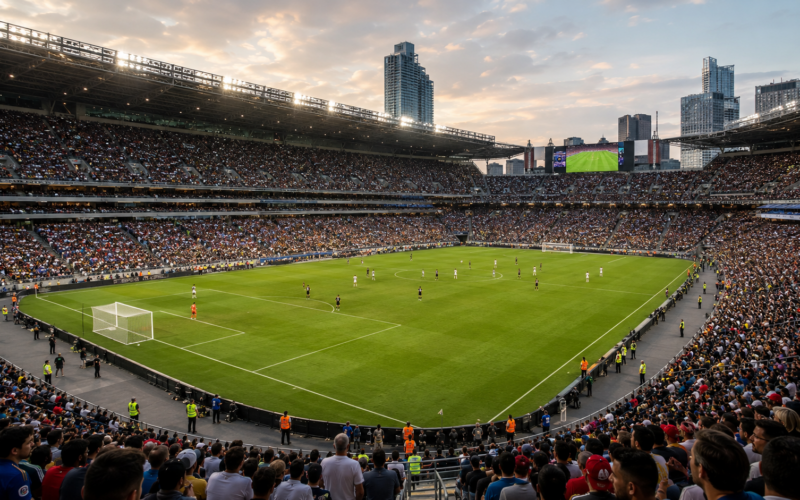
Yoane Wissa scored twice as DR Congo recovered from a half-time deficit to defeat Uzbekistan 3-1 in their decisive FIFA World Cup 2026 Group K match at Atlanta Stadium on Saturday, June 27, 2026. The historic comeback gave the Leopards their first victory at a FIFA World Cup and carried them into the knockout stage for the first time.
Eldor Shomurodov put Uzbekistan ahead in the 10th minute by racing beyond Aaron Wan-Bissaka and lifting the ball over the advancing Lionel Mpasi. DR Congo thought they had equalised through Nathanaël Mbuku later in the first half, but the goal was overturned after VAR identified a foul by the midfielder earlier in the attacking phase.
Wissa converted a 68th-minute penalty after Abdukodir Khusanov brought him down inside the area. Substitute Fiston Mayele completed the turnaround ten minutes later before Wissa added the third goal in the first minute of stoppage time.
The victory lifted DR Congo to four points and third place in Group K, enough to qualify as one of the eight strongest third-placed teams. They will remain in Atlanta to face Group L winners England in the Round of 32, while Uzbekistan exited their debut tournament after losing all three group matches.
FIFA World Cup 2026 DR Congo 3-1 Uzbekistan full match scorecard and key incidents
How did Uzbekistan threaten to transform the match inside the opening minute?
Uzbekistan began with an aggressive direct move that immediately exposed the space behind DR Congo’s defensive line. A long delivery released Khamdamov, whose attempt was blocked before Shomurodov placed the rebound into the net.
The assistant referee raised the flag because Khamdamov had moved beyond the defensive line before receiving the pass. The decision removed a goal scored within the opening 30 seconds, but it also revealed that DR Congo were vulnerable to early runs behind Wan-Bissaka and Arthur Masuaku.
Uzbekistan repeated the approach in the 10th minute. Shomurodov accelerated onto Mozgovoy’s forward pass, moved ahead of Wan-Bissaka and noticed Mpasi leaving his goal.
The captain lifted a controlled finish over the goalkeeper from the left side of the penalty area. It was Uzbekistan’s first lead at a FIFA World Cup and placed DR Congo in danger of elimination.
Why was Nathanaël Mbuku’s apparent equaliser overturned following the VAR review?
DR Congo reacted quickly to falling behind and thought they had equalised through Mbuku. Brian Cipenga carried possession down the left before the ball reached Mbuku, who drove a powerful half-volley beyond Nematov at the near post.
VAR reviewed an earlier moment in the same attacking phase. Mbuku’s trailing arm had caught Nasrullaev in the face while the two players competed for possession.
Referee Felix Zwayer was advised to review the incident at the pitch-side monitor. He ruled that Mbuku had committed a foul and cancelled the goal.
The decision became one of the match’s most debated moments because the contact occurred before the finish and appeared incidental rather than an attempt to strike the defender. DR Congo nevertheless had to continue from a goal down rather than allowing frustration to control the remainder of the half.
Why did DR Congo produce only four off-target attempts before half-time?
Uzbekistan protected their lead by dropping into a compact defensive shape. Khusanov, Rustam Ashurmatov and Nasrullaev defended close to Nematov, while the midfield restricted the central spaces available to Wissa and Bakambu.
DR Congo controlled more of the ball but circulated possession too slowly. Cipenga and Mbuku frequently received near the touchline without enough runners moving behind Uzbekistan’s wing-backs.
Wissa was also relatively quiet during the opening period. His clearest chance arrived from outside the penalty area, but the forward sent the shot over the crossbar.
The first-half expected-goals total of approximately 0.20 demonstrated how little DR Congo created despite needing a victory. Their possession lacked the speed and penalty-area occupation required to break down an opponent increasingly prepared to defend its advantage.
How did Fiston Mayele’s introduction change the structure of DR Congo’s attack?
Desabre made his first decisive change six minutes after half-time, replacing Bakambu with Mayele. The substitute remained closer to Uzbekistan’s centre-backs and attacked the six-yard area more aggressively.
The adjustment allowed Wissa to move into wider and deeper spaces before accelerating towards goal. Uzbekistan could no longer focus solely on protecting the central route because Mayele occupied defenders while Wissa and Mbuku attacked around him.
Mayele also pressed Nematov and the defenders with greater intensity. Uzbekistan’s clearances became shorter, allowing Sadiki and Moutoussamy to recover possession in advanced areas.
DR Congo registered 15 second-half attempts after managing only four before the interval. The improvement was not solely attributable to one player, but Mayele’s direct movement gave the attack a clear reference point.
Why did Abdukodir Khusanov’s penalty challenge transform the match?
Uzbekistan had defended successfully for almost an hour after Shomurodov’s goal. Their resistance ended when Wissa collected possession inside the penalty area and Khusanov attempted to challenge from behind.
The defender caught Wissa rather than playing the ball, leaving the referee with a straightforward penalty decision. Khusanov had already received a yellow card before half-time but avoided a second caution for the challenge.
Wissa waited for Nematov to commit before rolling the penalty into the bottom-right corner. The goal changed the emotional and tactical direction of the contest.
DR Congo no longer appeared desperate, while Uzbekistan began retreating more deeply. The equaliser also increased the pressure on a team that had spent much of the second half defending without offering a counterattacking outlet.
How did Fiston Mayele score the goal that completed DR Congo’s comeback?
Desabre made three additional substitutions in the 72nd minute, introducing Elia, Bongonda and Mukau. The changes gave DR Congo fresh energy across the attacking and midfield lines.
The winning goal arrived six minutes later. Elia drove a low effort towards goal, and the blocked ball spun into the space between Nematov and his defenders.
Mayele reacted before the goalkeeper could secure possession. The substitute reached the loose ball and lifted a delicate touch over Nematov into the net.
No official assist was recorded because the goal followed a blocked attempt. The finish nevertheless demonstrated the penalty-area anticipation that had been missing while DR Congo relied on slower attacks during the first half.
Mayele had entered in the 51st minute and scored the country’s first winning goal at a FIFA World Cup. His contribution also justified Desabre’s decision to change the striker while his team remained behind.
Why did Yoane Wissa become more dangerous after converting the penalty?
Wissa had struggled to influence the first half, but the penalty appeared to release the tension surrounding his performance. He became more willing to receive possession away from the penalty area and attack defenders directly.
His second goal arrived during stoppage time after Elia moved the ball towards him on the left. Wissa cut inside across the edge of the penalty area as Uzbekistan’s defenders continued retreating.
The forward was given enough time to position his body and drive a low shot into the bottom-right corner. Nematov was unable to reach the finish.
Wissa completed the match with two goals from six attempts. His tournament total increased to three, placing him among the leading African scorers at FIFA World Cup 2026.
The brace also completed a personal recovery after an injury-disrupted club season. Desabre had retained his confidence in Wissa, and the forward responded during the most important period of DR Congo’s campaign.
Why did Uzbekistan’s attacking threat disappear after the opening goal?
Uzbekistan attempted only three shots across the entire match and placed one on target. Shomurodov’s goal therefore represented both their best attack and their only accurate official attempt.
Cannavaro’s players spent increasing amounts of time protecting the penalty area rather than attempting to exploit the spaces behind DR Congo’s advanced full-backs. Shomurodov became isolated as Fayzullaev and Khamdamov dropped towards their own defenders.
The approach preserved the lead through half-time, but it imposed a major physical cost. Uzbekistan repeatedly moved laterally across the pitch as DR Congo switched possession from one wing to the other.
Cannavaro introduced Xamrobekov and Ganiev in the 58th minute to refresh the midfield. The changes did not provide an effective route out of defence, and possession continued returning quickly to DR Congo.
Once Wissa equalised, Uzbekistan lacked the attacking structure required to regain control. Their defensive plan had been built around protecting a lead rather than responding after that advantage disappeared.
What does the defeat mean for Uzbekistan after their first FIFA World Cup campaign?
Uzbekistan arrived at the tournament after achieving the country’s first qualification. The group stage nevertheless demonstrated the difference between succeeding in Asian qualifying and handling elite opposition at the finals.
Cannavaro’s side lost 3-1 to Colombia, 5-0 to Portugal and 3-1 to DR Congo. They scored twice and conceded 11 goals, leaving them with the weakest defensive record in Group K.
The match in Atlanta offered both encouragement and disappointment. Uzbekistan became the first team to lead DR Congo during the decisive contest, but they could not sustain the level required across 90 minutes.
Shomurodov, Fayzullaev, Khusanov and several younger players gained experience that could support the next qualification cycle. Uzbekistan must now improve its ability to retain possession and manage matches after taking the lead.
The immediate result was painful, but the appearance itself represented a major step for Uzbek football. The longer-term challenge is ensuring that qualification becomes part of sustained development rather than an isolated achievement.
How did DR Congo turn their 1974 disappointment into a historic knockout qualification?
DR Congo’s only previous FIFA World Cup appearance came in 1974, when the country competed as Zaire. The team lost all three matches, failed to score and conceded 14 goals.
The return after 52 years began with a 1-1 draw against Portugal, when Wissa scored the country’s first goal at the competition. A narrow 1-0 defeat to Colombia left Desabre’s team requiring victory over Uzbekistan.
The Leopards again fell behind, but their response separated this campaign from the events of 1974. Rather than collapsing after conceding or after Mbuku’s disallowed goal, they increased the pressure and scored three times during the final 23 minutes.
DR Congo became the 11th African country to progress beyond a FIFA World Cup group stage. More importantly for the country itself, the victory replaced a history defined by the 1974 defeats with a new tournament milestone.
How did the simultaneous Colombia and Portugal result determine the final Group K order?
Colombia and Portugal drew 0-0 in Miami during the simultaneous match. That result left Colombia first with seven points and Portugal second with five.
DR Congo’s victory moved them to four points and a positive goal difference. Four points guaranteed their place among the eight best third-placed teams without requiring assistance from the final Group J results.
Uzbekistan remained fourth without a point. Their minus-nine goal difference reflected the damage caused by the five-goal defeat against Portugal and the two additional three-goal losses.
The completed standings created three Round of 32 fixtures. Colombia will face Ghana, Portugal will meet Croatia and DR Congo will play England.
FIFA World Cup 2026 Group K final points table
Why could DR Congo create problems for England in the Round of 32?
England will enter the match as favourites, but DR Congo’s tournament performances suggest the contest may be more difficult than the rankings indicate. The Leopards held Portugal to a 1-1 draw and conceded only once against Colombia before producing their comeback in Atlanta.
Desabre has built a physically strong team capable of defending compactly and attacking through transitions. Wan-Bissaka, Axel Tuanzebe and Chancel Mbemba provide experience against elite forwards, while Wissa is familiar with several England players from club football.
England struggled for long periods against Ghana and Panama when required to break down compact defensive structures. DR Congo are likely to protect the centre, restrict the spaces available to Jude Bellingham and force England towards wider crossing positions.
The Leopards must avoid repeating the early defensive errors that allowed Shomurodov to score. Harry Kane, Bukayo Saka and Bellingham would punish similar hesitation more severely.
DR Congo’s opportunity will come when England’s full-backs advance. Wissa, Elia, Bongonda and Mayele can attack the spaces left behind, particularly if England lose possession before their midfield protection is established.
Key takeaways from DR Congo vs Uzbekistan at FIFA World Cup 2026
- DR Congo recovered from a half-time deficit to defeat Uzbekistan 3-1 and reach the Round of 32.
- Eldor Shomurodov gave Uzbekistan the lead in the 10th minute with a finish over Lionel Mpasi.
- Shomurodov had an earlier opening-minute goal disallowed for offside.
- Nathanaël Mbuku’s apparent equaliser was overturned after VAR identified a foul during the build-up.
- Yoane Wissa converted a 68th-minute penalty after Abdukodir Khusanov brought him down.
- Fiston Mayele scored the winning goal after entering as a substitute in the 51st minute.
- Wissa completed his brace with a low stoppage-time finish from Meschack Elia’s pass.
- DR Congo attempted 19 shots compared with only three from Uzbekistan.
- The victory was DR Congo’s first at a FIFA World Cup and secured their first knockout-stage appearance.
- DR Congo will face England in Atlanta, while Uzbekistan exited their debut tournament without a point.
Discover more from Business-News-Today.com
Subscribe to get the latest posts sent to your email.