


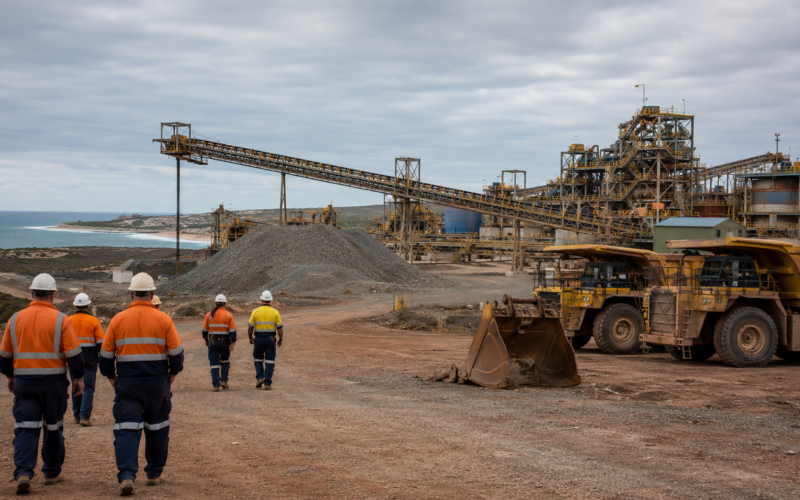
Mineral Resources Limited (ASX: MIN) will cease operations at the Lucky Bay garnet project in Western Australia on July 1, 2026, affecting approximately 110 employees less than a year after the diversified miner acquired the asset.
The company said conflict in the Middle East had materially weakened Lucky Bay’s financial performance because the region represents a significant proportion of the project’s sales. Higher diesel and shipping costs placed further pressure on the operation, leading a strategic review to conclude that continued production was no longer in the interests of Mineral Resources or its shareholders.
Affected workers will be offered redeployment opportunities across the company’s other operations where suitable, meaning the announcement does not necessarily translate into 110 immediate redundancies. Mineral Resources will also consider a potential divestment and expects to recognise an approximately A$40 million non-cash impairment in its fiscal 2026 results.
The closure raises questions that extend beyond a relatively small industrial-minerals asset. It tests Mineral Resources’ acquisition discipline, shows how geopolitical disruption can travel through commodity supply chains and places another Western Australian community under pressure from an abrupt change in mining employment.
Why is Mineral Resources closing Lucky Bay only nine months after taking control?
Mineral Resources acquired Lucky Bay in September 2025 through an asset and share sale agreement with the administrators of Resource Development Group Limited. The transaction was intended to preserve potential value from assets connected to a company in administration rather than representing a conventional acquisition of an established, strongly profitable business.
At the time, Mineral Resources said it would assess how best to realise value from the acquired operations for shareholders. The board handled the transaction while Managing Director Chris Ellison and company representatives associated with Resource Development Group were excluded from the relevant deliberations.
The subsequent closure suggests the economics deteriorated or proved weaker than Mineral Resources could justify after reviewing the operation within its broader portfolio. Lucky Bay’s exposure to Middle Eastern buyers left it particularly vulnerable when regional conflict disrupted trade and purchasing conditions.
The project also faced a cost structure shaped by diesel consumption and international shipping. Garnet is a bulk industrial product rather than a high-value precious metal, meaning freight and energy costs can consume a substantial portion of the selling price. A mine can possess a functioning resource and willing customers yet remain uneconomic when the cost of moving material overwhelms its margin.
Mineral Resources could have continued supporting the operation in the hope that trade conditions improved. Instead, the company chose to preserve the asset through care and maintenance, recognise the impairment and explore a sale. That decision indicates a lower tolerance for carrying marginal operations while the broader group focuses on balance-sheet strength and higher-priority iron ore, lithium and mining-services businesses.
How did the Middle East conflict turn into a Western Australian workforce problem?
The Lucky Bay decision illustrates how employment at a remote Australian mine can depend on events thousands of kilometres away.
The Middle East represents an important market for the project’s garnet production. Garnet is commonly used as an industrial abrasive, including for surface preparation and waterjet cutting. When regional conflict interrupts commercial activity, infrastructure work, shipping routes or customer purchasing, demand can weaken quickly.
The same disruption can increase the cost of producing and exporting the material. Mineral Resources identified materially higher diesel and shipping expenses as important factors in its decision. Mines depend on fuel for extraction, mobile equipment, processing and product transport, while export-focused operations remain exposed to freight rates and shipping availability.
Lucky Bay was therefore hit on both sides of its income statement. Demand from an important customer region weakened while the cost of supplying that market increased.
A large diversified miner may be able to absorb such pressure temporarily, but doing so must compete with alternative uses of capital. Every dollar spent supporting Lucky Bay is a dollar unavailable for debt reduction, iron ore operations, lithium growth or projects with stronger prospective returns.
The A$40 million impairment is non-cash, meaning it does not represent a new A$40 million payment when the results are reported. It reflects a reduction in the accounting value of the project after management reassessed the income it is likely to generate. Nevertheless, the writedown confirms that the company no longer expects Lucky Bay to deliver the value previously carried on its balance sheet.
Are all 110 Lucky Bay employees expected to lose their jobs?
Mineral Resources has said approximately 110 employees will be affected, but it has not stated that every worker will be made redundant.
The company plans to offer redeployment across its other operations where suitable. Mineral Resources has extensive businesses in iron ore, lithium, energy and mining services throughout Western Australia, creating potential destinations for workers whose qualifications, experience and location preferences match available roles.
The practical outcome will depend on several factors, including the number of vacancies, employee skills, roster arrangements and willingness to relocate. A role at Lucky Bay near Kalbarri cannot automatically be replaced by a position at an operation hundreds of kilometres away, particularly for workers with families or community ties.
Plant operators, mechanical trades, electrical technicians, maintenance workers, laboratory personnel, safety professionals, logistics specialists and site administrators may possess transferable mining-industry experience. However, the company has not published a role-by-role breakdown, redeployment timetable, severance structure or salary information.
That uncertainty matters. “Redeployment where suitable” protects the possibility of continued employment but does not guarantee a comparable position, roster, location or remuneration package.
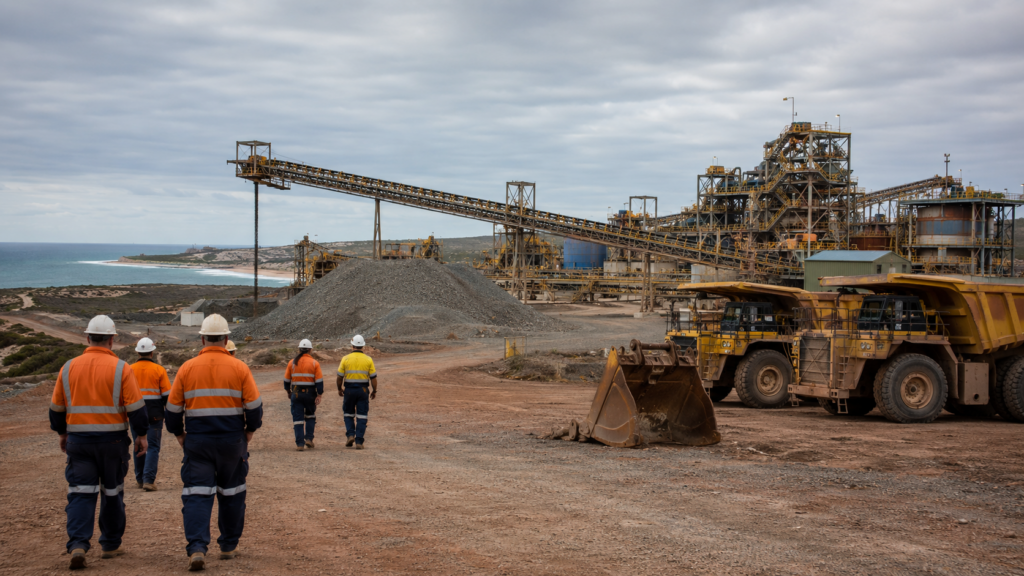
Employees will need clarity on whether alternative roles are permanent, whether relocation assistance is available and how long they have to accept an offer. Workers who cannot be redeployed will also need information about notice periods, accrued entitlements and redundancy arrangements.
What will the Lucky Bay closure mean for Kalbarri and surrounding communities?
The employment impact may be modest relative to the overall Mineral Resources workforce, but it is potentially significant for the local economy.
Lucky Bay is located south of Kalbarri in Western Australia’s Mid West, roughly 600 kilometres north of Perth. Regional mining operations support more than direct site employment. They generate spending for accommodation, transport, maintenance contractors, suppliers and local service businesses.
Australian Broadcasting Corporation reporting indicated that communities around Kalbarri were preparing for the economic effect of more than 100 positions disappearing from the operation. The closure could reduce household spending and contractor activity, even when some employees are redeployed elsewhere.
The speed of the transition increases the challenge. Mineral Resources announced the decision on June 25, with care and maintenance scheduled to begin on July 1. Although the company may have conducted an internal strategic review before the announcement, the public timeline provides little time for local businesses to adjust.
Care and maintenance is not necessarily permanent closure. A reduced team may remain to secure the site, manage environmental obligations and preserve equipment. Operations could restart if market conditions improve or a new owner develops a more viable commercial strategy.
However, communities cannot plan around a possible future restart without a buyer, timetable or improved market outlook. For employment purposes, the immediate effect is a substantial reduction in operating activity.
Why would Mineral Resources close one mine while investing elsewhere and creating other jobs?
Lucky Bay’s closure should not be interpreted as a group-wide retreat from mining investment.
Mineral Resources reported record first-half fiscal 2026 performance, supported by stronger lithium prices, increased output and improved recoveries. Its lithium operations generated A$167 million in earnings before interest, taxes, depreciation and amortisation during the period, while production increased at Wodgina and Mount Marion.
The company has also been expanding selected lithium operations and has previously restarted assets when commodity conditions improved. That creates potential redeployment capacity, although the availability of positions will not necessarily match the skills or circumstances of every Lucky Bay employee.
This is portfolio management rather than a contradiction. Diversified mining companies regularly invest in operations with improving economics while suspending assets that cannot meet return thresholds.
The uncomfortable part is that capital can move more easily than people. A company can redirect spending from garnet to lithium through a board decision, but a worker cannot always move from Kalbarri to another mine without disrupting housing, schooling and family arrangements.
For investors, closing an underperforming operation can be rational even when the company remains profitable. The decision prevents further operating losses and allows management to focus on assets capable of generating stronger cash flow.
For employees, the relevant measure is not the group’s overall growth. It is whether that growth creates accessible jobs before their current roles end.
Does the closure signal a tougher approach to workforce and portfolio restructuring?
Mineral Resources has already demonstrated a willingness to reduce its workforce when operating conditions require it.
The company disclosed in 2025 that approximately 1,740 roles had been removed across its head office and operating sites as part of cost-reduction initiatives. It also placed the Bald Hill lithium operation into care and maintenance during a period of weak lithium pricing before later moving towards renewed activity as market conditions strengthened.
Lucky Bay fits that broader pattern of adjusting capacity rather than supporting every asset indefinitely. The difference is that this project was acquired only recently, making the closure a visible test of whether management performed sufficient due diligence and whether the asset ever had a realistic route to acceptable profitability.
The company may argue that conditions changed materially after the acquisition, particularly because of Middle East conflict and freight costs. Investors may still question why Lucky Bay was acquired without greater protection against demand concentration and operating-cost volatility.
A potential divestment could partially recover value and transfer the project to an owner with a different customer network or cost structure. A sale would also reduce future care-and-maintenance liabilities.
The outcome will reveal whether Mineral Resources has preserved a saleable asset or merely delayed a permanent closure.
How does the Lucky Bay decision fit Mineral Resources’ governance reset?
The project has historical sensitivity because it was acquired from the administrators of Resource Development Group Limited, a business previously connected to people associated with Mineral Resources’ leadership.
Mineral Resources emphasised that its board controlled the September 2025 acquisition decision and that individuals facing potential conflicts did not participate in the relevant deliberations. That governance separation was intended to demonstrate that the transaction served shareholders rather than related interests.
The decision to stop operating Lucky Bay can be interpreted as another step towards applying conventional commercial discipline to a complicated inherited relationship. Management is accepting an impairment rather than continuing to support the asset to defend the original transaction.
That does not erase questions about the capital already committed. It does show that the company is prepared to recognise that the operation no longer meets its requirements.
The timing also comes as Mineral Resources continues a broader leadership and governance transition. Investors are watching succession planning, board oversight and the company’s treatment of historical related-party issues. The handling of Lucky Bay will therefore be judged not only as an operating decision but as evidence of whether governance reforms are changing capital allocation.
What does Mineral Resources stock performance reveal about investor sentiment?
Mineral Resources shares closed at A$63.14 on June 26, down approximately 1.6% during the session.
The stock had fallen about 8.7% across the five trading sessions from June 19 and approximately 11.7% compared with its May 26 closing level. Shares remained within a wide 52-week range of A$20.62 to A$74.94, leaving the stock about 15.7% below its annual high but still substantially above the lows recorded a year earlier.
The recent weakness cannot be attributed entirely to Lucky Bay. Australian mining stocks have faced commodity-price pressure, and Mineral Resources investors are also evaluating debt, lithium conditions, iron ore performance and leadership succession.
The closure is unlikely to materially change group earnings by itself because Lucky Bay is small compared with the company’s principal operations. The A$40 million impairment is also non-cash.
However, investor reaction may reflect concern about acquisition quality and the possibility of further undisclosed costs. Shareholders may ask whether other peripheral assets require review and whether care-and-maintenance spending will continue after production stops.
The positive interpretation is that management is acting quickly to stop losses. The negative interpretation is that an asset acquired nine months earlier has failed faster than expected. Both readings can be true at the same time.
What should affected workers and investors watch after operations cease on July 1?
Employees should watch for the number and location of formal redeployment offers. The quality of the company’s response will depend less on the promise to support workers and more on how many people receive practical alternatives with reasonable conditions.
Investors should look for additional detail in Mineral Resources’ fiscal 2026 full-year results, including the final impairment, closure expenses and ongoing care-and-maintenance obligations.
The company’s strategic review remains open because a potential divestment is still under consideration. Interest from a buyer would provide evidence that Lucky Bay retains economic or strategic value despite its current difficulties.
Customers and suppliers should monitor whether existing contracts are completed, suspended or transferred. The shutdown may affect local contractors and transport providers even when they are not included in the 110-employee figure.
The broader test is whether Mineral Resources can redeploy people as efficiently as it reallocates capital. Workforce promises are easiest to make when announcing a closure. Their credibility becomes visible only after employees begin receiving offers.
What are the key takeaways from the Mineral Resources Lucky Bay closure?
Mineral Resources will cease production at Lucky Bay and place the garnet project into care and maintenance from July 1, 2026. Approximately 110 employees are affected, although redeployment opportunities could reduce the number of permanent job losses.
The operation has been hit by weaker sales into the Middle East, together with substantially higher diesel and shipping costs. Mineral Resources expects to record an approximately A$40 million non-cash impairment and may sell the project.
The closure comes only nine months after the company acquired Lucky Bay from the administrators of Resource Development Group Limited. That short ownership period raises legitimate questions about the asset’s original commercial assumptions and the speed at which external conditions undermined them.
For Kalbarri and nearby communities, the immediate concern is the loss of mine-related income and spending. For investors, the decision demonstrates financial discipline but also adds scrutiny to Mineral Resources’ acquisition and governance record.
Share this:
Discover more from Business-News-Today.com
Subscribe to get the latest posts sent to your email.