

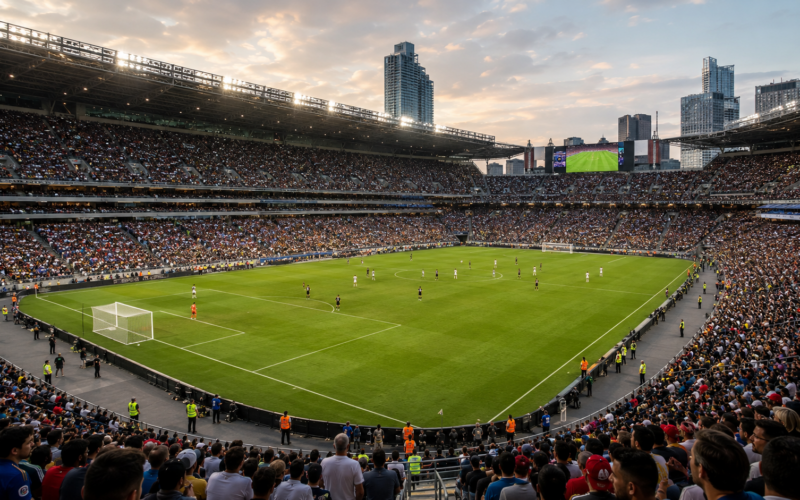
South Africa defeated Korea Republic 1-0 in their decisive FIFA World Cup 2026 Group A match at Monterrey Stadium in Monterrey, Mexico, on Wednesday, June 24, 2026. The match began at 7pm local time and concluded during the morning of June 25 in India, with an official attendance of 51,243 watching South Africa make national football history.
Thapelo Maseko scored the only goal in the 63rd minute, one minute after Tshepang Moremi entered as a substitute. Moremi found a gap in Korea Republic’s defensive line, and Maseko shifted the ball onto his left foot before driving a low finish into the bottom-right corner.
Korea Republic controlled 68% of possession and introduced Son Heung-min at half-time, but Hugo Broos’ compact South African defence restricted them to eight attempts and three shots on target. Aubrey Modiba made a crucial goal-line clearance from Kim Min-jae in the second minute, while Ronwen Williams protected the lead during Korea Republic’s late pressure.
The victory lifted South Africa to second place in Group A with four points and secured their first appearance in the knockout stage of a FIFA World Cup. Mexico won the group with nine points, Korea Republic finished third with three points and an unresolved best-third-place qualification position, while Czechia were eliminated in fourth place.
FIFA World Cup 2026 South Africa 1-0 Korea Republic full match scorecard and key incidents
How did South Africa’s compact 4-2-3-1 overcome Korea Republic’s overwhelming possession?
The possession figures suggested Korea Republic controlled the match, but the territorial reality was more complicated. South Africa willingly allowed Hong Myung-bo’s defenders and deeper midfielders to circulate the ball while concentrating their pressure around the central spaces that Lee Kang-in and Hwang Hee-chan wanted to occupy.
Sphephelo Sithole and Thalente Mbatha protected the area in front of the centre-backs, while Relebohile Mofokeng and Oswin Appollis narrowed their positions when Korea Republic attempted to play through midfield. This created a compact block that repeatedly forced the ball towards the flanks.
Korea Republic could advance into wide areas, but their crossing lacked accuracy and South Africa maintained numerical strength inside the penalty area. Mbekezeli Mbokazi and Ime Okon stayed close to Oh Hyeon-gyu, while Modiba and Khuliso Mudau recovered quickly whenever the wing-backs moved forward.
South Africa’s 32% possession was therefore part of the tactical design rather than evidence of complete domination by Korea Republic. Broos prioritised compactness, counterattacking space and the prevention of clear central chances over prolonged control of the ball.
Why was Aubrey Modiba’s early goal-line clearance as important as Maseko’s winner?
Korea Republic nearly changed the match after only two minutes when Kim Min-jae attacked a corner and powered a header towards goal. Modiba was positioned on the line and blocked the attempt before South Africa had fully settled into their defensive structure.
An early goal would have transformed the qualification equation. Korea Republic needed only a draw to finish second, while South Africa required victory, so falling behind would have forced Broos’ team to abandon their compact approach and take greater attacking risks.
Lee Kang-in then sent another opportunity narrowly wide after moving into space inside the penalty area. Those two incidents represented Korea Republic’s strongest attacking period and demonstrated the danger South Africa faced before establishing control.
Modiba’s intervention allowed South Africa to remain patient. Rather than chasing the game, they could defend the central zones, wait for transition opportunities and gradually test Korea Republic’s high defensive line.
How did South Africa create the better first-half chances despite having less of the ball?
South Africa’s attack was built around speed rather than possession volume. Maseko and Appollis looked to run beyond Korea Republic’s wing-backs, while Makgopa occupied the centre-backs and created space for Mofokeng to receive between midfield and defence.
Maseko nearly reached a through ball in the 19th minute, but Lee Gi-hyuk recovered with an excellent last-ditch challenge. The opportunity demonstrated how vulnerable Korea Republic could become when their midfield possession broke down and the defensive line was left exposed.
The clearest chance arrived in the 30th minute. Mbatha drove a powerful effort towards goal, Kim Seung-gyu parried it and then recovered quickly enough to smother Makgopa’s follow-up.
South Africa completed the half with fewer passes but greater attacking clarity. Their transitions reached the penalty area more directly, while Korea Republic’s longer possession sequences frequently ended with a blocked cross or a pass back into midfield.
Why did Korea Republic’s three half-time changes fail to unlock South Africa’s defence?
Hong responded aggressively at the interval by introducing Son Heung-min, Kim Jin-gyu and Jens Castrop. Hwang Hee-chan, Paik Seung-ho and Lee Tae-seok were withdrawn as Korea Republic abandoned the original back-three structure and moved towards a back four.
The changes increased the number of attacking players and gave Lee Kang-in more freedom to move across the pitch. Son became captain following Kim Min-jae’s eventual substitution and attempted to receive between the defensive and midfield lines.
South Africa adjusted by narrowing the distances between Sithole, Mbatha and the centre-backs. Whenever Son received possession, he was usually surrounded by multiple defenders and forced to play away from goal.
Son recorded more involvement than during the opening half, but little of it occurred inside the penalty area. Korea Republic’s possession increased without producing the sharp combinations, diagonal runs or accurate final passes required to separate South Africa’s defensive lines.
How did Tshepang Moremi change the match within one minute of entering as a substitute?
Broos introduced Moremi for Appollis in the 62nd minute, seeking fresh speed against a Korea Republic defence that had moved higher after the interval. The substitution produced an immediate result.
Moremi collected possession during a transition and identified a gap between the central defenders. His pass reached Maseko inside the penalty area, where the forward shifted the ball away from the recovering challenge and finished accurately with his left foot.
The move contained the central reason South Africa won. Korea Republic had more of the ball but became vulnerable immediately after losing it, while South Africa required only a small number of controlled passes to reach a scoring position.
Maseko’s finish also rewarded an influential individual performance. He attempted five shots, made repeated runs behind the defence and remained South Africa’s most dangerous attacker before being replaced by Rayners in the 75th minute.
How did South Africa protect the lead during Korea Republic’s final attacking push?
Korea Republic replaced Kim Min-jae with Park Jin-seob and later introduced Cho Gue-sung for Oh Hyeon-gyu. Those changes increased their aerial presence and reflected a shift towards crosses, second balls and direct deliveries into the penalty area.
South Africa responded by defending deeper without completely abandoning their counterattacking threat. Rayners replaced Maseko to provide fresh running, while Adams entered for Mofokeng to strengthen the midfield during the final ten minutes.
Modiba was booked in the 72nd minute for a challenge during Korea Republic’s pressure, while Cho received a yellow card six minutes later. The contest remained physical but controlled, with no red cards, penalties or decisive VAR interventions.
Williams made an important late save from Park Jin-seob’s header and dealt confidently with several crosses. Korea Republic accumulated six corners, but South Africa continued winning the first contact or positioning a second defender behind the initial challenge.
The closing six minutes of stoppage time required concentration rather than tactical reinvention. South Africa protected the centre, resisted the temptation to chase the ball into wide areas and allowed Korea Republic to deliver from positions that favoured the defenders.
Why did Korea Republic’s 68% possession produce only eight attempts at goal?
Korea Republic’s possession lacked vertical progression. Hwang In-beom regularly received the ball in deeper midfield positions, but South Africa prevented him from connecting quickly with the attackers between the lines.
The wing-backs and later full-backs were allowed to advance, yet their deliveries rarely found a teammate in a clear shooting position. South Africa’s centre-backs controlled the aerial space, and the midfielders recovered towards the edge of the penalty area to block second-phase shots.
Korea Republic also lacked off-ball movement behind South Africa’s defensive line. Son and Lee Kang-in often moved towards the ball rather than stretching the defenders with runs in opposite directions.
The official statistics captured the problem clearly. Korea Republic had more than twice as much possession but registered five fewer attempts and one fewer shot on target than South Africa.
Hong’s team did not lose because it lacked access to the ball. It lost because South Africa controlled where that possession could become dangerous and punished the most important defensive opening at the other end.
How did the result determine the final FIFA World Cup 2026 Group A standings?
Mexico completed Group A with three victories, nine points and no goals conceded. South Africa recovered from their opening defeat to Mexico by drawing with Czechia and defeating Korea Republic, giving them four points and second place.
Korea Republic finished third with three points after defeating Czechia but losing to Mexico and South Africa. Their goal difference of minus one placed them ahead of Scotland’s three-point record, but qualification could not be confirmed until more groups completed their final fixtures.
Czechia finished fourth with one point and were eliminated. Their only result came from the 1-1 draw against South Africa.
South Africa and Korea Republic finished with identical goal differences and goals scored, but the direct result between the teams placed South Africa above Korea Republic. The victory therefore carried both immediate and historic importance.
FIFA World Cup 2026 Group A final points table
What does the Canada fixture mean for South Africa’s historic knockout opportunity?
South Africa will face Canada at Los Angeles Stadium in Inglewood, California, on Sunday, June 28, 2026. Both countries will be appearing in a FIFA World Cup knockout match for the first time, guaranteeing that one will reach the Round of 16 for the first time.
Canada present a different challenge from Korea Republic. Jesse Marsch’s side scored eight goals during the group stage, including six against Qatar, and possess greater speed in wide areas than South Africa faced in Monterrey.
Broos is unlikely to abandon the compact structure that delivered qualification. However, South Africa will need longer periods of controlled possession because defending close to their own penalty area for most of the match would invite sustained pressure from Canada’s runners and overlapping full-backs.
Maseko and Moremi demonstrated that South Africa can threaten space during transitions. Makgopa’s ability to hold the ball and connect with the wide forwards will become especially important if Canada press aggressively and leave defenders isolated.
The winner will advance to face the winner of the Round of 32 match between the Netherlands and Morocco. South Africa’s route is difficult, but the Canada fixture offers a genuine opportunity to extend an already historic campaign.
What must happen for Korea Republic to progress through the third-place ranking?
Korea Republic completed Group A with three points, two goals scored, three conceded and a goal difference of minus one. Their record placed them above Scotland, who also had three points but finished with a goal difference of minus three.
Three points did not guarantee qualification. Korea Republic required enough of the remaining third-placed teams to finish with fewer points or an inferior goal difference and goals-scored record.
Teams finishing third with four points would automatically rank above Korea Republic. Teams ending with three points could also move ahead through goal difference, followed by goals scored and the remaining FIFA tiebreakers.
Korea Republic therefore had no confirmed next fixture when the match report was prepared. Their fate depended entirely on results from groups that had not yet completed the final round.
Key takeaways from South Africa vs Korea Republic at FIFA World Cup 2026
- South Africa defeated Korea Republic 1-0 and reached the FIFA World Cup knockout stage for the first time.
- Thapelo Maseko scored the decisive goal in the 63rd minute with a low left-footed finish.
- Tshepang Moremi assisted the winner only one minute after entering as a substitute.
- Aubrey Modiba cleared Kim Min-jae’s early header from the goal line.
- Kim Seung-gyu made a first-half double save from Thalente Mbatha and Evidence Makgopa.
- Korea Republic controlled 68% possession but recorded only eight attempts and three shots on target.
- Son Heung-min entered at half-time as Korea Republic changed from a back three to a back four.
- South Africa finished second in Group A with four points and will face Canada in the Round of 32.
- Korea Republic finished third with three points and remained dependent on the best-third-place ranking.
- Czechia were eliminated, while Mexico completed a perfect nine-point group campaign.
Share this:
Discover more from Business-News-Today.com
Subscribe to get the latest posts sent to your email.