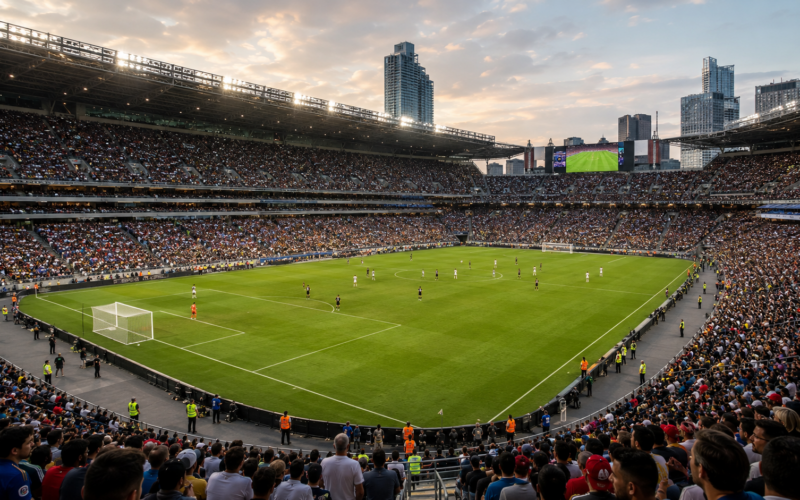
Bosnia and Herzegovina defeated Qatar 3-1 in their final FIFA World Cup 2026 Group B match at Seattle Stadium in Seattle, Washington, on Wednesday, June 24, 2026. The match, played before 66,925 spectators, finished during the early hours of June 25 in India and delivered Bosnia and Herzegovina’s first qualification for the knockout stage of a FIFA World Cup.
Kerim Alajbegović opened the scoring in the 29th minute with a powerful individual finish after receiving the ball from Ivan Bašić. Bosnia and Herzegovina doubled their advantage five minutes later when Edin Džeko’s attempt took decisive deflections inside the Qatar penalty area and resulted in an own goal.
Qatar captain Hassan Al-Haydos reduced the deficit in the 42nd minute after Edmílson Junior found space to deliver the final pass across the penalty area. Qatar then came within centimetres of equalising when Pedro Miguel struck the post in first-half stoppage time, but substitute Ermin Mahmić settled the contest in the 80th minute after Dennis Hadžikadunić helped recycle a corner.
The victory left Bosnia and Herzegovina third in Group B with four points, level with Canada but behind the tournament co-hosts on the applicable tiebreakers. Switzerland won the group with seven points, Canada finished second, Bosnia and Herzegovina advanced as one of the eight best third-placed teams, and Qatar were eliminated after collecting one point from three matches.
FIFA World Cup 2026 Bosnia and Herzegovina 3-1 Qatar full match scorecard
How did Bosnia and Herzegovina’s aggressive 4-4-2 seize control before Qatar could settle?
Bosnia and Herzegovina approached the contest as a team that understood victory was essential. Sergej Barbarez used a 4-4-2 in which Edin Džeko and Ermedin Demirović occupied Qatar’s central defenders, while Alajbegović and Esmir Bajraktarević provided width, direct running and the ability to move inside between defensive lines.
The pressure was immediate. Mahmoud Abunada was required to make early saves as Bosnia and Herzegovina attacked second balls, prevented Qatar from establishing a comfortable passing rhythm and forced Julen Lopetegui’s side to defend closer to their penalty area than intended.
Ivan Bašić and Ivan Šunjić were important in sustaining that territorial advantage. Rather than allowing Qatar to clear and reset, Bosnia and Herzegovina frequently recovered possession in advanced areas and restarted attacks before Akram Afif or Edmílson Junior could lead a counterattack.
Qatar still carried a transition threat, particularly when Bosnia and Herzegovina committed both wide midfielders forward. Šunjić’s recovery challenge on Afif during the opening exchanges prevented an early warning from becoming a potentially match-changing opportunity.
Why did Kerim Alajbegović’s individual quality transform the tactical balance of the match?
The opening goal arrived after the match had temporarily settled following Bosnia and Herzegovina’s intense start. Alajbegović received possession from Bašić, advanced through pressure and created his own shooting angle before driving the ball beyond Abunada from outside the penalty area.
It was not merely an aesthetically impressive goal. The strike forced Qatar to abandon some of their caution and increased the spaces available to Džeko, Demirović and Bosnia and Herzegovina’s advancing midfielders.
Alajbegović’s ability to move from a wide starting position into central shooting areas repeatedly complicated Qatar’s defensive assignments. The 18-year-old could carry the ball directly at defenders, combine with the strikers or attack the space outside Qatar’s holding midfielder, making him difficult to contain with a single marker.
The goal also provided a visible connection between Bosnia and Herzegovina’s emerging generation and the experience represented by Džeko. On the day of his 150th international appearance, the 40-year-old captain remained the focal point around whom younger attackers could make aggressive supporting runs.
How did Edin Džeko’s positioning force the own goal and nearly end the contest early?
Bosnia and Herzegovina’s second goal developed from their ability to keep Qatar under pressure after a set-piece sequence. Džeko positioned himself beyond the main defensive line, attacked the ball at the back post and directed an effort across goal.
The ball took decisive contact inside the six-yard area, involving defender Sultan Al-Brake and goalkeeper Mahmoud Abunada before crossing the line. The formal own-goal attribution varied between match records, but the tactical cause was clear: Qatar failed to control Džeko’s movement and could not clear the second phase.
Džeko almost added a third four minutes later after Alajbegović released him into space. His shot struck the right post, leaving Qatar within two goals when the match could already have moved beyond recovery.
That miss became more significant when Qatar responded before the interval. Bosnia and Herzegovina had created enough opportunities to establish a decisive lead, but their failure to convert the next chance allowed the match to remain competitive.
Why did Hassan Al-Haydos’ goal expose a weakness Bosnia must address before the knockout stage?
Qatar’s goal in the 42nd minute demonstrated why their attacking players remained dangerous despite the difficult tournament. Edmílson Junior reached a productive position and delivered the ball across the penalty area, where Al-Haydos arrived to finish from close range.
Bosnia and Herzegovina’s defensive structure had become stretched after the second goal. Their midfield pressure was less coordinated, Qatar began finding spaces behind the wide players, and the defensive line became vulnerable to deliveries across the face of goal.
Pedro Miguel nearly completed the comeback before half-time after Afif helped construct one of Qatar’s best combinations. His low attempt struck the post during stoppage time, giving Bosnia and Herzegovina a reminder that the scoreline had not yet secured the result.
The sequence provides an important warning for the knockout phase. Bosnia and Herzegovina defended the centre strongly for much of the match, but cutbacks, switches of play and runners arriving away from the ball caused greater difficulty than direct attacks through their centre-backs.
How did the half-time changes help Bosnia and Herzegovina survive Qatar’s improved second-half pressure?
Barbarez responded at the interval by introducing Benjamin Tahirović for Šunjić and Amar Memić for Arjan Malić. The changes provided fresh legs in midfield and on the flank at a point when Qatar had begun moving the ball with greater confidence.
Bosnia and Herzegovina subsequently defended deeper, reducing the space behind their back line and accepting that Qatar would have longer periods of possession. This made the second half less comfortable from an attacking perspective, but it limited Qatar’s ability to turn possession into clear shots inside the penalty area.
Afif attempted to take greater responsibility and produced efforts in the 57th and 60th minutes. Qatar later introduced Almoez Ali, their record goalscorer, but Bosnia and Herzegovina’s compact defensive block restricted the quality of service reaching him.
Nikola Vasilj remained alert during the closing stages, particularly when Pedro Miguel and Almoez Ali tested the goalkeeper in stoppage time. Those saves protected the two-goal margin, although they arrived after Mahmić had already provided the decisive moment.
Why were Dennis Hadžikadunić and Ermin Mahmić the substitutions that finally decided the result?
Hadžikadunić replaced Nikola Katić and Mahmić entered for Džeko during the 64th minute. The double change removed Bosnia and Herzegovina’s most experienced forward but added defensive stability, energy and a runner capable of attacking loose balls.
Their impact became decisive following an 80th-minute corner. Qatar failed to complete the clearance, Hadžikadunić helped return the ball into the danger area and Mahmić maintained his composure during a crowded sequence to finish beyond Abunada.
The goal illustrated the strength of Barbarez’s bench management. Both the scorer and the provider had entered during the second half, allowing Bosnia and Herzegovina to regain control through fresh players rather than relying solely on increasingly tired starters.
Mahmić was booked two minutes later after removing his shirt during the celebration. Ahmed Fathy had received Qatar’s only yellow card in the 78th minute, while the match finished without a red card or a decisive VAR controversy.
What did the match statistics reveal about why Bosnia and Herzegovina deserved the victory?
Bosnia and Herzegovina finished with 54.4% possession, 14 attempts and five shots on target. Qatar recorded nine attempts and three efforts on target, reflecting a match in which they had dangerous moments but could not sustain enough attacking pressure.
The passing figures were relatively close in quality, with Bosnia and Herzegovina completing 452 passes at 87.8% accuracy and Qatar completing 371 at 85.5%. The larger difference appeared in physical contests, defensive actions and Bosnia and Herzegovina’s capacity to win the ball back before Qatar could launch transitions.
Bosnia and Herzegovina won 60% of the total duels and more than 70% of the aerial contests. That superiority helped them protect their penalty area during the second half and made Qatar’s attempts to play directly towards their forwards less effective.
Both teams struck the woodwork and both had periods when the next goal appeared possible. Bosnia and Herzegovina ultimately prevailed because they converted their moments of momentum, defended the central areas more effectively and received a productive contribution from their substitutes.
How did the final Group B standings determine qualification and elimination?
Switzerland finished first with seven points after defeating Canada 2-1 in the group’s other final-round match. Canada remained second with four points and a goal difference of plus five, while Bosnia and Herzegovina also collected four points but finished third with a goal difference of minus one.
Bosnia and Herzegovina’s tournament record consisted of a 1-1 draw with Canada, a 4-1 defeat against Switzerland and the 3-1 victory over Qatar. The five goals they scored and the four points they accumulated proved sufficient for qualification through the ranking of third-placed teams.
Qatar finished bottom after drawing 1-1 with Switzerland, losing 6-0 to Canada and falling 3-1 against Bosnia and Herzegovina. Their solitary point was historically significant because it was Qatar’s first at a FIFA World Cup, but the team conceded ten goals and could not recover from the heavy defeat against Canada.
The final standings therefore produced three Group B qualifiers. Switzerland progressed as group winners, Canada advanced as runners-up, Bosnia and Herzegovina reached the Round of 32 through the third-place route, and Qatar’s campaign ended.
FIFA World Cup 2026 Group B final points table
What does qualification mean for Bosnia and Herzegovina’s Round of 32 prospects?
Qualification represents a significant step for a national team competing in only its second FIFA World Cup. Bosnia and Herzegovina did not progress from the group stage in 2014, making the 2026 campaign their first appearance in the knockout rounds.
Their exact Round of 32 allocation was not yet fully settled when qualification was confirmed because FIFA’s third-place matrix depends on the final combination of qualifying teams from all 12 groups. Bosnia and Herzegovina therefore knew they had advanced, but still had to await formal confirmation of their opponent, venue and match slot.
Tactically, the Qatar match demonstrated that Bosnia and Herzegovina can combine direct play, physical strength and individual quality. Alajbegović and Mahmić have added youthful unpredictability, while Džeko, Sead Kolašinac and the senior core continue to provide experience in high-pressure moments.
The challenge will be sustaining control against a stronger knockout opponent. Bosnia and Herzegovina cannot afford the same drop in midfield pressure that allowed Qatar to score and hit the post before half-time, while their defensive block will need to protect the wide channels and cutback zones more consistently.
What must Qatar change after a second consecutive group-stage elimination?
Qatar leave the tournament with their first FIFA World Cup point but without their first victory. The draw against Switzerland offered encouragement, yet the subsequent defeats by Canada and Bosnia and Herzegovina exposed major problems in defensive transition, duel strength and control of the penalty area.
Lopetegui’s team showed technical ability when Afif, Edmílson Junior and Al-Haydos combined in advanced positions. The difficulty was turning those combinations into sustained pressure while remaining protected when possession was lost.
The squad also faces an important transition between generations. Several senior players remain central to Qatar’s identity, but the next development cycle must create younger alternatives capable of matching the speed and physical demands demonstrated by their Group B opponents.
Qatar’s longer-term evaluation should therefore distinguish between isolated attacking promise and the structural weaknesses that produced ten goals conceded. Improvement will require greater defensive compactness, more resistance in duels and a broader group of players able to perform at international tournament intensity.
Key takeaways from Bosnia and Herzegovina vs Qatar at FIFA World Cup 2026
- Bosnia and Herzegovina defeated Qatar 3-1 at Seattle Stadium on June 24, 2026.
- Kerim Alajbegović opened the scoring in the 29th minute with the match’s outstanding individual moment.
- A Qatar own goal five minutes later gave Bosnia and Herzegovina early control of the contest.
- Hassan Al-Haydos reduced the deficit before half-time after an assist from Edmílson Junior.
- Edin Džeko struck the post on his 150th international appearance, while Pedro Miguel hit the woodwork for Qatar.
- Dennis Hadžikadunić and Ermin Mahmić entered as substitutes and combined for Bosnia and Herzegovina’s decisive third goal.
- Bosnia and Herzegovina finished third in Group B with four points and qualified for the Round of 32.
- Qatar finished bottom with one point and were eliminated from the FIFA World Cup 2026.
- Bosnia and Herzegovina’s physical superiority and ability to win second balls were central to the result.
- Qatar must improve defensive transitions and begin managing an important generational change.
Share this:
Discover more from Business-News-Today.com
Subscribe to get the latest posts sent to your email.