

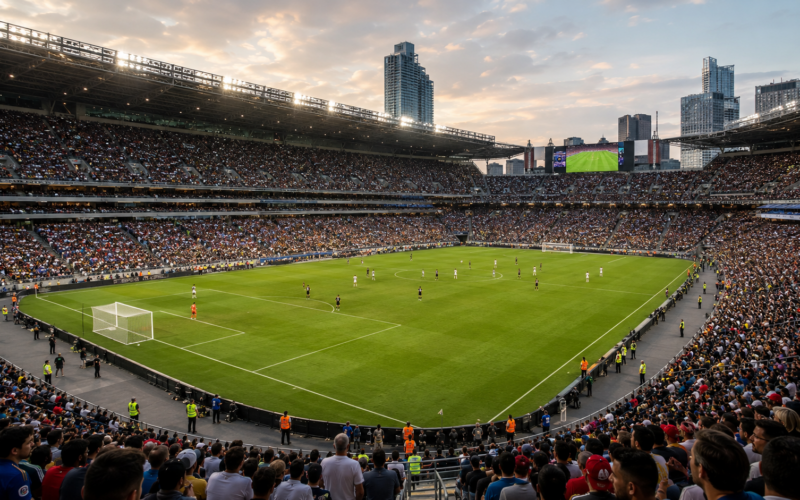
Algeria came from behind to defeat Jordan 2-1 at San Francisco Bay Area Stadium in Santa Clara on June 22, 2026 local time, with the match concluding on June 23 in India. Nizar Al-Rashdan gave Jordan the lead in the 36th minute before second-half goals from substitutes Nadhir Benbouali and Amine Gouiri transformed the FIFA World Cup 2026 Group J contest.
Benbouali equalised with a 69th-minute header from Riyad Mahrez’s corner. Gouiri then reacted fastest during another crowded corner sequence in the 82nd minute, forcing the ball over the line before the winning goal survived a VAR review for a possible offside.
The victory gave Algeria their first points of the tournament after a 3-0 defeat by Argentina. Vladimir Petković’s side moved level with Austria on three points and preserved a direct route into the Round of 32 ahead of their decisive final group meeting.
Jordan were eliminated after suffering a second consecutive defeat in their first men’s World Cup campaign. Jamal Sellami’s team produced the country’s first World Cup lead and competed with discipline, but Algeria’s second-half pressure and superior bench depth eventually decided the match.
Jordan vs Algeria FIFA World Cup 2026 match scorecard
How did Nizar Al-Rashdan give Jordan their first lead at a men’s World Cup?
Jordan began with greater belief than their limited possession suggested. Sellami’s team defended compactly, protected the central channels and attempted to attack through Musa Al-Taamari and Ali Olwan whenever Algeria lost the ball.
Al-Rashdan produced an early warning when he headed wide from a free-kick inside the opening minute. The opportunity demonstrated Jordan’s intention to challenge Algeria through quick transitions and set-piece deliveries rather than simply defend near their own area.
Algeria controlled most of the ball but struggled to create clear openings during the first half. Jordan’s midfield remained close to the defensive line, reducing the space available to Ibrahim Maza, Farès Chaïbi and Mahrez.
The opening goal arrived in the 36th minute. Al-Rashdan reached the ball near the edge of the area and met it first time with the outside of his boot.
The finish travelled beyond Luca Zidane before the Algeria goalkeeper could adjust. It gave Jordan their first lead in World Cup history and rewarded a disciplined performance against an opponent expected to control the match.
The goal also increased the pressure on Algeria. A second defeat would have left Petković’s team close to elimination before facing Austria.
Jordan entered half-time ahead despite holding less than one-third of possession. Their defensive block had prevented Algeria from turning territorial control into a valid goal, while Al-Rashdan had converted one of the few opportunities available.
Why did Algeria struggle to convert overwhelming possession during the first half?
Algeria finished with 72.1 percent possession and completed 561 accurate passes, compared with Jordan’s 181. Those numbers reveal the scale of their control but not the limited threat created before half-time.
Jordan allowed Algeria to circulate possession around the defensive block. Mahrez frequently received the ball wide, while Maza and Gouiri attempted to find space between several compact defenders.
The problem was speed. Algeria moved the ball without consistently forcing Jordan’s midfield to turn or defend while moving toward its own goal.
Crosses were also directed into an area where Jordan’s centre-backs held a physical advantage. Benbouali was not yet on the pitch, leaving Algeria without a dominant aerial target against the crowded defence.
Mahrez received Algeria’s clearest first-half opportunity when a pass released him behind the Jordanian line. Yazeed Abulaila advanced and saved the captain’s attempted finish.
Jordan then punished Algeria’s failure to convert pressure when Al-Rashdan scored at the opposite end.
The first half showed why possession alone can become misleading in tournament football. Algeria controlled territory, but Jordan controlled the type of chances being created.
Petković needed to change the physical and tactical structure rather than simply demand more of the same approach.
How did Nadhir Benbouali transform Algeria’s attack after entering at half-time?
Petković introduced Benbouali during the interval to give Algeria a stronger penalty-area presence.
The forward immediately created a different problem for Jordan’s defenders. He competed for high deliveries, protected the ball under pressure and occupied the centre-backs while Maza and Mahrez moved into supporting positions.
Jordan were pushed progressively deeper as the second half developed. Algeria recorded 14 attempts after the interval compared with only two for Jordan.
Benbouali first threatened when Nabil Bentaleb found him inside the area. His header lacked enough power to beat Abulaila, but the chance showed that Algeria now possessed a clear target for direct service.
The equaliser arrived in the 69th minute. Mahrez delivered an accurate corner toward the central area, and Benbouali rose above the surrounding defenders.
His header travelled into the net and gave Algeria their first goal of FIFA World Cup 2026.
The substitution therefore changed more than the score. Benbouali forced Jordan to defend deeper, increased the value of Mahrez’s set-piece delivery and created space for Gouiri and Maza around the second ball.
Algeria’s bench had supplied the tactical quality missing during the first half. That depth became even more important as Jordan’s players began tiring after spending long periods without possession.
Why did Algeria’s set-piece pressure eventually decide the Group J contest?
Both Algeria goals developed from corners, reflecting their growing territorial pressure and Jordan’s inability to clear repeated deliveries.
Algeria won ten corners compared with only one for Jordan. The number was not merely statistical. Each set piece forced Jordan’s defenders to contest another aerial ball while physically fatigued.
Benbouali’s equaliser followed Mahrez’s precise delivery. The striker’s height and timing gave Algeria a threat Jordan had not faced during the opening half.
The winner arrived from another corner in the 82nd minute. Hadj Moussa delivered into a crowded penalty area, where several players challenged for the initial ball.
Jordan could not complete the clearance. Gouiri reacted faster than the surrounding defenders and forced the loose ball into the net from close range.
A VAR review examined a possible offside during the sequence. The goal was eventually confirmed, giving Algeria the lead with eight minutes of normal time remaining.
Jordan’s set-piece resistance had been strong for much of the match, but the volume of pressure became unsustainable. Algeria attempted 21 crosses, created 15 chances and recorded 30 touches inside the opposition penalty area.
The decisive difference was not simply that Algeria possessed taller or stronger players. Their substitutions allowed them to place more bodies around the second ball, making every incomplete clearance another potential chance.
How important was Ibrahim Maza to Algeria’s second-half recovery?
Maza had struggled to influence the first half because Jordan denied him space between midfield and defence.
The 20-year-old became far more active after the restart. Benbouali’s presence occupied the centre-backs, allowing Maza to receive possession slightly farther from the crowded central area.
He began carrying the ball through midfield and forcing Jordan’s defenders to step away from their preferred compact positions.
One run took him around the right side of Jordan’s defence before his shot drifted wide. The attempt did not produce a goal, but it demonstrated the greater aggression Algeria had lacked before the interval.
Maza also contributed to the sustained pressure that generated repeated free-kicks and corners. Jordan could no longer remain stationary inside a compact block because the young attacker was willing to dribble directly toward defenders.
His growing influence complemented Mahrez’s passing and Benbouali’s physical presence. Algeria now had three different methods of attacking: wide delivery, central carrying and aerial pressure.
Maza’s performance became an important signal before the decisive match against Austria. Algeria will need more than isolated moments from Mahrez if they are to control a stronger and more aggressive opponent.
Why could Jordan not recover after Algeria scored the equaliser?
Jordan’s plan depended on protecting the lead, remaining compact and using Al-Taamari or Olwan to threaten on the counterattack.
The equaliser removed the most important advantage within that structure. Jordan could no longer defend entirely around their penalty area because a draw offered limited value after the opening defeat by Austria.
Sellami’s players attempted to move forward, but the transition was difficult after they had spent much of the match defending.
Mahmoud Al-Mardi produced an effort shortly after Algeria equalised, while Al-Taamari continued trying to carry the ball into the final third. Jordan could not sustain possession long enough to push several players forward.
Algeria recovered the ball quickly and resumed pressure. Their midfield remained close to the attacking line, while Jordan’s forwards became increasingly isolated.
Once Gouiri scored, Algeria reduced the tempo and protected the central areas. Jordan had seven minutes of stoppage time but did not produce the equaliser required to keep their campaign alive.
The defeat resembled Jordan’s opening match against Austria. They competed effectively, created meaningful attacking moments and remained level or ahead for long periods before losing control during the final phase.
The pattern suggests Jordan’s World Cup debut has been more competitive than the standings indicate. The challenge has been sustaining the same physical and tactical intensity across the complete match.
What does Jordan’s elimination mean for their first World Cup campaign?
Jordan qualified for the men’s World Cup for the first time and entered a difficult group containing defending champions Argentina, Austria and Algeria.
Their first two performances produced moments of genuine promise. They scored against Austria, then led Algeria through Al-Rashdan’s memorable finish.
Jordan have not looked overwhelmed by the technical level of the tournament. Their organisation, counterattacking speed and willingness to compete physically have allowed them to challenge two experienced international sides.
The decisive weakness has been game management during the later stages. Austria scored twice after half-time, while Algeria overturned Jordan’s lead through two second-half set pieces.
The final match against Argentina no longer carries qualification implications for Jordan, but it remains a major occasion for the players and supporters.
Sellami can use the fixture to give Jordan another opportunity to demonstrate that qualification was not the endpoint of their development.
Avoiding a heavy defeat and producing another competitive performance would strengthen the long-term value of the campaign, even though the team cannot reach the Round of 32.
What does Algeria’s comeback mean for the FIFA World Cup 2026 Group J table?
Argentina lead Group J with six points after victories over Algeria and Austria. The defending champions are confirmed in the Round of 32.
Austria remain second with three points and a neutral goal difference. Algeria also have three points but sit third because their goal difference is -2.
Jordan remain fourth without a point and are eliminated.
FIFA World Cup 2026 Group J points table
| Team | P | W | D | L | GF | GA | GD | Pts |
|---|---|---|---|---|---|---|---|---|
| Argentina | 2 | 2 | 0 | 0 | 5 | 0 | +5 | 6 |
| Austria | 2 | 1 | 0 | 1 | 3 | 3 | 0 | 3 |
| Algeria | 2 | 1 | 0 | 1 | 2 | 4 | -2 | 3 |
| Jordan | 2 | 0 | 0 | 2 | 2 | 5 | -3 | 0 |
Algeria will guarantee a stronger qualification position by defeating Austria. Victory would take Petković’s side to six points and move them above Austria into second place.
A draw would leave Algeria on four points. That may be sufficient to advance among the leading third-placed teams, depending on results across the remaining groups.
Austria can retain second place by avoiding defeat. Their neutral goal difference also gives them an advantage entering the final match.
Jordan cannot qualify but can still influence the group by facing Argentina in their final fixture.
Why does the Austria match represent the defining test of Algeria’s recovery?
Algeria entered the tournament with expectations of reaching the knockout phase but suffered a damaging 3-0 defeat against Argentina.
The Jordan match restored belief without removing every concern. Algeria dominated possession and created 17 attempts, but required two set-piece goals after struggling to break down a compact defence.
Austria will provide a different challenge. Rangnick’s side press aggressively, compete strongly in midfield and are unlikely to defend as deeply as Jordan.
That may create more space for Maza, Mahrez and Gouiri, but it will also place Algeria’s defenders and midfielders under greater pressure during the build-up.
Benbouali’s impact gives Petković another attacking option. The coach must decide whether to retain the physical forward from the start or use him again as a second-half weapon.
Algeria now control their opportunity. A victory would transform an uncertain campaign into qualification, while defeat could end their tournament despite the comeback in Santa Clara.
Key takeaways from Jordan vs Algeria at FIFA World Cup 2026
- Algeria came from behind to defeat Jordan 2-1 at San Francisco Bay Area Stadium on June 22, 2026 local time.
- Nizar Al-Rashdan gave Jordan their first World Cup lead with an outside-of-the-boot finish in the 36th minute.
- Nadhir Benbouali entered at half-time and headed in Riyad Mahrez’s corner in the 69th minute.
- Amine Gouiri scored the winning goal during a corner scramble in the 82nd minute.
- Gouiri’s goal survived a VAR review for a possible offside.
- Algeria controlled 72.1 percent possession and recorded 17 attempts, including eight on target.
- Jordan goalkeeper Yazeed Abulaila made six saves as Algeria increased the pressure after half-time.
- Algeria won ten corners, with both goals developing from set-piece situations.
- Algeria moved level with Austria on three points and next face them in a decisive Group J fixture.
- Jordan were eliminated after two defeats but conclude their first World Cup campaign against Argentina.
Share this:
Discover more from Business-News-Today.com
Subscribe to get the latest posts sent to your email.