


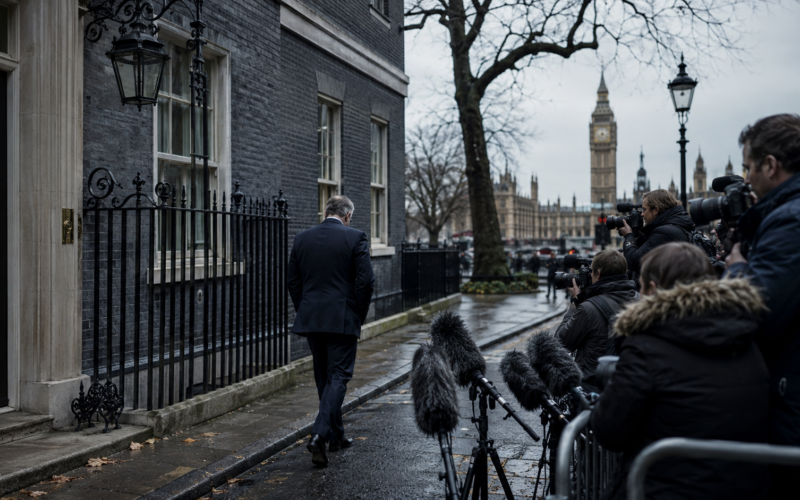
British Prime Minister Keir Starmer announced on June 22, 2026, that he will resign after concluding that he no longer commands sufficient support within the Labour Party to lead it into the next general election. Starmer will remain prime minister during an orderly transition, with nominations for the Labour leadership opening on July 9 and a successor expected by September at the latest. Andy Burnham, the newly elected Member of Parliament for Makerfield and former mayor of Greater Manchester, has emerged as the clear frontrunner after potential rival Wes Streeting endorsed him and ruled himself out of the contest.
The resignation comes less than two years after Starmer led Labour to a landslide election victory in 2024 and promised to restore stability after years of Conservative political turmoil. His departure means Britain is preparing for its seventh prime minister since the 2016 Brexit referendum, extending a decade in which successive leaders have struggled with low growth, public-service pressures, immigration, high debt and voter dissatisfaction.
Starmer’s announcement does not immediately trigger a general election. Labour retains its parliamentary majority and can choose a new party leader who would then be invited by King Charles III to form a government, although Reform UK leader Nigel Farage and other opponents are demanding that the next prime minister seek a fresh public mandate.
Financial markets initially treated the resignation as a widely anticipated political transition rather than an immediate constitutional or fiscal crisis. Sterling remained weaker at approximately $1.322, the 10-year gilt yield was broadly unchanged at 4.85 percent and the FTSE 100 remained steady, but investors are now focused on whether the next Labour leader changes tax, borrowing and spending policy.
Why did Keir Starmer resign less than two years after Labour’s landslide victory?
Starmer said he had listened to Labour members of Parliament and accepted that the party no longer viewed him as the best person to lead it into the general election due by 2029. His announcement followed months of pressure over the government’s political direction, economic performance and ability to communicate a clear programme to voters.
Labour entered government with an exceptionally large majority, but that parliamentary strength did not translate into durable public enthusiasm. Critics within the party accused Starmer of governing cautiously without providing a strong explanation of how Labour intended to improve living standards, public services and national confidence.
A series of policy reversals weakened his reputation for competence and consistency. The government faced criticism over immigration, energy policy, welfare decisions and the limited pace of economic improvement, while personnel controversies added to the perception that Downing Street had lost control of its political agenda.
The pressure intensified as Nigel Farage’s Reform UK gained support and performed strongly against Labour. Many Labour members of Parliament became concerned that Starmer’s leadership style and falling popularity could expose them to defeat at the next election despite the scale of their 2024 victory.
Starmer’s position deteriorated further after Andy Burnham won the Makerfield parliamentary election and returned to Westminster. Burnham’s victory gave Labour lawmakers a credible alternative leader with national experience, a regional power base and stronger communication skills.
What timetable has Labour established for choosing Britain’s next prime minister?
Starmer asked Labour’s organising authorities to establish the leadership process while he remains in office. Nominations are scheduled to open on July 9 and close by the middle of July, with the transition completed before Parliament returns in September if several candidates contest the leadership.
The process could conclude much earlier if Andy Burnham becomes the only candidate who secures the necessary nominations. In that situation, Labour could install him as leader by the middle of July, allowing Starmer to submit his formal resignation to the monarch and enabling Burnham to become prime minister.
A contested election would require Labour members and other eligible supporters to choose between candidates after a campaign covering economic policy, public services, immigration, defence and the party’s political direction. Such a campaign could expose serious divisions at a time when Labour is already under pressure from Reform UK, the Conservatives, the Liberal Democrats and parties on the left.
Some Labour lawmakers may prefer an uncontested transition to reduce uncertainty and prevent weeks of internal attacks. Others may argue that a competitive process is necessary because the next leader will become prime minister without winning a general election under their own programme.
Starmer will continue exercising the powers of prime minister during the transition. However, major policy decisions may be delayed when ministers, civil servants and international partners know that a new leader could soon change the government’s priorities.
Why has Andy Burnham moved so quickly into a commanding leadership position?
Andy Burnham returned to Parliament after serving as mayor of Greater Manchester, a position that allowed him to build a profile outside Westminster and present himself as an advocate for English regions neglected by central government. He has also served as health secretary, culture secretary and chief secretary to the Treasury, giving him experience across major areas of national policy.
His strongest political advantage is that Labour lawmakers increasingly view him as capable of competing directly with Nigel Farage. Burnham has cultivated an accessible public image and can argue that his record in Greater Manchester demonstrates practical experience in transport, policing, housing and regional economic policy.
Wes Streeting’s endorsement substantially strengthened Burnham’s position. Streeting had previously been viewed as a possible leadership candidate, but he said Labour should unite behind Burnham rather than spend the summer exaggerating relatively small internal differences.
Burnham nevertheless enters the race without a fully developed national programme. He has promised fundamental change and stronger action on the cost of living, but investors, Labour members and international partners still need clarity on taxation, borrowing, defence, immigration, European relations and support for Ukraine.
His previous policy positions have included greater public control of utilities and higher taxes on some forms of wealth and investment income. Burnham has recently attempted to reassure financial markets that he understands Britain’s fiscal constraints and intends to respect rules governing borrowing and debt.
Would Andy Burnham need to call an immediate United Kingdom general election?
The British constitution does not require a general election whenever a governing party changes its leader. Voters elect members of Parliament rather than directly electing the prime minister, and the monarch appoints the person most capable of commanding a majority in the House of Commons.
Labour’s parliamentary majority means a new leader could govern until the next election without seeking immediate public approval. This is how several previous British prime ministers entered office between elections, including Theresa May, Boris Johnson, Liz Truss and Rishi Sunak.
The constitutional position does not remove the political argument. Nigel Farage has demanded an election and will portray any new Labour prime minister as lacking a personal mandate, particularly if Burnham is installed without a full leadership contest.
Burnham has said it is too early to discuss whether he would call an election. His immediate priority would probably be stabilising the government, appointing a Cabinet and establishing a policy programme before considering whether an early vote would strengthen or endanger Labour’s position.
An early election would be highly risky for Labour while Reform UK remains strong and public confidence in the government is weak. Delaying until 2029 would provide time for a new leader to improve economic conditions, but it could reinforce opposition claims that Labour is avoiding the electorate.
How did markets respond and what economic risks will the next prime minister inherit?
The initial financial reaction was restrained because investors had been preparing for Starmer’s departure. Sterling remained modestly weaker, gilt yields were stable and the FTSE 100 showed little movement immediately after the announcement.
Market stability does not mean investors are unconcerned about the leadership change. Britain already faces high government borrowing costs, weak economic growth, substantial debt interest payments and competing demands for defence, welfare, healthcare and infrastructure spending.
The next prime minister’s choice of chancellor will be closely watched because a leadership change could produce pressure for higher spending or tax changes. A move towards significantly greater borrowing could weaken sterling and push gilt yields higher if investors conclude that the government’s fiscal framework is losing credibility.
Burnham has attempted to reassure markets by indicating that he would retain Labour’s fiscal rules. However, maintaining those rules while delivering visible improvements in housing, public services and household finances may prove politically difficult.
The central economic challenge is that Britain’s voters want faster change than the public finances can easily support. Starmer struggled to reconcile those expectations, and his successor will inherit the same structural problem rather than a clean economic starting point.
What does Starmer’s departure mean for Britain’s relations with Europe and Ukraine?
Starmer placed closer cooperation with European governments near the centre of his foreign policy. His government sought to improve practical relations with the European Union after the tensions created by Brexit, while continuing to support Ukraine and strengthen European security coordination.
The European Union is now reconsidering whether to proceed with a United Kingdom-European Union summit planned for July 22. European Commission President Ursula von der Leyen praised Starmer’s contribution to European and Ukrainian security, while officials said relations with Britain would remain strong despite the leadership transition.
A new Labour prime minister is unlikely to reverse Britain’s support for NATO or Ukraine immediately. However, Andy Burnham has provided less detail on foreign affairs and defence than on domestic and regional policy, leaving European partners uncertain about the emphasis of his government.
The timing creates a diplomatic complication because international summits and negotiations depend heavily on political authority. Foreign leaders may hesitate to reach major agreements with Starmer when they know his successor will soon take office.
The transition may also affect Britain’s approach to the United States, the Middle East and defence spending. The new leader will need to establish credibility quickly as international instability increases demands on the British military and diplomatic system.
Why does Britain now face its seventh prime minister in only ten years?
The political instability began when David Cameron resigned after Britain voted to leave the European Union in June 2016. Theresa May, Boris Johnson, Liz Truss and Rishi Sunak followed before Starmer brought Labour to power in 2024.
Starmer promised that his large majority would end the cycle of short premierships and internal party conflict. His resignation after less than two years means Labour has now become part of the same pattern it criticised while in opposition.
Brexit was the original trigger, but the underlying instability has widened. Britain has faced low productivity, regional inequality, public-service pressures, high housing costs, changing party loyalties and declining trust in political institutions.
Voters have repeatedly supported parties or leaders promising decisive change and then become frustrated by the limits of government delivery. Each leadership change has raised expectations without resolving the structural constraints facing the country.
Britain’s seventh prime minister since the referendum will therefore inherit more than a party-management problem. The next leader must show that government can produce visible results before another wave of dissatisfaction forces further political disruption.
What happens next as Keir Starmer prepares to leave Downing Street?
Labour’s first task is determining whether any candidate can mount a credible challenge to Andy Burnham. Nominations will show whether the party wants a genuine debate or prefers a rapid transfer designed to restore discipline.
Starmer will remain prime minister until his successor is elected and formally appointed. He must continue representing Britain internationally, managing government business and responding to emergencies during the transition.
Burnham will need to establish a national team and decide whether senior figures from Starmer’s government remain in place. His choice of chancellor, foreign secretary, home secretary and defence secretary would provide the clearest early indication of policy continuity or change.
The opposition will increase pressure for a general election while portraying the leadership transition as another example of Westminster instability. Reform UK will attempt to turn Starmer’s resignation into evidence that Labour’s 2024 mandate has already failed.
The most important question is whether the transition produces a temporary improvement in Labour morale or a lasting recovery in public confidence. Starmer’s removal solves the party’s immediate leadership crisis, but the economic, institutional and political problems that caused it remain unresolved.
What are the key takeaways from Keir Starmer’s resignation as United Kingdom prime minister?
- Keir Starmer announced on June 22, 2026, that he will resign after accepting that Labour members of Parliament no longer viewed him as the strongest leader for the next general election.
- Starmer will remain prime minister during an orderly leadership transition, with Labour nominations opening on July 9 and a successor expected by September, or potentially by mid-July if only one candidate qualifies.
- Andy Burnham has emerged as the clear frontrunner after returning to Parliament as the Member of Parliament for Makerfield and receiving the endorsement of former potential rival Wes Streeting.
- Labour can install a new prime minister without calling an immediate general election because it retains a parliamentary majority, although Nigel Farage and other opponents are demanding a fresh national vote.
- Financial markets initially remained calm, but investors are watching whether the next leader changes Britain’s fiscal rules, expands borrowing or appoints a chancellor associated with substantially higher public spending.
- Starmer’s departure less than two years after his 2024 landslide means Britain is preparing for its seventh prime minister since the Brexit referendum, extending a decade of unusually rapid leadership turnover.
- The transition creates uncertainty for the planned July United Kingdom-European Union summit and for Britain’s foreign-policy positioning, although major changes to NATO membership or support for Ukraine appear unlikely immediately.
- Removing Starmer may ease Labour’s internal crisis, but his successor will still face weak growth, high borrowing costs, immigration pressures, strained public services and rising support for Reform UK.
Share this:
Discover more from Business-News-Today.com
Subscribe to get the latest posts sent to your email.