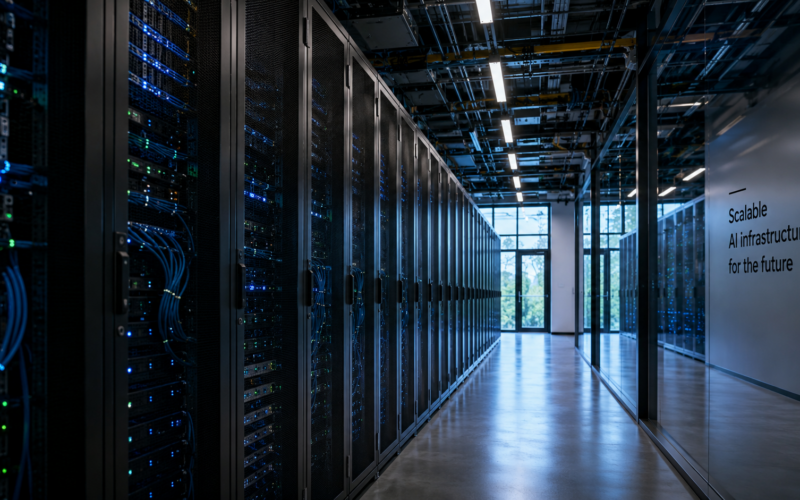
Nebius (NASDAQ: NBIS) is an Amsterdam-headquartered AI cloud company that emerged from the former Yandex N.V. operations and has spent the last eighteen months turning a USD 120 million annualised revenue starting point into one of the most aggressive AI infrastructure stories on the Nasdaq. The stock trades near USD 286, sits close to an all-time high of USD 298.85, and is up roughly 7x over the trailing twelve months. The next discrete catalyst is the company’s inclusion in the Nasdaq-100 Index effective 22 June 2026, which brings passive index demand into a name where the contracted backlog already approaches USD 50 billion against full-year 2026 revenue guidance of USD 3.0 billion to USD 3.4 billion. For a retail investor landing here from a tweet or an AI infrastructure feed, the question is whether the index inclusion sustains the move or whether the USD 20 billion to USD 25 billion capex programme catches up with the multiple first.
What does Nebius actually do as the former Yandex AI cloud business hits Nasdaq-100?
Nebius is a full-stack AI cloud company that builds and operates large-scale GPU clusters, the surrounding networking and storage infrastructure, and the software platform layer that sits on top of it for AI-native and enterprise customers. The core business goes to market as Nebius AI Cloud, currently in version 3.5 on the proprietary Aether platform, with the Token Factory managed inference product as the higher-margin software service. The customer base spans large hyperscalers such as Meta and Microsoft, AI-native model labs, independent software vendors, and a growing enterprise pipeline.
The corporate structure also carries two non-core assets that were retained when Yandex N.V. separated from its Russian operations. TripleTen is an edtech platform for re-skilling individuals into technology careers, and Avride is an autonomous driving and delivery robotics business. Neither is the reason the stock has rallied, but both sit inside the consolidated reporting and provide optionality for future spin or sale alongside the core AI cloud business.
The risk inside the business model is that Nebius is one of several pure-play AI cloud or neocloud operators competing for hyperscale and AI-native demand alongside CoreWeave, IREN, Applied Digital, and the captive cloud businesses of the major hyperscalers themselves. Nebius differentiates on speed of deployment, NVIDIA technology alignment, and an integrated platform stack, but the competitive intensity in the segment is structurally high and is rising.
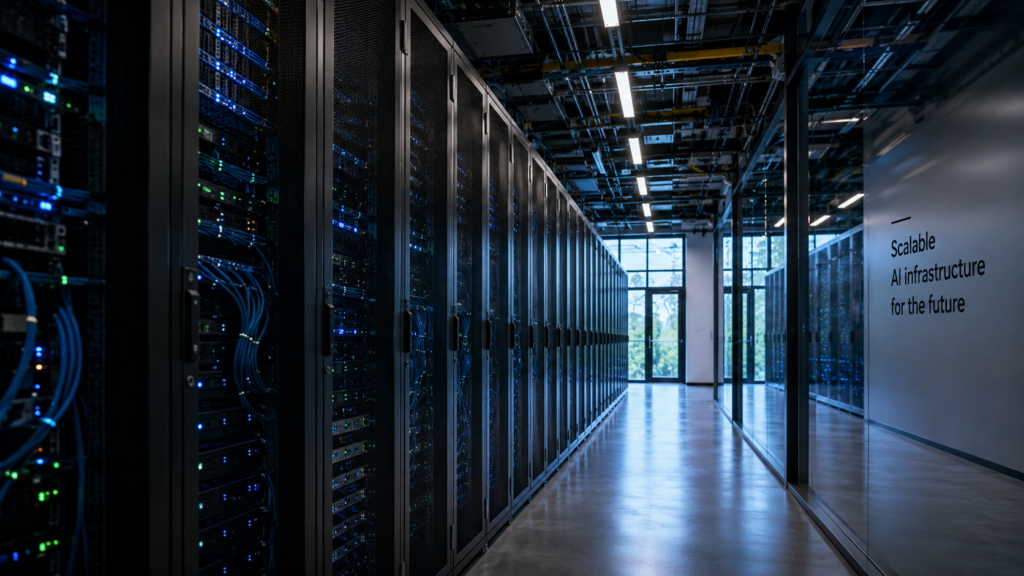
Why does the Nasdaq-100 inclusion on 22 June matter for the NBIS retail investor base?
The Nasdaq-100 inclusion is a mechanical catalyst that compresses several types of flow into a single window. Index-tracking funds and ETFs benchmarked to the Nasdaq-100 are required to acquire the stock at the index weight on the effective date, which has historically driven multi-day flow surges of meaningful size for names of comparable market capitalisation. Nebius enters the index alongside CoreWeave on the same effective date, which means the AI infrastructure category as a whole is getting a passive demand event.
The implication for retail investors is twofold. The first is that the float available to active investors meaningfully tightens as passive vehicles absorb their index share, which can amplify both the upside on positive catalysts and the downside on disappointments. The second is reputational. Index inclusion is generally read by the broader market as confirmation that a company has crossed into the institutional mainstream, which can unlock additional sources of capital from mandates that previously could not own the name.
The risk in pricing the inclusion event itself is that the catalyst has been telegraphed for weeks and a meaningful portion of the expected flow is likely already in the stock. The pre-announcement run in NBIS, with shares up roughly 23.4 percent over the past week and roughly 30.4 percent over the past month into the inclusion, suggests that the easy phase of the inclusion trade has already occurred. The interesting question becomes whether the post-inclusion price action holds, fades, or extends into Q2 earnings.
How big is the contracted backlog and what do the Meta and Microsoft deals actually cover?
The contracted backlog at Nebius approaches USD 50 billion across the announced multi-year customer commitments, which is a number that genuinely separates the company from most listed AI cloud peers. The anchor contracts are a USD 27 billion multi-year agreement with Meta Platforms and a commitment of up to USD 19.4 billion from Microsoft. Both contracts cover dedicated AI compute capacity provisioned across Nebius’s owned and colocation data centre footprint, with deployment ramps that run through 2026 and into 2027 and 2028.
Management has been careful to frame the hyperscaler relationships as additive to the broader customer base rather than a substitute for it. Q1 2026 reported pipeline growth of approximately 3.5x quarter over quarter excluding the strategic hyperscaler deals, which means the underlying AI-native and enterprise demand is compounding independently of the headline contracts. Sold-out status through the first quarter of 2026 and continued capacity constraints into the back half of the year reinforce that the demand environment is genuinely supply-limited rather than price-limited.
The execution risk on the backlog is timing. Large multi-year capacity commitments depend on Nebius bringing power, land, GPUs, and the surrounding infrastructure online in the right sequence at the right cost. Any slippage in a Pennsylvania, UK, Finland, or US site ramp is a slippage in recognised revenue against the backlog, and the market is currently underwriting essentially flawless execution against a guidance bar that the company has already raised twice in 2026.
What does the USD 2 billion NVIDIA equity investment change about the supply story?
In March 2026, Nebius secured a USD 2 billion strategic equity investment from NVIDIA that extended the existing multi-year technology partnership between the two companies. The strategic significance of the investment runs deeper than the cash. NVIDIA’s equity position aligns Nebius into NVIDIA’s preferred allocation framework for the next several GPU platform generations, including the GB300 Grace Blackwell Superchip and the upcoming Vera Rubin architecture, and into the equally constrained networking and switching infrastructure that sits alongside GPU clusters.
Nebius has subsequently achieved NVIDIA Exemplar Cloud status on the GB300 Grace Blackwell Superchip for training, which is a designation that carries practical implications around early access to capacity, joint engineering on optimisation, and co-marketing into AI-native customers. In a market where GPU supply remains the binding constraint on AI cloud revenue growth across the industry, an aligned supplier relationship is the difference between hitting a deployment ramp on time and missing it by a quarter.
The risk in over-relying on the NVIDIA relationship is concentration. Nebius is now structurally tied to the NVIDIA ecosystem at every layer from silicon through networking through software, which is competitively advantageous as long as NVIDIA remains the dominant AI compute platform. The bear case in the longer run is that custom silicon programmes at the hyperscalers, AMD’s MI300 and MI400 ramps, or open standard alternatives compress the proportion of AI workloads that flow through NVIDIA-aligned clouds.
How does the Eigen AI acquisition push Nebius up the AI cloud platform value stack?
The Eigen AI acquisition, announced on 1 May 2026 for approximately USD 643 million in cash and stock and closed on 10 June 2026, is the most consequential platform move Nebius has made in 2026. Eigen AI specialises in inference and model optimisation, which is the discipline of running trained AI models efficiently in production by reducing compute and memory requirements. The technology is being integrated directly into the Token Factory managed inference platform, which is where Nebius captures higher-margin software-defined revenue on top of the underlying compute layer.
The strategic significance is that Nebius is no longer attempting to compete only on the infrastructure layer of the AI stack. By pushing into model optimisation and inference orchestration, the company is moving up the value stack toward services where pricing is less directly indexed to GPU hours and more directly indexed to outcomes the customer cares about, such as tokens generated, latency met, and cost per inference. This is precisely the kind of margin profile that justifies a higher valuation multiple than the underlying compute business alone supports.
The risk for retail investors is integration. The Token Factory product is still relatively new, the Eigen AI integration is fresh, and the AI inference market is moving extremely quickly. A faster competitor that bundles inference optimisation natively into a hyperscaler cloud at scale could compress the time window during which Nebius’s platform play earns premium pricing.
What is the milestone path from the Q1 2026 print to the USD 7 to USD 9 billion ARR target?
The Q1 2026 print delivered revenue of USD 399 million, up 684 percent year on year and ahead of the USD 391.6 million Street consensus, with adjusted EBITDA of USD 129.5 million against a prior-year loss. The AI business segment margin expanded to 45 percent in Q1 from 24 percent in Q4 2025, although the company has guided to a non-linear margin progression through 2026 with Q2 stepping lower, returning to Q1 levels in Q3, and stepping higher in Q4 as new capacity comes online.
The annualised run rate guidance for year-end 2026 sits at USD 7 billion to USD 9 billion, which would represent a roughly 5x to 7x exit run rate against the Q1 revenue. The path to that exit ARR runs through three operational milestones. The first is bringing connected capacity from current levels to 800 megawatts to 1 gigawatt by year-end 2026, against a contracted power target of more than 3 gigawatts. The second is converting that connected capacity into utilised capacity and recognised revenue. The third is delivering on the platform layer revenue through Token Factory and Aether.
The longer milestone path is even larger. The Pennsylvania site, where Nebius has secured 1.2 gigawatts of power and land, is expected to bring its first 250 megawatts to 300 megawatts online by the end of 2027, with subsequent 300 megawatt annual additions through to a full 1.2 gigawatts by mid-2030. The UK buildout, supported by the GBP 1.7 billion announcement for three new data centres, is positioned to support AI compute demand for British and European academic, research, and enterprise customers under a ten-year partnership framework.
Why are NBIS analyst price targets trailing the current quote and what does the spread imply?
The current quote on NBIS sits roughly 17 percent above the average Wall Street price target, which is an unusual configuration and worth thinking about carefully. The consensus 12-month price target across roughly 15 to 16 analysts sits at approximately USD 244.07 against a quote near USD 286. One widely followed buyside narrative model places fair value around USD 165.85, which would imply meaningful downside, while the more bullish analyst narratives project USD 19.4 billion in revenue and USD 470.6 million in earnings by 2029, supporting valuations well above current levels.
The reason the spread is so wide is that the Street is genuinely divided on how to value a hyper-growth AI infrastructure company that is still loss-making on a GAAP basis and still in the heavy capital expenditure phase. The bull case extrapolates the contracted backlog, assumes 40 percent adjusted EBITDA margins are sustainable, and arrives at a multiple that supports the current quote. The bear case anchors on the ongoing net losses, the capex intensity, the dilution from convertibles and the NVIDIA equity, and arrives at a substantially lower fair value.
The implication for retail investors is that NBIS is now genuinely a momentum stock in the technical sense, where the share price has decoupled from the bottom-up models that most institutional buyers run. Index inclusion and passive flow will likely support the current quote through the near term, but the gap between the quote and the analyst average is the kind of configuration that resolves either through earnings beats large enough to pull the Street higher or through a multiple compression event triggered by a missed quarter or a macro AI capex pause.
What are retail investors on X, Reddit and AI infrastructure forums saying about NBIS today?
Retail conversation on NBIS has converged around the Nasdaq-100 inclusion as the centrepiece narrative, with cashtag threads and AI investing communities framing the 22 June event as a forced-buy catalyst that should support the stock through the second half of 2026. The bull case being made on X anchors on the USD 50 billion backlog, the NVIDIA partnership, and the index inclusion compounding into Q2 earnings. The most aggressive posts compare NBIS to CoreWeave and argue that Nebius deserves to trade at premium given the platform layer and the international footprint.
Reddit threads have been more measured. The AI infrastructure communities there have engaged substantively with the capex programme, modelling out the USD 20 billion to USD 25 billion 2026 spend against the revenue ramp and asking the obvious question of how the company finances the gap. The convertible debt structure, the NVIDIA equity, and the strong USD 9.3 billion cash position have generally satisfied that conversation, but the dilution risk and the persistent net losses are the two themes that keep coming up.
The implication for a retail investor framing a position is that the bull and bear cases on NBIS are unusually well-defined and the catalyst calendar is unusually dense. The next twelve months will deliver multiple binary information events, starting with the Nasdaq-100 inclusion on 22 June, continuing through Q2 2026 earnings, the Pennsylvania site progress updates, and the Eigen AI integration into Token Factory. Position sizing into a stock running this hot is the practical question rather than the directional view.
Key takeaways for NBIS retail investors weighing the Nasdaq-100 inclusion and the backlog
- Nebius is set to join the Nasdaq-100 Index effective 22 June 2026 alongside CoreWeave, bringing passive index demand into the AI infrastructure category
- The contracted backlog approaches USD 50 billion, anchored by a USD 27 billion Meta deal, up to USD 19.4 billion from Microsoft, and a USD 2 billion strategic equity investment from NVIDIA
- Q1 2026 revenue of USD 399 million represented 684 percent year on year growth, with AI segment adjusted EBITDA margin expanding to 45 percent
- Full-year 2026 guidance sits at USD 3.0 billion to USD 3.4 billion in group revenue, around 40 percent adjusted EBITDA margin, USD 20 billion to USD 25 billion in capex, and a USD 7 billion to USD 9 billion exit ARR
- The Eigen AI acquisition, closed on 10 June 2026 for approximately USD 643 million, moves Nebius up the value stack into managed inference through Token Factory
- The current quote near USD 286 trades roughly 17 percent above the average analyst price target of approximately USD 244, reflecting genuine valuation disagreement
- Key risks are capex execution, ongoing GAAP losses, GPU supply, component cost inflation, political opposition to US data centre construction, and hyperscaler competition
Share this:
Discover more from Business-News-Today.com
Subscribe to get the latest posts sent to your email.