

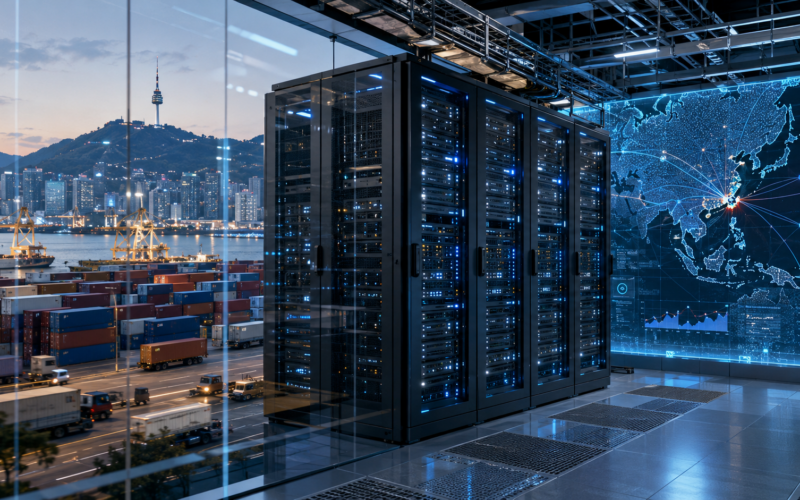
GoodVision AI and ATTO Research have signed a memorandum of understanding to jointly develop Korea’s first supply chain-focused AI data centers, giving the proposed public-market story around Calisa Acquisition Corp (NASDAQ: ALIS) a more tangible infrastructure dimension. The agreement commits at least $50 million toward AI data center construction, graphics processing unit infrastructure and financing solutions for digital infrastructure assets. The planned network will begin with 0.75MW of AI Factory compute capacity, scale toward 5.5MW by 2027, and target 40MW of combined capacity across sites near Seoul, Busan and Daegu over time. The strategic relevance is clear: GoodVision AI Inc. is trying to move from AI infrastructure positioning to capacity delivery, while ATTO Research brings local power, site and network-integration capability in one of Asia’s most policy-active artificial intelligence markets.
Why does the GoodVision AI and ATTO Research MOU matter for South Korea’s AI data center buildout?
The GoodVision AI and ATTO Research agreement matters because it addresses a problem that is becoming more urgent than model quality itself: the physical mismatch between AI demand and deployable compute infrastructure. Enterprises can buy or reserve graphics processing unit servers much faster than developers can build traditional data centers, and that timing gap can leave AI projects stuck between procurement and production. In South Korea, where manufacturing, logistics, e-commerce, semiconductors and telecommunications are deeply interconnected, that bottleneck is not just a technology issue. It is becoming an industrial competitiveness issue.
The MOU also places GoodVision AI Inc. in a more asset-linked part of the AI value chain. Rather than remaining only an AI inference, routing or cloud-services story, the company is now aligning itself with physical capacity, land, power access, modular deployment and financing. That matters for investors because AI infrastructure firms are increasingly being judged not only on software claims, but on whether they can secure power, deploy racks, fill capacity, manage utilization and protect margins. In plain English, the market is getting less patient with slideware. The servers eventually have to go somewhere.
For ATTO Research, the partnership offers a route to connect domestic development expertise with a global AI infrastructure narrative. The company’s role in site and power infrastructure resources gives the project a local execution base, which is critical in a market where permitting, regional dispersion and grid impact are not side issues. If the partners can deliver even the early phases on schedule, the project could become a reference model for smaller, modular AI data center deployment in South Korea, especially for enterprise workloads that need capacity sooner than hyperscale campuses can provide.
How could supply chain-focused AI data centers change enterprise deployment economics in Korea?
The most interesting part of the announcement is not the headline capacity figure. It is the supply chain-focused positioning. A generic AI data center sells compute. A supply chain-focused AI data center, if executed with discipline, sells compute that is closer to specific operational outcomes such as demand forecasting, inventory optimization, route planning, procurement visibility, quality control, warehouse automation and cross-border commerce analytics. That distinction could matter in South Korea because many of the country’s largest industrial and technology ecosystems are built around complex, time-sensitive supply chains.
GoodVision AI Inc. appears to be targeting the inference side of artificial intelligence rather than only large model training. That is an important strategic nuance. Training workloads are capital-intensive, power-hungry and often concentrated in very large clusters. Inference workloads can be more distributed, latency-sensitive and commercially tied to real-time business applications. A supply chain AI system that helps a manufacturer reroute inventory, a retailer adjust replenishment, or a logistics provider respond to port or warehouse disruption does not simply need raw compute. It needs dependable, location-aware and cost-sensitive compute.
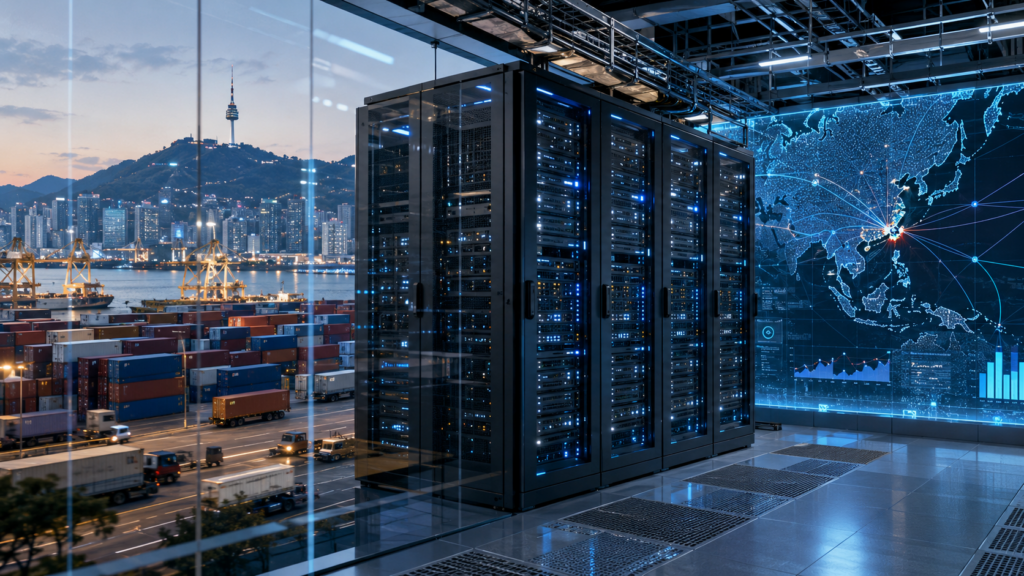
That creates a possible economic opening for modular AI Factory capacity. If enterprises can align capacity with graphics processing unit procurement cycles, they may avoid the cost of waiting years for conventional data center space. The flip side is that modular does not mean easy. GoodVision AI Inc. and ATTO Research will need to prove that smaller phased deployments can deliver reliability, security, cooling performance, energy stability and customer economics that compete with larger colocation or cloud alternatives. Supply chains hate uncertainty. So do chief information officers when uptime is on the line.
What execution risks could decide whether the 40MW Korea AI data center plan scales?
The first risk is that an MOU is not the same as completed capacity. The agreement sets strategic intent, but the project still needs site-level execution, power allocation, financing follow-through, construction discipline, equipment availability and customer demand. The jump from 0.75MW to 5.5MW by 2027 is manageable on paper, but the longer-term move to 40MW requires a much broader operational machine. The market will watch whether the partners convert the initial phase into a functioning proof point rather than simply announcing a larger ambition.
The second risk is power. South Korea is actively promoting AI data centers, but the country is also wrestling with regional grid pressure, capital-region concentration and the need to move some digital infrastructure away from the Greater Seoul Area. The GoodVision AI Inc. and ATTO Research plan includes locations near Seoul, Busan and Daegu, which may help the partners balance demand proximity with regional deployment logic. However, every attractive data center location eventually runs into the same blunt question: can the project secure reliable electricity at an acceptable cost and timeline?
The third risk is capacity utilization. AI data centers are expensive assets, and phased deployment only works if customer demand grows alongside buildout. GoodVision AI Inc. will need enterprise customers that value dedicated or specialized supply chain AI compute enough to commit to recurring usage. Without that demand visibility, the project could face the classic infrastructure trap of spending ahead of revenue. With it, the company could build a stronger case that AI inference infrastructure can be financed, deployed and monetized in more targeted vertical markets.
How does the Calisa Acquisition Corp stock context shape investor sentiment around GoodVision AI?
Calisa Acquisition Corp shares have traded in a narrow range typical of special purpose acquisition companies, with ALIS recently near the top of its 52-week range but still close to the familiar $10 zone. That price behavior suggests investors are not yet assigning a dramatic premium to the proposed GoodVision AI Inc. transaction. This is not surprising. Until the business combination closes, public investors are effectively weighing deal completion risk, redemption dynamics, financing conditions and the credibility of GoodVision AI Inc.’s growth plan.
The Korea AI data center MOU gives ALIS holders a more specific catalyst to evaluate. Instead of assessing GoodVision AI Inc. only as a broad AI infrastructure company, investors can now track a concrete deployment roadmap. The early 0.75MW phase, the 5.5MW target by 2027 and the longer-term 40MW goal create milestones that can be tested over time. That is useful, but it also raises the bar. Once a company attaches numbers to its infrastructure strategy, the market gets a ruler.
Sentiment remains cautiously constructive rather than euphoric. The proposed merger valued GoodVision AI Inc. at $180 million, and the business combination includes performance-linked economics tied to revenue and share-price thresholds. That structure makes execution especially important. If the Korea project helps GoodVision AI Inc. secure customers, demonstrate deployment speed and validate AI inference demand, it could strengthen the post-merger story. If delays emerge, the same announcement could become a source of investor skepticism, particularly because AI infrastructure investors have become more sensitive to capital intensity and power bottlenecks.
What does the partnership signal about AI infrastructure competition across Northeast Asia?
The GoodVision AI and ATTO Research plan fits into a broader shift in AI competition across Northeast Asia. Governments and companies are no longer treating data centers as back-office real estate. They are treating them as strategic industrial platforms that connect semiconductors, energy, cloud services, enterprise software, cooling systems, construction, finance and national AI policy. South Korea’s policy push around AI data centers reinforces that direction, especially as the country tries to convert its semiconductor and communications strengths into a stronger position in applied artificial intelligence.
The supply chain angle is also geopolitically relevant. Global companies are under pressure to make supply chains more resilient, visible and responsive. Artificial intelligence can help, but only if computing capacity is available where business processes actually happen. South Korea’s manufacturing base, port connectivity and advanced enterprise technology adoption make it a logical test bed for AI systems tied to logistics and industrial operations. If GoodVision AI Inc. and ATTO Research can prove the model locally, similar deployments could become relevant in Japan, Singapore, Taiwan and other capacity-constrained markets.
The competitive implication is that not every AI data center needs to be a megaproject. The industry still needs hyperscale campuses for frontier training and large cloud workloads, but enterprise inference could create room for smaller, distributed, specialized facilities. That is where GoodVision AI Inc. is trying to insert itself. The opportunity is attractive because it avoids direct comparison with the largest cloud players on scale alone. The challenge is that specialization must translate into customer economics, not just a nicer label on a server room.
What happens next if GoodVision AI and ATTO Research execute the Korea AI data center plan?
The next phase will be judged less by announcements and more by operational evidence. The first real milestone is whether the partners can bring the initial AI Factory capacity online with a clear customer proposition. The second is whether the 5.5MW target for 2027 remains credible as power, permitting, hardware procurement and financing details become more visible. The third is whether the project can attract enterprise workloads that validate the supply chain-focused thesis.
If the plan succeeds, GoodVision AI Inc. could enter the public markets with a stronger infrastructure-backed narrative, and ATTO Research could strengthen its role as a domestic enabler of South Korea’s AI data center expansion. The project could also support South Korea’s ambition to reduce the lag between graphics processing unit availability and usable AI capacity. In that scenario, the MOU becomes more than a partnership announcement. It becomes a small but visible proof point in the commercialization of vertical AI infrastructure.
If the plan struggles, the risks will be familiar: delayed power approvals, construction friction, underutilized capacity, financing gaps, or customers choosing larger cloud and colocation providers instead. That would not necessarily invalidate the AI data center market, but it would weaken the argument that GoodVision AI Inc. can scale quickly through modular, supply chain-focused deployments. For now, the announcement is strategically meaningful, but still execution-dependent. The idea is sharp. The grid, the balance sheet and the customer pipeline now get a vote.
Key takeaways on what GoodVision AI’s Korea AI data center plan means for ALIS investors and the AI infrastructure sector
- GoodVision AI Inc. and ATTO Research are moving beyond a generic AI infrastructure narrative by targeting supply chain-focused AI data centers, a more vertical approach that could appeal to industrial, logistics and e-commerce customers.
- The minimum $50 million commitment gives the partnership a clearer capital framework, but investors will still need evidence of financing execution, site readiness and customer demand before treating the 40MW target as bankable.
- The phased plan reduces some execution risk by starting with 0.75MW of capacity, but the jump to 5.5MW by 2027 will be the first meaningful test of project delivery discipline.
- The longer-term 40MW ambition is strategically relevant, but it will depend on power availability, regional permitting, cooling efficiency and the ability to manage Korea’s grid constraints.
- The proposed Calisa Acquisition Corp and GoodVision AI Inc. business combination gives ALIS investors an AI infrastructure angle, but current stock behavior suggests the market is still waiting for harder proof of execution.
- South Korea’s AI data center policy backdrop is supportive, but regulatory easing does not eliminate the practical constraints of electricity supply, construction timelines and local acceptance.
- The project’s supply chain focus could differentiate GoodVision AI Inc. from broader cloud and colocation providers, but only if specialized compute translates into measurable enterprise value.
- ATTO Research gives the plan local credibility through site, power and network-integration capabilities, which are critical in a market where infrastructure access is often more decisive than software branding.
- The biggest competitive implication is that AI inference infrastructure may evolve toward distributed, vertical facilities rather than relying entirely on hyperscale campuses.
- The central investor question is whether GoodVision AI Inc. can turn a well-timed Korea AI data center MOU into recurring revenue, reliable utilization and stronger post-merger market confidence.
Share this:
Discover more from Business-News-Today.com
Subscribe to get the latest posts sent to your email.