






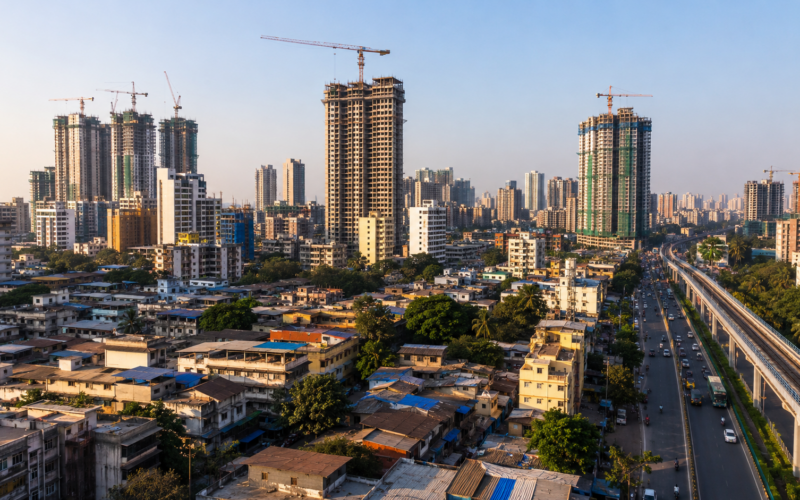
Reliance Industries Limited (NSE: RELIANCE, BSE: 500325) has entered one of Mumbai’s largest slum redevelopment opportunities after a consortium led by Reliance 4IR Realty Development Limited won the bid for the Juhu Galli slum cluster redevelopment project in Andheri West. The project spans about 101.36 acres and is expected to create more than 28,000 rehabilitation homes for eligible residents, making it a major urban renewal mandate under Maharashtra’s cluster redevelopment framework. The consortium also includes Mahadev Realtors Juhu, linked to Aspect Realty, placing Reliance Industries Limited alongside specialist real estate partners in a complex housing and land redevelopment structure. Strategically, the bid win matters because RELIANCE is trading close to its 52-week low, making investors more attentive to whether new infrastructure, real estate and digital-era assets can add long-term optionality beyond the company’s core energy, retail and telecom engines.
Why does Reliance Industries Limited’s Juhu Galli redevelopment win matter for Mumbai real estate?
Reliance Industries Limited’s linked entry into the Juhu Galli slum cluster project matters because Mumbai’s redevelopment market is shifting from fragmented, mid-sized schemes to large, institutionally backed urban renewal projects. The scale of the Juhu Galli project places it among the more ambitious redevelopment exercises in the city, particularly because it involves a large contiguous land parcel in Andheri West, one of Mumbai’s commercially dense and transport-linked suburban markets. For Reliance Industries Limited, the project gives its real estate subsidiary a seat in a sector where land access, policy navigation, rehabilitation execution and saleable development rights can create significant long-term value.
The commercial logic is not limited to housing. Large redevelopment projects in Mumbai can reshape neighbourhood-level infrastructure, unlock premium saleable space and create new mixed-use opportunities when implemented well. Andheri West already benefits from residential demand, commercial activity, airport connectivity, metro access and proximity to higher-income catchments such as Juhu, Versova and Lokhandwala. In that context, Juhu Galli is not merely a rehabilitation project. It is a possible urban land transformation play in a supply-constrained city where clean, developable land is harder to find than a parking spot during peak wedding season.
The risk is equally obvious. Slum redevelopment in Mumbai is notoriously difficult because it combines resident eligibility, temporary relocation, documentation, legal disputes, political sensitivities, infrastructure pressure and long execution cycles. Reliance Industries Limited may bring balance-sheet strength and institutional credibility, but capital alone does not solve the human and administrative complexity of redevelopment. The bid win is important, but the project’s value will be created only if rehabilitation, approvals, construction sequencing and monetisation move without prolonged friction.
How could the Juhu Galli project change Reliance Industries Limited’s real estate ambitions?
The Juhu Galli win could signal a more serious real estate direction for Reliance Industries Limited-linked entities, especially through Reliance 4IR Realty Development Limited. Reliance Industries Limited already sits across energy, petrochemicals, retail, digital services, media, consumer brands and new energy, but real estate has generally not been the most visible part of its public-market narrative. A 101-acre redevelopment mandate in Mumbai changes that visibility because it places the group in a politically sensitive and financially meaningful urban infrastructure category.
This does not mean investors should suddenly treat Reliance Industries Limited as a real estate stock. The group’s valuation will still be dominated by its oil-to-chemicals, retail, telecom, digital and energy transition businesses. However, large redevelopment projects can add hidden optionality if they create monetisable commercial and residential assets over time. The project could become part of a broader strategy to own or influence high-value urban infrastructure around mobility, housing, retail ecosystems and digital services.

The most important question is whether this becomes a one-off strategic entry or the beginning of a larger redevelopment platform. If Reliance Industries Limited-linked entities pursue more cluster redevelopment projects, the market may start assigning greater strategic significance to real estate. If Juhu Galli remains an isolated project, its relevance will be mostly local and execution-led. Either way, the bid win expands the company’s optionality in a sector where access to large urban land parcels is rare.
Why is Maharashtra’s cluster redevelopment framework attracting major corporate groups?
Maharashtra’s cluster redevelopment framework is attracting large corporate groups because it changes the economics and execution structure of slum redevelopment. Historically, many Mumbai slum rehabilitation schemes were slowed by fragmented ownership, consent requirements, smaller plot sizes, legal disputes and undercapitalised developers. Large cluster-based projects offer bigger contiguous land parcels and a more centralised development route, making them more attractive to companies with the financial capacity to manage long timelines and high upfront obligations.
The Juhu Galli tender drew interest from major business groups, including Reliance-linked entities, JSW Group and Shapoorji Pallonji Group. That level of interest suggests that Mumbai redevelopment is no longer only the territory of niche local developers. Large corporate groups appear to see a combination of policy support, redevelopment rights, saleable space potential and long-term urban demand. This is a major shift in the competitive architecture of Mumbai real estate.
However, the policy shift also raises social and execution questions. Larger projects may improve coordination and funding capacity, but they also concentrate risk. If a large redevelopment project stalls, the consequences affect thousands of residents, public agencies and surrounding neighbourhoods. For Maharashtra, the attraction of corporate capital must be balanced by strong oversight, transparent rehabilitation processes and clear accountability. Big names help, but execution still has to work at the lane, building and household level.
What does the Juhu Galli project mean for RELIANCE investors near the stock’s 52-week low?
RELIANCE closed around ₹1,263 on June 11, 2026, very close to its 52-week low of ₹1,253.20 and far below its 52-week high of ₹1,611.80. The stock has also been under pressure over the past month, which means the market is not currently rewarding Reliance Industries Limited with a broad momentum premium. Against that backdrop, the Juhu Galli redevelopment win should be read as a long-term strategic signal rather than a near-term earnings catalyst.
The project is unlikely to change consolidated financial performance in the short run. Reliance Industries Limited is simply too large for a single redevelopment bid to move earnings meaningfully in the near term. The more relevant question is whether the company is building a portfolio of infrastructure-linked assets that can generate value over a longer horizon. That includes digital infrastructure, energy transition assets, consumer ecosystems and now potentially large-scale urban redevelopment.
Investor sentiment may remain cautious until there is clearer visibility on execution timelines, financial structure, project cost, saleable development potential and risk allocation between consortium partners. For now, the bid win adds strategic interest but not immediate valuation certainty. RELIANCE investors will likely watch whether the group can turn real estate optionality into measurable value without distracting management from bigger earnings drivers such as retail growth, telecom monetisation, refining margins and new energy execution.
How does the Reliance-linked win compare with Adani Group’s Dharavi redevelopment play?
The obvious comparison is Adani Group’s Dharavi redevelopment project, but Juhu Galli and Dharavi should not be treated as identical assets. Dharavi is far larger in social, political and symbolic terms, with a much higher public visibility and a more intense debate around resident rights, eligibility and relocation. Juhu Galli is also large and complex, but it sits within a different urban context in Andheri West and may follow a distinct execution route under the cluster redevelopment framework.
The comparison still matters because it shows that large conglomerates are now willing to enter sectors that were once seen as too messy for institutional capital. Adani Group’s Dharavi experience has shown that winning a redevelopment mandate is only the beginning. Legal challenges, resident concerns, political scrutiny and execution delays can shape the real economics of such projects. Reliance-linked entities will know that the public optics of rehabilitation are as important as the financial engineering of saleable space.
For Mumbai, the entry of major groups could create a new redevelopment template if projects are executed transparently and efficiently. If these projects succeed, they could accelerate the replacement of unsafe housing with formal homes and new infrastructure. If they falter, they could deepen public distrust of large-scale redevelopment. The opportunity is enormous, but so is the reputational exposure. In urban renewal, spreadsheets meet society very quickly.
What execution risks could challenge the Juhu Galli redevelopment project?
The first major risk is resident rehabilitation. More than 28,000 rehabilitation homes are expected under the project, which means eligibility verification, temporary accommodation, rent payments, documentation and eventual handover will require disciplined execution. Any dispute around eligibility or relocation could slow the project and increase political pressure. For a project of this scale, social coordination is not a soft issue. It is the core operating challenge.
The second risk is project economics. Large redevelopment projects often depend on the relationship between rehabilitation obligations, construction cost, development rights, saleable area, premium pricing and regulatory timelines. If construction costs rise, approvals slow or saleable market conditions weaken, financial returns can change materially. Mumbai real estate is valuable, but it is not risk-free. High land value can hide high complexity, at least until the invoices arrive.
The third risk is infrastructure absorption. Redeveloping a large cluster can increase density and pressure on roads, water, sewage, electricity, schools, healthcare access and public transport. If the project is not coordinated with city infrastructure planning, it could create a better housing stock but a strained neighbourhood. For Reliance-linked entities and Maharashtra agencies, the challenge will be to ensure that redevelopment is not reduced to tower construction. It must be treated as neighbourhood-level urban planning.
What could the project mean for Mumbai’s slum rehabilitation model?
The Juhu Galli win could become an important test case for Mumbai’s next phase of slum rehabilitation. The city has long struggled with the gap between formal real estate values and informal housing realities. Redevelopment promises to bridge that gap, but past schemes have often faced delays, disputes and uneven outcomes. A large corporate-led project could improve financing capacity and execution discipline if governance is strong.
The cluster model also has the potential to reduce fragmentation. Instead of redeveloping small pockets separately, a larger integrated project can plan roads, open spaces, utilities, rehabilitation buildings and saleable development more coherently. That is the theoretical advantage. The practical challenge is that larger projects also have larger failure points. A stalled cluster project can affect a much bigger population than a smaller scheme.
For policymakers, the Reliance-linked bid win validates corporate interest in redevelopment, but it also raises the standard for oversight. The Slum Rehabilitation Authority and state agencies will need to monitor temporary rent obligations, rehabilitation timelines, construction quality, grievance redressal and transparency. If Juhu Galli succeeds, it could encourage more large-scale cluster redevelopment. If it gets bogged down, it could become a cautionary tale about the limits of corporate capital in complex urban housing.
What should investors and policymakers watch next in the Juhu Galli redevelopment process?
The first checkpoint is the formal project agreement and financial structure. Investors will need clarity on the role of Reliance 4IR Realty Development Limited, Mahadev Realtors Juhu and other consortium-level obligations. The exact risk-sharing model will matter because redevelopment projects can involve large upfront cash commitments before revenue realisation begins. Temporary rent obligations, deposits and performance guarantees are only the beginning of a longer capital cycle.
The second checkpoint is the rehabilitation timeline. A credible schedule for resident documentation, transit arrangements, rent payments, construction phases and handover will be essential. Without visible rehabilitation progress, even the strongest corporate sponsor can face delays. This is where execution becomes hyperlocal. The big headline is 101 acres. The real work is one household, one document and one building at a time.
The third checkpoint is saleable development strategy. The economic upside of the project will depend on what can be built, when it can be sold, at what price and under what regulatory conditions. Andheri West is a valuable market, but property cycles can shift. If the consortium times premium inventory well and manages project phasing carefully, the project could create long-term value. If market conditions weaken during monetisation, returns could narrow even if construction progresses.
Key takeaways on what Reliance Industries Limited’s Juhu Galli redevelopment win means for Mumbai and RELIANCE
- Reliance Industries Limited-linked Reliance 4IR Realty Development Limited has entered a major Mumbai redevelopment opportunity through the Juhu Galli slum cluster project in Andheri West.
- The project covers about 101.36 acres and is expected to create more than 28,000 rehabilitation homes, making it one of Mumbai’s more significant cluster redevelopment mandates.
- The consortium structure, including Mahadev Realtors Juhu and links to Aspect Realty, suggests Reliance-linked capital is being paired with real estate execution expertise.
- RELIANCE is trading close to its 52-week low, so investors are likely to treat the bid win as long-term optionality rather than an immediate earnings trigger.
- The project signals rising corporate interest in Mumbai slum redevelopment as Maharashtra’s cluster redevelopment framework makes larger urban renewal mandates more attractive.
- The opportunity lies in unlocking high-value urban land, building formal housing and creating saleable real estate in a strategically located Mumbai suburb.
- The biggest risks include resident eligibility disputes, relocation complexity, rent obligations, approvals, construction cost inflation, infrastructure pressure and long project timelines.
- Comparisons with Adani Group’s Dharavi redevelopment are inevitable, but Juhu Galli has a different scale, geography and execution context.
- The project could strengthen Reliance Industries Limited’s real estate optionality, although the company’s core valuation remains driven by energy, retail, telecom, digital and new energy businesses.
- The next milestones will be project agreement details, rehabilitation planning, temporary rent implementation, construction phasing, regulatory approvals and saleable development visibility.
Share this:
Discover more from Business-News-Today.com
Subscribe to get the latest posts sent to your email.
