




Palantir Technologies Inc. (NASDAQ: PLTR) has entered a multi-year, multi-million-dollar strategic partnership with McCarthy Building Companies Inc. to expand artificial intelligence and data-driven decision-making across construction operations. The partnership builds on McCarthy Building Companies Inc.’s use of Pulse, an AI-native operating system powered by Palantir’s Artificial Intelligence Platform, to support field teams with real-time insights, planning, risk analysis and faster decision-making. The deal matters because it pushes Palantir Technologies Inc. further into the construction sector at a time when contractors are under pressure to improve productivity, reduce delays and manage increasingly complex project portfolios. Strategically, the partnership is less about adding another dashboard and more about whether artificial intelligence can become a practical operating layer for field execution.
For Palantir Technologies Inc., the McCarthy Building Companies Inc. partnership strengthens its push into U.S. commercial markets beyond its traditional defence, intelligence and government base. Construction is a useful proving ground because the industry is large, data-heavy and still operationally fragmented. Contractors generate enormous volumes of information across schedules, budgets, safety records, procurement, equipment, workforce planning, design coordination and field reporting. The problem is that too much of that data sits in disconnected systems, spreadsheets and project silos.
For McCarthy Building Companies Inc., the partnership is a bet that artificial intelligence can improve decision velocity in the field. Construction margins are often thin, and project risk can compound quickly when delays, design changes, labour shortages or supply issues are not surfaced early enough. If Pulse can help teams identify risks sooner, allocate resources better and reduce avoidable rework, the value case becomes operational rather than cosmetic. That is important because construction technology has seen plenty of shiny tools. The field crews are still waiting for the ones that actually make Monday morning less chaotic.
How could Palantir’s Artificial Intelligence Platform change construction field execution?
Palantir’s Artificial Intelligence Platform is designed to connect data, workflows and decision-making through an operational layer that can support human teams and automated recommendations. In construction, that could mean bringing together schedules, drawings, procurement data, cost forecasts, safety records, weather exposure, labour availability and field progress into a single decision environment. The goal is not simply to store information. The goal is to make project teams act faster and with better context.
That matters because construction problems rarely arrive neatly. A delayed material shipment may affect crew productivity, which may affect a subcontractor sequence, which may affect commissioning, which may trigger cost pressure and owner discussions. Traditional project reporting often identifies these issues after they have already damaged the schedule. An AI-supported operating system could help detect early signals and surface intervention options before a problem becomes expensive.
The field execution angle is particularly important. Many construction software tools have historically served office users better than field users. Superintendents, project executives and trade teams need tools that are fast, mobile, practical and connected to real decisions. If Pulse can translate complex project data into usable insight for field teams, it could help bridge the gap between executive dashboards and jobsite reality.
However, the challenge is adoption. Construction teams do not automatically trust AI-generated recommendations, especially when schedule risk, safety decisions or subcontractor coordination are involved. Palantir Technologies Inc. and McCarthy Building Companies Inc. will need to show that the system supports experienced judgment rather than replacing it with opaque software logic. In construction, artificial intelligence cannot behave like a mysterious oracle. It needs to behave like a very sharp assistant superintendent who knows where the problems are hiding.
Why is construction productivity such a difficult problem for AI companies to solve?
Construction productivity is difficult because every project is partly unique. Unlike manufacturing, where repeatable processes can be optimised inside controlled environments, construction happens across changing sites, weather conditions, local regulations, labour mixes, subcontractor networks and owner requirements. A hospital, bridge, data center, school and semiconductor plant may all be “construction,” but their risk profiles and workflows are very different.
That uniqueness makes data standardisation hard. A project may have separate systems for scheduling, building information modelling, document control, procurement, cost management, safety, quality and field reporting. Subcontractors may use their own tools. Owners may demand different reporting formats. Data may be incomplete, delayed or inconsistent. Artificial intelligence is only as useful as the operational data it can access and trust.
The second difficulty is behavioural. Construction decisions depend on experience, relationships and timing. A superintendent may know that a subcontractor is technically on schedule but practically at risk because crew productivity has weakened for three days. A project manager may know that a change order is likely to become contentious because the owner has not aligned internally. These realities are hard to capture unless technology is embedded deeply enough into daily workflows.
The third difficulty is commercial. Contractors cannot afford software experiments that slow projects down. If an AI platform creates extra administrative work without reducing risk or improving margins, field teams will avoid it. The Palantir and McCarthy partnership will therefore be judged on practical results: fewer surprises, faster decisions, better resource allocation, improved risk visibility and measurable operating leverage.
What does the McCarthy deal signal about Palantir’s commercial AI strategy?
The McCarthy Building Companies Inc. partnership supports Palantir Technologies Inc.’s broader strategy of moving from government-heavy deployments into commercial operating environments where AI can support high-value decisions. The company has been trying to prove that its Artificial Intelligence Platform can serve industries such as manufacturing, healthcare, finance, energy, legal services and construction. Construction is strategically useful because it combines physical-world complexity with large economic stakes.
Palantir Technologies Inc. has often positioned itself as a company that helps organisations operationalise data rather than merely analyse it. That distinction matters in construction. A conventional analytics tool might show that a project is behind schedule. An operational AI platform should help identify why, what decisions are available, which crews or materials are affected, and what trade-offs a project executive must weigh. The closer the system gets to action, the more valuable it becomes.
The McCarthy partnership also gives Palantir Technologies Inc. a credible commercial reference in a sector where large contractors may watch each other closely. If McCarthy Building Companies Inc. can demonstrate measurable value from Pulse, other contractors may become more willing to explore AI operating systems. If the partnership fails to produce practical field outcomes, construction leaders may treat it as another executive-level technology story that never survives contact with the jobsite.
The strategic risk for Palantir Technologies Inc. is that commercial AI customers may demand quicker proof of value than government clients. Construction companies operate on project margins, not abstract transformation narratives. Palantir Technologies Inc. must show that its platform can create operational gains without requiring endless implementation cycles. Long deployments, expensive integrations and unclear returns would weaken the commercial case.
How should investors read Palantir stock after the McCarthy AI partnership?
Palantir Technologies Inc. shares recently traded at $135.53, down 4.27 percent, with a market capitalisation of about $348.44 billion. The stock remains one of the most closely watched artificial intelligence names, but valuation remains a central investor concern. The McCarthy Building Companies Inc. partnership strengthens Palantir Technologies Inc.’s commercial AI story, yet it is not large enough by itself to justify the company’s premium valuation. Investors will want evidence that deals like this can scale across sectors and translate into recurring revenue growth.
The stock’s sharp pullback highlights the tension around Palantir Technologies Inc. The market recognises the company’s momentum in artificial intelligence, but also questions whether growth can keep pace with expectations. Palantir Technologies Inc. trades at a high earnings multiple, which means even strategically positive partnerships can be overshadowed by broader concerns about valuation, margin sustainability and competition. In other words, the company does not just need good announcements. It needs announcements that become durable numbers.
The McCarthy partnership can help if it becomes a repeatable construction-sector model. If Palantir Technologies Inc. can build a construction operating template that applies across large contractors, engineering firms, infrastructure owners and industrial builders, the commercial opportunity becomes more meaningful. Construction is a massive market, but historically difficult for software companies to penetrate deeply. Success would suggest Palantir Technologies Inc. can move AI from conference-stage demos into operational workflows.
Investor sentiment will likely depend on whether commercial customer expansion continues alongside government growth. Palantir Technologies Inc. has benefited from strong interest in AI platforms, but competition is intensifying from cloud providers, enterprise software companies and specialised AI startups. The McCarthy partnership supports the argument that Palantir Technologies Inc. has an advantage in complex, mission-critical operations. The market will still ask whether that advantage is worth the price investors are paying.
Why could McCarthy’s Pulse system become a model for AI adoption in construction?
McCarthy Building Companies Inc.’s Pulse system is important because it appears to be designed around construction operations rather than generic enterprise analytics. That distinction could make adoption easier. Contractors need AI systems that understand project schedules, cost risk, safety exposure, labour planning and field constraints. A construction-specific operating layer can potentially deliver more value than a general chatbot sitting on top of disconnected data.
The Pulse model could also help address the trust problem. Construction teams are more likely to use AI if it is embedded into familiar workflows and tied to their actual projects. If Pulse can show project teams why it is flagging a risk, what data it is using and what action is recommended, it can become a decision-support tool rather than a black box. Transparency matters because construction decisions carry financial and safety consequences.
Another advantage is that AI can help institutionalise best practices across a large contractor. McCarthy Building Companies Inc. has more than 160 years of construction experience, but experience often sits unevenly across teams, regions and project types. An AI operating system could help capture patterns from successful project execution and make them available across the enterprise. That does not replace seasoned project leaders. It gives newer teams a better operational memory.
The challenge is avoiding over-centralisation. Construction is local and situational. A system that tries to impose rigid corporate logic on every jobsite may face resistance. The best use of AI in construction may be to improve visibility and decision quality while leaving room for field judgment. McCarthy Building Companies Inc. and Palantir Technologies Inc. will need to balance standardisation with jobsite flexibility.
What are the competitive implications for construction technology and enterprise software rivals?
The Palantir and McCarthy partnership will likely be watched by construction technology companies, enterprise software vendors and large cloud platforms. Procore Technologies Inc., Autodesk Inc., Trimble Inc., Oracle Corporation, Bentley Systems and other software companies already compete for pieces of the construction workflow. Palantir Technologies Inc. is entering from a different angle, positioning itself as an operating intelligence layer rather than a traditional construction project management tool.
That could create both competition and integration pressure. Contractors may not want to replace existing tools for documents, schedules, models or cost control. Instead, they may want an AI platform that connects those tools and helps teams make better decisions across them. If Palantir Technologies Inc. can become the orchestration layer, it could gain strategic influence without needing to own every individual workflow application.
The risk for existing construction software vendors is that their systems may become data sources rather than decision centers. If AI platforms sit above them and generate the operational recommendations executives care about, the value capture could shift. That does not mean project management software becomes irrelevant. It means the most valuable layer may move from recordkeeping to decision automation.
Cloud providers will also be relevant. Microsoft Corporation, Amazon Web Services, Google Cloud and Oracle Corporation are all trying to embed AI into enterprise workflows. Palantir Technologies Inc.’s advantage is its focus on operational ontology and decision environments. Its challenge is that hyperscalers have massive distribution, infrastructure and developer ecosystems. Construction customers may ultimately use a mix of platforms, which makes interoperability and implementation speed critical.
What are the main risks if AI becomes more deeply embedded in construction decisions?
The first risk is data quality. If project data is incomplete, outdated or inconsistent, AI recommendations may be misleading. Construction decisions depend on accurate field information, and many projects still struggle with timely reporting. Before contractors can trust AI, they must improve the data discipline behind it. Bad data plus confident AI is not transformation. It is a faster way to make mistakes.
The second risk is accountability. If an AI system recommends a schedule change, flags a safety risk or prioritises one procurement action over another, human teams must still be responsible for decisions. Contractors will need clear governance around who reviews AI outputs, how recommendations are documented and how disputes are handled. Owners and insurers may also ask how AI-supported decisions affect liability.
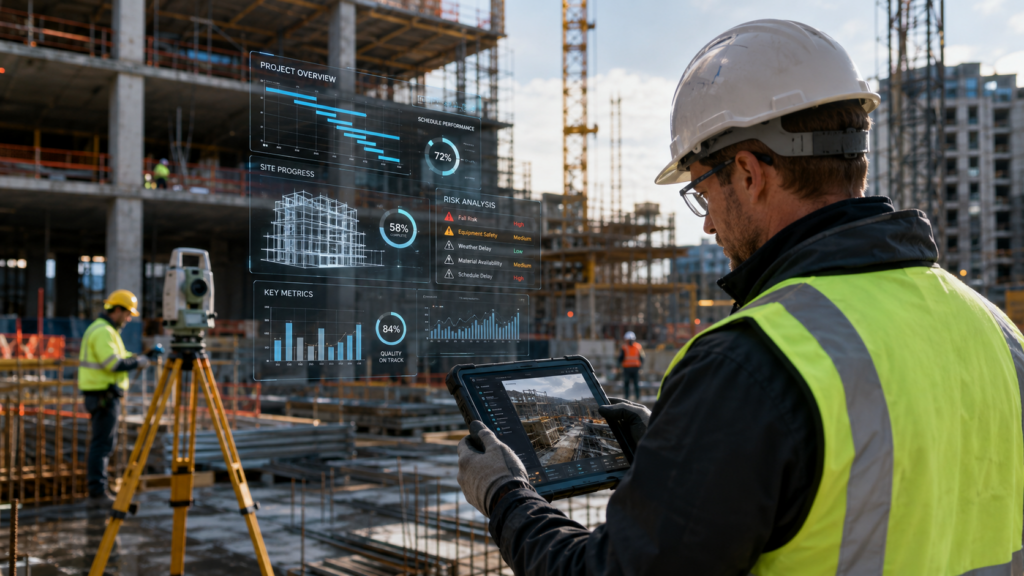
The third risk is workforce resistance. Field teams may view AI as surveillance if implementation is poorly communicated. Labour productivity tools can quickly become sensitive if workers believe data is being used to monitor performance rather than support planning and safety. Successful adoption will require cultural care, not just technical deployment.
Cybersecurity and confidentiality also matter. Construction projects involve sensitive information, including designs, budgets, owner data, subcontractor pricing and infrastructure details. AI platforms that connect enterprise data must meet high security standards. This is especially important for contractors involved in healthcare, data centers, energy, defence or public infrastructure. In those sectors, information security is not optional.
What happens next if Palantir and McCarthy make AI work in the field?
If Palantir Technologies Inc. and McCarthy Building Companies Inc. can demonstrate measurable improvements in planning, field execution, risk management and productivity, the partnership could become a reference model for AI adoption across the construction industry. Other large contractors may look more seriously at enterprise AI platforms, especially if Pulse shows that AI can reduce schedule surprises, improve coordination and support margin discipline.
The commercial opportunity could extend beyond contractors. Owners, infrastructure agencies, developers and industrial companies also need better visibility into project risk. If Palantir Technologies Inc. can use construction partnerships to prove its value across capital project delivery, it may open a larger market in project controls, asset delivery and infrastructure intelligence. That would connect well with broader demand for data-driven capital allocation.
If the partnership underdelivers, the construction industry may become more cautious. Contractors have seen technology promises before, and field adoption can be unforgiving. If AI adds cost or complexity without clear operational gains, executives may slow investment and return to more incremental digitisation. The sector does not lack pilots. It lacks scaled proof.
For now, the partnership is a meaningful signal. Palantir Technologies Inc. is trying to prove that its AI operating model can work in one of the most complex physical industries. McCarthy Building Companies Inc. is trying to turn its project experience into a more intelligent operating system. If they get it right, construction AI may move beyond buzzwords and into the daily decisions that decide whether projects finish on time, on budget and without avoidable drama. That may not sound glamorous, but in construction, fewer surprises are a luxury product.
Key takeaways on what the Palantir and McCarthy AI partnership means for construction
- Palantir Technologies Inc. and McCarthy Building Companies Inc. have entered a multi-year strategic partnership to expand AI and data-driven decision-making across construction operations.
- McCarthy Building Companies Inc.’s Pulse system uses Palantir’s Artificial Intelligence Platform to support field teams with real-time insight, planning, risk analysis and faster decisions.
- The partnership gives Palantir Technologies Inc. a stronger commercial AI reference in construction, a large but fragmented industry with persistent productivity challenges.
- For McCarthy Building Companies Inc., the value case depends on whether AI can improve field execution, reduce schedule surprises and support better project-level risk management.
- Palantir Technologies Inc. stock remains valuation-sensitive, meaning investors will look for scalable commercial revenue rather than treating the partnership as a standalone catalyst.
- Construction technology rivals may face pressure if Palantir Technologies Inc. becomes an AI orchestration layer above existing project management, scheduling and cost-control systems.
- The partnership could help institutionalise best practices across McCarthy Building Companies Inc. by turning project experience into a more connected enterprise operating system.
- Adoption risks remain significant because construction teams need transparent, practical AI tools that support field judgment rather than creating black-box recommendations.
- Data quality, accountability, workforce trust and cybersecurity will determine whether AI becomes embedded in construction decisions or remains limited to pilot projects.
- If successful, the Palantir and McCarthy model could accelerate AI adoption across contractors, infrastructure owners and capital project delivery markets.
Discover more from Business-News-Today.com
Subscribe to get the latest posts sent to your email.