
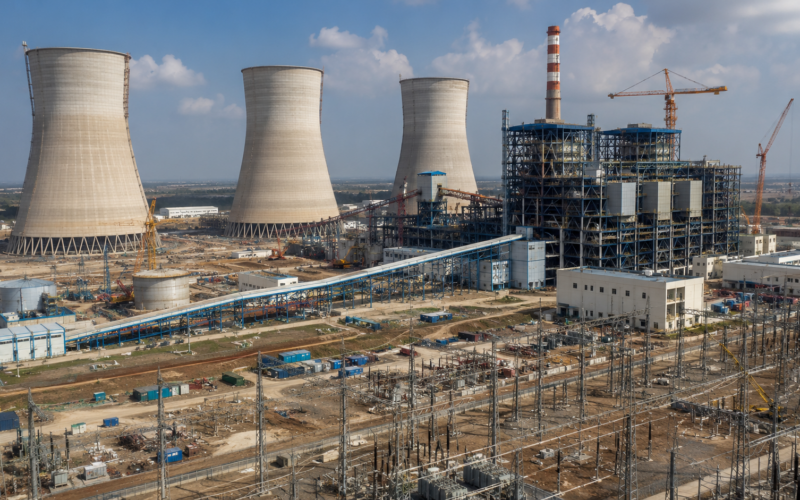
Bharat Heavy Electricals Limited (NSE: BHEL, BSE: 500103) has secured an engineering, procurement and construction order worth more than ₹21,000 crore from Meja Urja Nigam Private Limited for the Meja Supercritical Thermal Power Project Stage II in Uttar Pradesh. The contract covers three 800 MW supercritical thermal units at Prayagraj, making it one of the most significant recent wins for the state-owned power equipment manufacturer. The award strengthens Bharat Heavy Electricals Limited’s power-sector order book at a time when India is balancing renewable energy expansion with a continued need for reliable baseload capacity. For investors, the announcement also lands at a sensitive moment, with Bharat Heavy Electricals Limited shares trading below their recent 52-week high despite a strong medium-term rally.
Why does Bharat Heavy Electricals’ ₹21,000 crore Meja order matter for India’s power equipment market?
The Meja Stage II order matters because it reinforces Bharat Heavy Electricals Limited’s relevance in India’s large thermal power project pipeline at a time when the company is trying to convert a revival in capital expenditure into sustainable earnings momentum. The project involves three supercritical units of 800 MW each, bringing the planned capacity addition to 2,400 MW. For a company whose fortunes are still closely tied to the timing, size and profitability of power-sector orders, a contract of this scale offers both revenue visibility and a demanding execution benchmark.

The award also signals that India’s electricity planning remains far more complicated than a simple renewable versus thermal debate. Solar, wind, hydro and battery storage are expanding quickly, but grid stability, peak demand management and industrial power needs continue to keep coal-based supercritical capacity in the policy mix. Supercritical technology is not a decarbonisation solution, but it is more efficient than older subcritical plants and remains part of the transition architecture in markets where demand growth is still running ahead of firm renewable capacity.
For Bharat Heavy Electricals Limited, the strategic relevance is not merely that it has won a large order. The deeper question is whether the company can execute the Meja project on schedule, protect margins across a nearly six-year delivery cycle and avoid the cost inflation, working capital pressure and project delays that have historically weighed on large engineering contracts. Big orders look good on paper. In infrastructure, the paper usually starts arguing back once procurement, civil works and commissioning milestones arrive.
How could the Meja Supercritical Thermal Power Project reshape BHEL’s order book and execution profile?
The Meja Supercritical Thermal Power Project strengthens Bharat Heavy Electricals Limited’s visibility in the thermal EPC market, where scale and domestic manufacturing capability remain important competitive advantages. The contract covers design, engineering, manufacturing, supply, construction, erection, testing and commissioning, which means Bharat Heavy Electricals Limited is not simply supplying equipment. It is taking responsibility for a broad project-delivery chain that spans manufacturing discipline, site execution and coordination with the project owner.
That breadth creates a stronger revenue opportunity, but it also raises execution risk. A 70-month completion period gives Bharat Heavy Electricals Limited a long runway, yet long-duration contracts expose engineering companies to changes in input prices, vendor availability, labour productivity, logistics and financing conditions. If Bharat Heavy Electricals Limited can manage these variables well, the order could improve confidence in its ability to deliver complex power projects at scale. If execution slips, the same order could become another reminder that EPC wins and cash conversion are not the same thing.
The order also arrives as India’s public-sector power ecosystem continues to rely on domestic suppliers for strategically important generation assets. Meja Urja Nigam Private Limited, a joint venture connected to the public power sector, gives Bharat Heavy Electricals Limited an order that fits its historical institutional strengths. However, the company still needs to show that legacy relationships can translate into modern project economics. In today’s market, being a trusted supplier is helpful, but being a profitable, timely and cash-efficient supplier is what investors will actually reward.
What does the BHEL share price reaction say about investor sentiment after the Meja order?
Bharat Heavy Electricals Limited shares closed at ₹386.95 on June 5, 2026, below their 52-week high of ₹424.90 but far above the 52-week low of ₹205.12. That positioning is important because it suggests the stock had already priced in a meaningful recovery before the Meja order became part of the market narrative. The one-week decline in the stock also shows that investors are not treating a large order win as an automatic upgrade to the earnings story.
That caution is understandable. Bharat Heavy Electricals Limited has benefited from renewed interest in public-sector capital expenditure, energy infrastructure and domestic manufacturing. However, valuation comfort becomes more difficult when a stock has already rallied sharply from its lows. At that stage, investors often move from asking whether the order book is growing to asking whether revenue recognition, operating margin and cash flow will follow in a cleaner sequence.
The market may therefore view the Meja order as strategically positive but not risk-free. The announcement supports the long-term case that Bharat Heavy Electricals Limited remains central to India’s large-scale power equipment ecosystem. At the same time, investors will want to see whether the company can convert a headline order into stronger quarterly execution, improved profitability and better working capital discipline. A ₹21,000 crore contract can lift sentiment, but sustained rerating usually needs numbers that survive beyond the announcement day.
Why is India still awarding large thermal power projects despite the renewable energy push?
India’s continuing thermal power awards reflect the country’s uncomfortable but practical energy reality. Electricity demand is rising because of industrial activity, urbanisation, cooling demand, electrification and data-centre growth. Renewable energy is scaling rapidly, but intermittency, grid balancing, storage costs and transmission readiness mean the country still needs dependable capacity that can support peak demand and regional load requirements.
That does not mean thermal power is free from policy, environmental or financing pressure. New coal-based capacity faces scrutiny over emissions, water use, land requirements and long-term asset risk. Supercritical projects offer higher efficiency than older plants, but they still sit inside a carbon-intensive generation model. This makes the Meja project part of India’s transitional power strategy rather than a clean break from old energy systems.
For Bharat Heavy Electricals Limited, this creates a narrow but meaningful window. The company can benefit from thermal replacement and capacity-addition orders while also developing capabilities in transmission, renewables, storage, rail, defence and industrial systems. The risk is overdependence on a thermal upcycle that may not remain equally investable forever. The opportunity is to use current power-sector momentum to strengthen manufacturing execution, diversify revenue streams and rebuild investor trust.
What risks could affect BHEL’s ability to convert the Meja order into stronger earnings?
The first risk is execution complexity. Large power projects involve multiple technical packages, subcontractors, site dependencies and regulatory clearances. Any slippage in equipment delivery, civil construction, logistics or testing can delay revenue recognition and raise costs. Since the Meja project has a completion horizon of nearly six years, Bharat Heavy Electricals Limited will need to manage both project milestones and inflation exposure across a long cycle.
The second risk is margin quality. EPC contracts can add scale to the order book, but the quality of earnings depends on pricing discipline, procurement efficiency and claims management. If input costs rise faster than contract protections allow, or if execution requires additional working capital, the financial benefit may be weaker than the order value suggests. This is where investors will separate order-book optics from genuine earnings improvement.
The third risk is policy direction. India may continue to need thermal power, but the pace of renewable integration, battery storage deployment and grid upgrades could influence how future thermal orders are viewed by lenders, policymakers and investors. Bharat Heavy Electricals Limited does not need thermal power to remain dominant forever, but it does need current thermal orders to produce cash and credibility while the company expands into adjacent growth areas.
How could Bharat Heavy Electricals use this order to strengthen its long-term transition strategy?
Bharat Heavy Electricals Limited can use the Meja order as a platform to demonstrate that its manufacturing and engineering model remains relevant in India’s next phase of infrastructure spending. The company has deep technical capacity, long experience with power-sector customers and a domestic industrial base that aligns with India’s preference for strategic manufacturing resilience. If the Meja project is delivered well, Bharat Heavy Electricals Limited could strengthen its credibility for future thermal, industrial and energy-transition-linked contracts.
The company also has an opportunity to frame its role beyond coal equipment. India’s power system will require grid equipment, storage integration, flexible generation, industrial electrification and cleaner fuels over time. Bharat Heavy Electricals Limited’s long-term investment case will improve if investors see the company as an energy infrastructure manufacturer rather than only a thermal power contractor. The Meja order gives the company scale, but diversification will decide whether the market assigns a higher-quality multiple.
This is why the order should be read as both a win and a test. It validates Bharat Heavy Electricals Limited’s position in a major public-sector power project. It also increases the pressure on management to prove that order inflow can become revenue, revenue can become margin and margin can become cash. In infrastructure, the applause comes at award stage, but the valuation premium comes at execution stage.
Key takeaways on what BHEL’s Meja power order means for investors and India’s energy sector
- Bharat Heavy Electricals Limited has secured one of its largest recent thermal EPC orders, strengthening its power-sector order book and reinforcing its relevance in India’s centralised generation infrastructure.
- The Meja Supercritical Thermal Power Project Stage II adds 2,400 MW of planned capacity, highlighting India’s continued need for firm baseload power alongside renewable energy expansion.
- The ₹21,000 crore order improves revenue visibility, but the nearly six-year execution timeline means investors will closely track project milestones, margins and working capital discipline.
- Bharat Heavy Electricals Limited’s share price remains below its 52-week high, suggesting that the market is treating the order as positive but not enough to erase execution and valuation concerns.
- The project supports India’s domestic manufacturing agenda because Bharat Heavy Electricals Limited remains a key public-sector engineering supplier for strategic power infrastructure.
- The order also exposes Bharat Heavy Electricals Limited to long-duration EPC risks, including input-cost inflation, site execution delays, vendor coordination challenges and potential cash conversion pressure.
- India’s continued thermal project awards show that renewable growth has not removed the need for dependable capacity, especially as peak demand, industry and data infrastructure expand.
- The strategic test for Bharat Heavy Electricals Limited is whether it can use thermal order momentum to strengthen its broader energy infrastructure portfolio, including grid, storage and industrial systems.
- Investors are likely to reward Bharat Heavy Electricals Limited more for margin resilience and cash flow improvement than for order wins alone, making execution the central stock catalyst.
- The Meja order gives Bharat Heavy Electricals Limited a major platform to rebuild confidence, but the company now has to prove that scale can translate into sustainable earnings quality.
Discover more from Business-News-Today.com
Subscribe to get the latest posts sent to your email.