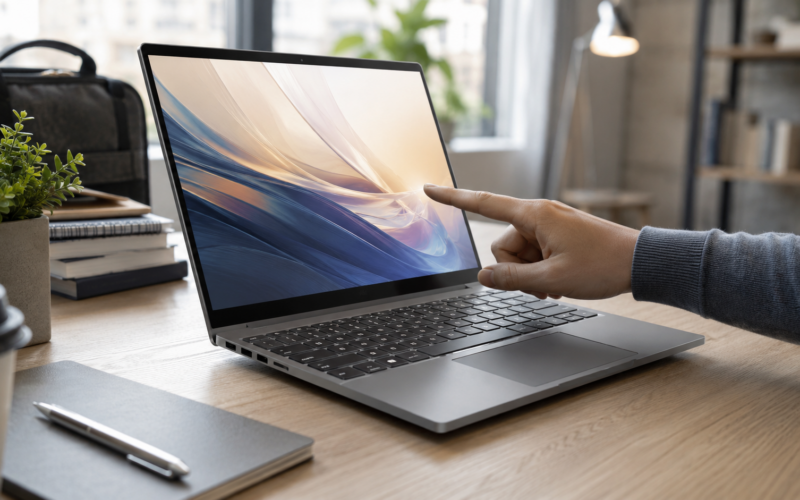
Dell Technologies Inc. (NYSE: DELL) has launched a lower-priced touch-screen XPS 13 starting at $699, positioning the device directly against Apple Inc.’s MacBook Neo in the entry-level premium laptop market. The new model will also be offered at $599 for eligible students during the back-to-school season, putting Dell Technologies in a sharper fight for younger buyers, mobile professionals, and cost-conscious premium users. The move matters because Apple has already shown that a lower-priced MacBook can pull demand away from Windows laptops without abandoning premium brand cues. Dell Technologies shares have recently traded near their 52-week high, suggesting investors are already pricing the company more as an artificial intelligence infrastructure and premium hardware beneficiary than as a slow-growth personal computer vendor.
Why is Dell Technologies using a lower-priced XPS 13 to challenge Apple MacBook Neo now?
Dell Technologies is using the XPS 13 price reset to address a basic but uncomfortable shift in the personal computer market: premium design is no longer enough if the entry price feels out of step with household and student budgets. Apple’s MacBook Neo has changed the reference point for what consumers may expect from a sub-$700 laptop, especially when the product carries the Apple brand, long battery life expectations, and tight ecosystem integration. Dell Technologies is responding by pulling the XPS brand into a lower price band rather than leaving the segment to mainstream Inspiron-style machines or rival Windows manufacturers.
That is a notable strategic move because XPS has traditionally acted as Dell Technologies’ design and brand halo in consumer laptops. Lowering the access point to $699 risks compressing margins if Dell Technologies cannot manage component costs, inventory planning, and configuration discipline. However, the bigger risk may be doing nothing while Apple trains consumers to associate affordable premium notebooks with macOS rather than Windows.
The student discount is not just a seasonal promotion. It is a customer acquisition tactic. Students who buy into an operating system, productivity workflow, and accessory ecosystem often remain within that environment after graduation. Apple has understood this for years. Dell Technologies now appears to be using XPS 13 as a counterweight, not merely as a laptop launch but as a retention play for Windows in education-adjacent premium computing.
How does the new Dell XPS 13 compare with Apple MacBook Neo on pricing and product positioning?
The new Dell XPS 13 starts at $699 for general buyers and falls to $599 for students aged 16 and older during the back-to-school period. That matters because the price overlaps with the psychological zone Apple has entered with MacBook Neo, where premium laptops begin to compete not only on specifications but also on perceived value. Dell Technologies is trying to make the argument that buyers do not need to leave Windows to get a thin, light, well-built device at an aggressive price.
The product positioning leans heavily on portability and display quality. Dell Technologies is presenting the new XPS 13 as its thinnest and lightest XPS 13 model, with a larger display than Apple’s rival and a lower weight profile. The device is expected to launch first with Intel Core Series 3 processors, with Intel Core Ultra Series 3 versions and a Storm colour option coming later in the summer. That staggered launch gives Dell Technologies a way to capture early back-to-school demand while leaving room for higher-priced configurations.
The touch-screen angle is important because Apple continues to avoid touch input on MacBook devices. For Windows users, touch is not a novelty feature. It is part of the operating system’s usage logic, especially for note-taking, browsing, creative work, and casual productivity. Dell Technologies can use that difference to make the XPS 13 feel more flexible than Apple MacBook Neo, even if Apple retains the ecosystem advantage.
What does the $699 XPS 13 say about Dell Technologies’ broader consumer laptop strategy?
Dell Technologies is signalling that its consumer laptop strategy cannot rely only on premium pricing and enterprise spillover demand. The personal computer industry is dealing with a complicated mix of replacement-cycle recovery, artificial intelligence personal computer marketing, and component cost pressure. At the same time, consumers are still price-sensitive after several years of inflation. A lower-priced XPS 13 allows Dell Technologies to defend brand relevance while still participating in the premium category.
This is also a response to Apple’s ability to set market expectations. When Apple moves into a lower price tier, competitors are forced to decide whether to protect margins or defend volume. Dell Technologies appears to be choosing a middle path by using XPS design language and student pricing to stay visible in a segment that could shape future platform loyalty.
There is a careful balancing act here. If Dell Technologies cuts too far, XPS risks losing some of its premium aura. If Dell Technologies prices too high, Apple can frame MacBook Neo as the cleaner value proposition. The $699 starting point gives Dell Technologies a plausible way to compete without fully turning XPS into a budget brand. That is the laptop equivalent of walking a tightrope while holding a tray of expensive aluminium.
Why could the new XPS 13 matter for Intel, Windows laptops, and the artificial intelligence personal computer cycle?
The new XPS 13 also matters because it gives Intel Corporation another high-visibility platform in the consumer notebook market. Dell Technologies is launching the device with Intel Core Series 3 processors first, while more advanced Intel Core Ultra Series 3 options are expected later. That matters for Intel Corporation because Apple’s lower-cost MacBook Neo strengthens Apple’s silicon story at a time when Windows original equipment manufacturers need strong battery life, thermal performance, and price discipline to remain competitive.
For Microsoft Corporation and the broader Windows ecosystem, Dell Technologies’ pricing move is strategically useful. Windows laptops have often competed through specification variety, discounting, and enterprise familiarity. Apple competes through vertical integration, software polish, and brand loyalty. A polished, cheaper XPS 13 gives Windows a stronger answer in the segment where students and early-career professionals make long-term platform choices.
The artificial intelligence personal computer cycle adds another layer. Consumers are still sorting out whether on-device artificial intelligence features justify upgrades. A lower entry price can reduce that friction. Dell Technologies does not need every XPS 13 buyer to purchase a top-end artificial intelligence personal computer configuration immediately. It needs them to stay within Dell Technologies’ upgrade ladder as processors, memory, and local artificial intelligence workloads become more important over the next few replacement cycles.
How should investors read Dell Technologies stock sentiment after the XPS 13 launch?
Dell Technologies stock has recently traded around $420.91, close to a reported 52-week range of about $106.38 to $429.15. That price context matters because the XPS 13 launch is not carrying investor sentiment on its own. The larger market narrative around Dell Technologies remains tied to artificial intelligence servers, infrastructure demand, and enterprise technology spending. Consumer laptops are important, but they are not the main reason the stock has been rewarded so sharply.
Even so, the XPS 13 launch helps reinforce a broader investor thesis that Dell Technologies can operate across both infrastructure and client devices without surrendering the consumer premium segment. If artificial intelligence infrastructure demand remains strong, the consumer personal computer business does not need to be spectacular to support sentiment. It simply needs to avoid becoming a drag.
The risk is that aggressive consumer pricing may invite questions about margins, especially if memory chip costs and supply pressures persist. Dell Technologies must show that lower entry pricing can expand reach without diluting profitability. Investors may tolerate thinner consumer margins if the company continues to deliver in artificial intelligence infrastructure, but the market will be less forgiving if price cuts look like defensive discounting rather than strategic share capture.
Could Dell Technologies’ XPS 13 pricing pressure Apple and other Windows laptop makers?
Dell Technologies’ pricing move places pressure on both Apple and Windows rivals, but in different ways. For Apple, the challenge is not that Dell Technologies can easily replicate the Mac ecosystem. The challenge is that Dell Technologies can make the MacBook Neo look less obviously superior on price, portability, touch capability, and display size. That could matter for buyers who want premium hardware but are not deeply locked into Apple services.
For Windows rivals such as HP Inc., Lenovo Group Limited, Acer Inc., and Microsoft Corporation’s Surface line, the XPS 13 creates another problem. If Dell Technologies can bring XPS styling into a lower price band, other Windows brands may need to justify either higher prices or less premium designs. The Windows market is already crowded, and a more affordable XPS could force competitors to sharpen their own entry-level premium strategies.
This is where Dell Technologies may have an advantage. Dell Technologies can use its scale, procurement relationships, direct sales channels, and enterprise credibility to support aggressive consumer positioning. Smaller or less vertically coordinated rivals may find it harder to match a premium-feeling device at a similar price without sacrificing margin or build quality.
What execution risks could limit Dell Technologies’ XPS 13 push against Apple MacBook Neo?
The biggest execution risk is configuration perception. If the entry-level XPS 13 is viewed as underpowered, especially with lower memory configurations, buyers may see the $699 price as more of a teaser than a true value proposition. Apple faces similar criticism when entry models ship with restrained memory or storage, but Apple’s software optimisation and brand loyalty often soften the blow. Dell Technologies must work harder because Windows buyers compare specifications more aggressively.
Battery life is another risk. Apple has built a strong reputation around efficient silicon and real-world battery performance. Dell Technologies can make strong design and display claims, but consumers will judge the XPS 13 on everyday endurance, heat, fan noise, and performance consistency. A thin chassis can be elegant, but it can also become a thermal negotiation with physics. Physics, sadly, does not respond to marketing decks.
Port selection may also matter. Ultra-thin laptops often sacrifice ports in the name of portability. That can frustrate students, creators, and professionals who still rely on accessories, external displays, headphones, cameras, and storage devices. Dell Technologies will need to persuade buyers that portability and design simplicity outweigh those compromises.
What does Dell Technologies’ XPS 13 launch mean for the future of affordable premium laptops?
The XPS 13 launch suggests that affordable premium laptops are becoming a more serious battleground rather than a narrow seasonal category. Apple has pulled its premium brand into a lower price point. Dell Technologies is now answering with XPS. If the strategy works, the next wave of competition may shift away from pure specification tables and toward perceived premium value at mainstream prices.
That could reshape the laptop market in two ways. First, brands may become more willing to use flagship sub-brands in lower-priced configurations to win younger users. Second, component suppliers may face pressure to support thinner, lighter, more efficient systems at lower bills of materials. The winners will be the companies that can make a $699 laptop feel like a strategic gateway rather than a cost-cut product.
For Dell Technologies, the opportunity is clear. The company can use XPS 13 to defend Windows premium relevance, build loyalty among students and young professionals, and preserve its role in the consumer notebook conversation while artificial intelligence infrastructure drives the bigger investor narrative. The challenge is equally clear. Apple has made affordable premium look simple. Dell Technologies now has to prove it can make it profitable.
Key takeaways on how Dell Technologies’ $699 XPS 13 could reshape the premium laptop market
- Dell Technologies is using the new XPS 13 to challenge Apple MacBook Neo directly in the lower-priced premium laptop segment, with a $699 starting price and a $599 student offer.
- The XPS 13 launch is strategically important because Apple has moved into a price band that could pull students, young professionals, and cost-sensitive premium buyers away from Windows laptops.
- Dell Technologies is trying to protect the premium identity of the XPS brand while making the line more accessible, a balancing act that could either expand reach or pressure margins.
- The touch-screen display gives Dell Technologies a clear product distinction against Apple MacBook Neo, particularly for Windows users who value flexible input and productivity use cases.
- Intel Corporation benefits from the launch because the XPS 13 gives its latest consumer processors another high-profile Windows platform against Apple’s in-house silicon.
- Dell Technologies stock sentiment remains more closely tied to artificial intelligence infrastructure demand than consumer laptops, but a credible XPS revival supports the broader hardware platform story.
- The main risks include entry-level configuration limits, real-world battery performance, port compromises, and whether lower pricing can be sustained without damaging XPS profitability.
- Competitors such as HP Inc., Lenovo Group Limited, Acer Inc., and Microsoft Corporation may face pressure to improve the design and value equation of their own lower-priced premium laptops.
- The launch suggests that affordable premium laptops could become a larger battleground as brands compete for students and early-career users before platform loyalty hardens.
- Dell Technologies’ success will depend on whether the XPS 13 feels like a true premium value product rather than a defensive price cut against Apple.
Share this:
Discover more from Business-News-Today.com
Subscribe to get the latest posts sent to your email.