





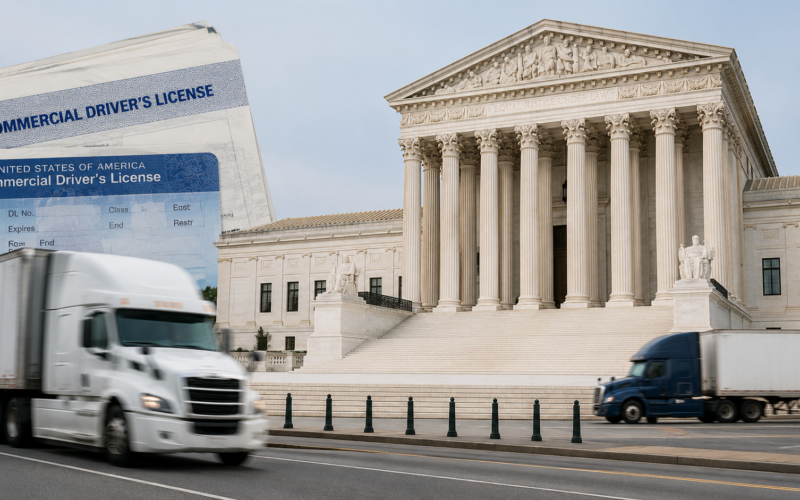
The United States Supreme Court has rejected Florida’s attempt to sue California and Washington over commercial driver’s licenses issued to immigrant truck drivers, leaving unresolved a politically charged dispute involving immigration status, highway safety, state licensing authority and the court’s role in interstate conflicts.
The court denied Florida’s motion for leave to file a bill of complaint against California and Washington. The order means Florida cannot use the Supreme Court’s original jurisdiction process to challenge the two Democratic-led states directly in the nation’s highest court over commercial driver’s license policies.
Florida had accused California and Washington of defying federal immigration and trucking laws by issuing commercial driver’s licenses to people who are not United States citizens or lawful permanent residents. Florida argued that some drivers who received such licenses could not read English and should not have been allowed to operate commercial motor vehicles.
The case followed a fatal Florida crash last year that killed three people. The driver, Harjinder Singh, is accused of making an illegal U-turn that caused the crash. Harjinder Singh, who is from India, held a valid commercial driver’s license from California and had earlier received one from Washington.
The Supreme Court rejected Florida’s request without taking up the case. Justice Clarence Thomas, joined by Justice Samuel Alito, dissented from the denial. Justice Clarence Thomas argued that the Supreme Court should hear disputes between states because federal law gives the court exclusive original jurisdiction over such cases.
The decision does not decide the underlying legality of California and Washington licensing policies. It also does not resolve the broader national debate over whether states should be allowed to issue commercial driver’s licenses to unauthorized immigrants or other noncitizens. Instead, the decision leaves Florida without the direct Supreme Court lawsuit it sought and preserves the court’s usual reluctance to accept original lawsuits between states.
Why did the United States Supreme Court reject Florida’s lawsuit against California and Washington?
The United States Supreme Court rejected Florida’s lawsuit by denying the state’s motion for leave to file a bill of complaint. That procedural decision prevented Florida from opening an original lawsuit against California and Washington directly at the Supreme Court.
The confirmed legal action is narrow but important. The Supreme Court did not hold a full hearing on whether California and Washington violated federal law. The court did not issue a majority opinion explaining why it rejected Florida’s motion. The practical result is that Florida’s interstate complaint will not move forward in the Supreme Court.
Florida’s position was that California and Washington had created a safety and immigration problem by issuing commercial driver’s licenses to drivers who were not citizens or lawful permanent residents. Florida framed the dispute as a matter of federal compliance, interstate harm and public safety after the fatal crash involving Harjinder Singh.
California and Washington were not forced into a Supreme Court trial because the court declined to accept the case. That matters because original jurisdiction cases between states bypass the normal path of district court, appeals court and Supreme Court review. The Supreme Court has increasingly treated such cases as exceptional, even though some justices argue that the court has a duty to hear them.
The broader consequence is that the court avoided becoming the first forum for a politically loaded clash between Republican-led Florida and Democratic-led California and Washington. The immigration and licensing issues remain alive, but not through the direct state-versus-state route Florida attempted.
How did the fatal Florida crash involving Harjinder Singh shape the licensing dispute?
The fatal Florida crash involving Harjinder Singh shaped the dispute by turning an administrative licensing issue into a national political and legal controversy. The crash killed three people and focused public attention on how states issue commercial driver’s licenses to noncitizens.
Harjinder Singh is accused of making an illegal U-turn that caused the crash. Harjinder Singh carried a valid commercial driver’s license from California and had previously received one from Washington. Florida used those facts to argue that licensing decisions made by other states created public safety risks on Florida roads.
That argument is powerful politically because commercial trucking is inherently interstate. A license issued in California or Washington can allow a driver to operate across state lines, including in Florida. Florida’s claim was that one state’s licensing policy can create consequences in another state that did not choose that policy.
The institutional question is more complicated. Commercial driver licensing is governed by a mix of state administration and federal standards. States issue commercial driver’s licenses, but federal rules govern core eligibility, safety standards and interstate recognition. That shared structure makes disputes over noncitizen licensing especially difficult because they involve both state discretion and federal oversight.
The broader public-policy consequence is that highway safety has become tied to immigration enforcement. Florida framed the issue as a safety failure and a federal-law violation. Critics of restrictive licensing policies may argue that licensing systems can improve safety by bringing drivers into regulated testing and oversight. The Supreme Court’s denial did not resolve that debate.
Why do commercial driver’s licenses for immigrants create a federalism conflict?
Commercial driver’s licenses for immigrants create a federalism conflict because states issue the licenses, federal law sets key standards, and commercial drivers operate across state lines. That structure creates tension when states disagree about who should be eligible.
Florida argued that California and Washington exceeded their authority by issuing licenses to people who were not citizens or lawful permanent residents. Florida’s position was that state licensing decisions in California and Washington imposed risks on Florida because commercial truck drivers cross state borders.
California and Washington have defended broader access to state-issued licenses as part of their own policy frameworks. States have different approaches to immigrants, workers, licensing access and public safety. Some states view licensing as a way to ensure that people who are already driving are tested, insured, identified and subject to regulation. Other states view such licensing as a reward or legal recognition for people who lack proper immigration status.
The institutional tension is that federal immigration law is national, while licensing administration is partly state-based. The United States Constitution gives the federal government broad authority over immigration, but states retain control over many licensing and road-safety functions. When those two areas overlap, courts may be asked to decide where state authority ends.
The Supreme Court’s refusal to hear Florida’s original lawsuit avoids that boundary question for now. However, the underlying conflict is unlikely to disappear because commercial driver’s license rules affect trucking companies, state transportation agencies, immigrant workers, highway enforcement and public safety politics.
What did Justices Clarence Thomas and Samuel Alito say about original jurisdiction?
Justice Clarence Thomas and Justice Samuel Alito dissented because they have long argued that the Supreme Court should not refuse to hear qualifying disputes between states. In this case, Justice Clarence Thomas said the court should have accepted Florida’s complaint because disputes between states fall within the Supreme Court’s original jurisdiction.
The legal issue is not only about immigrant truck drivers. It is also about the Supreme Court’s gatekeeping role. Original jurisdiction means certain cases can begin at the Supreme Court rather than reaching the court after lower-court proceedings. Disputes between states are one of the classic categories of original jurisdiction.
The Supreme Court, however, has developed a discretionary approach. The court often denies requests to file original actions if it believes the dispute is unsuitable, lacks sufficient gravity, can be resolved elsewhere or would place the court in the role of a trial court. Justice Clarence Thomas and Justice Samuel Alito have repeatedly objected to that approach.
Their dissent in the Florida case reflects a broader institutional disagreement. The majority’s denial leaves intact the court’s practice of screening state-versus-state cases. The dissenters’ view would make it harder for the court to turn away such disputes when one state asks to sue another state.
The broader consequence is that the case becomes part of a continuing debate over Supreme Court procedure. For Florida, the immediate issue was commercial driver licensing. For the dissenting justices, the larger issue was whether the court is wrongly avoiding cases that federal law says it alone can hear.
How does the Florida case connect immigration policy with highway safety regulation?
The Florida case connects immigration policy with highway safety because the dispute turns on whether immigration status should affect eligibility for commercial driver’s licenses. Commercial driver’s licenses are not ordinary driving credentials. They allow drivers to operate large trucks, buses and other commercial vehicles that can pose serious risks if drivers are not properly trained or tested.
Florida argued that California and Washington created dangers by issuing commercial driver’s licenses to unauthorized immigrants and drivers who allegedly could not read English. Florida presented the issue as a public-safety failure with interstate consequences.
The countervailing policy argument is that licensing rules can serve safety by requiring testing, identification, recordkeeping and accountability. If people are driving commercial vehicles regardless of immigration status, some policymakers argue that licensing systems are safer than leaving drivers outside formal oversight. Others argue that commercial trucking requires stricter national standards because the consequences of error can be deadly.
The federal government has also become involved in the wider issue. A separate federal appeals court has blocked a Trump administration proposal that would sharply limit which immigrants can obtain commercial driver’s licenses to operate semitrailer trucks or buses. That separate litigation shows that the licensing debate is not limited to Florida, California and Washington.
The broader consequence is that immigrant access to commercial driver’s licenses may remain a recurring flashpoint. It sits at the intersection of labor demand in trucking, immigration enforcement, state licensing policy, federal safety standards and public reaction to fatal crashes.
Why does the Supreme Court decision matter beyond Florida, California and Washington?
The Supreme Court decision matters beyond the three states because it leaves unresolved a national question about how commercial driver licensing should treat noncitizens and unauthorized immigrants. Trucking is a national industry, and commercial driver’s licenses issued in one state can affect roads, businesses and communities across the country.
For states, the decision preserves existing divisions. States with stricter immigration policies may continue objecting to licensing practices in states with broader access. States with broader access may continue arguing that their licensing systems improve safety and accountability. Without a definitive Supreme Court ruling, those policy differences remain.
For the trucking industry, uncertainty remains over workforce rules, compliance standards and state-by-state licensing practices. Commercial trucking depends heavily on interstate movement. If eligibility rules vary widely, companies may face compliance complexity, particularly when drivers operate across multiple jurisdictions.
For federal policymakers, the case underscores the limits of using state lawsuits to settle national regulatory conflicts. If Congress or federal agencies want uniform rules, they may need to act through legislation or formal rulemaking. Court action may still occur, but the Supreme Court’s refusal to hear Florida’s original action signals that not every interstate dispute will get immediate high-court review.
For immigration policy, the ruling leaves the larger issue contested. The Supreme Court did not validate California and Washington policies on the merits, but it also did not give Florida the declaration it wanted. That unresolved middle ground is likely to keep the issue alive in state politics, federal rulemaking and future litigation.
What are the key takeaways from the Supreme Court rejection of Florida’s truck license lawsuit?
- The United States Supreme Court rejected Florida’s attempt to sue California and Washington directly. The court denied Florida’s motion for leave to file a bill of complaint in an original jurisdiction case.
- Florida accused California and Washington of violating federal law through commercial driver’s license policies. Florida argued that the states issued licenses to people who were not citizens or lawful permanent residents.
- The dispute followed a fatal Florida crash involving Harjinder Singh. Harjinder Singh is accused of making an illegal U-turn that caused a crash that killed three people.
- Harjinder Singh held a valid commercial driver’s license from California and had earlier received one from Washington.
Florida used that licensing history to argue that other states’ policies created safety risks on Florida roads. - Justice Clarence Thomas and Justice Samuel Alito dissented from the Supreme Court’s denial. They argued that the Supreme Court should hear disputes between states under its original jurisdiction.
- The ruling does not decide whether California and Washington licensing policies are lawful. It leaves the broader conflict over immigration status, commercial driver licensing and highway safety unresolved.
Discover more from Business-News-Today.com
Subscribe to get the latest posts sent to your email.


