



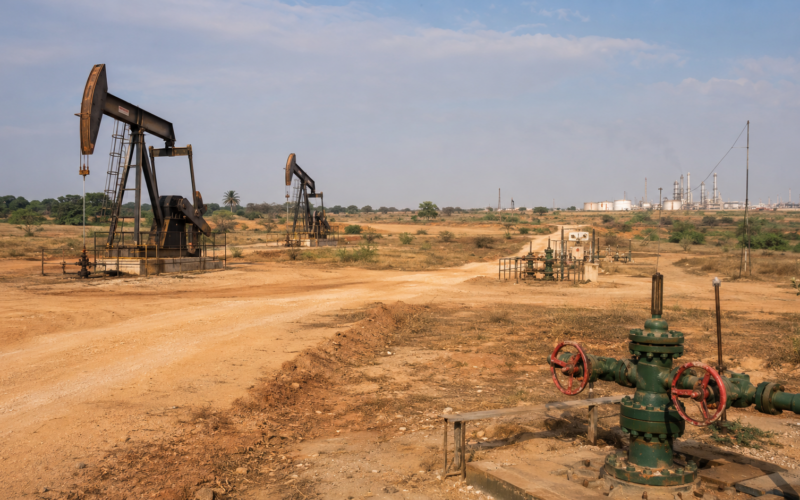
Afentra plc (AIM: AET) has secured formal approval for the Risk Service Contract covering onshore Block KON4 in Angola, giving the company a 35 percent operated interest in a licence that could reshape its Kwanza basin strategy. The award, approved by Presidential Decree on May 26, 2026, places Afentra plc alongside Grupo Simples Oil, Sonangol E&P, Brite’s Oil and Gas, and Sodedurs in a block that includes legacy oil fields and new exploration potential. The most important asset inside KON4 is the Quenguela Norte field, which has previously produced oil but has been shut in since 1999. For investors watching AIM-listed Afentra plc, the announcement moves the company further from a pure offshore Angola consolidation story toward a broader operated redevelopment platform across one of Africa’s under-explored hydrocarbon basins.
The timing matters because Afentra plc has been building a deliberate Angola-led portfolio rather than chasing scattered frontier exposure across the continent. Offshore Angola already provides the company with producing and near-field interests, while KON4, KON15 and KON19 now give it a broader onshore footprint in the Kwanza basin. That combination gives Afentra plc a more layered strategy: cash flow from producing assets, redevelopment potential from discovered fields, and exploration optionality from under-drilled acreage. In small-cap oil and gas, that is the difference between owning isolated licences and owning a basin thesis.
Why does Afentra plc’s KON4 licence matter for Angola’s onshore oil redevelopment strategy?
The KON4 award matters because it strengthens Afentra plc’s position in Angola at a time when mature and previously abandoned fields are becoming more attractive to smaller, technically focused operators. Large international oil companies often prioritize scale, deep-water economics, and portfolio simplification. Smaller independents can sometimes find value in assets that were left behind because past technology, infrastructure access, or commercial terms did not support further development. Afentra plc is effectively betting that modern subsurface interpretation, lower-cost field redevelopment, and existing infrastructure can turn old discoveries into investable production opportunities.
KON4 covers 1,387 square kilometres in the onshore Kwanza basin, a historically productive region where 11 oil fields and two gas fields have been discovered. More than 90 million barrels of oil equivalent have been produced from the area, which gives the block a different risk profile from a pure wildcat exploration licence. This is not a clean-sheet frontier story where management has to convince investors that hydrocarbons may exist. The sharper question is whether Afentra plc and its partners can reactivate known resources economically, safely, and within a timeframe that satisfies public-market investors.
The Quenguela Norte field is central to that proposition. The field is described as the largest onshore discovery in the onshore Kwanza basin to date, with more than 200 million barrels of discovered oil in place in Tertiary reservoirs. It previously reached peak production of 12,000 barrels of oil per day and recovered 46 million barrels before being shut in and abandoned in 1999. Those figures are not trivial for an AIM-listed independent. They also raise the real test: whether historical production data, remaining reservoir potential, and current redevelopment techniques can be brought together without the usual cost creep that haunts legacy-field revivals.
How could the Quenguela Norte field change Afentra plc’s production and cash flow profile?
Quenguela Norte gives Afentra plc something that exploration companies love to talk about but rarely possess in such tangible form: discovered oil, historical production, and a visible redevelopment concept. The field’s prior production record provides technical evidence that the reservoir system worked, while its abandonment in 1999 leaves open the possibility that economics, technology, or operating priorities rather than geology limited the field’s ultimate recovery. That is why Afentra plc’s early work programme is focused on subsurface studies assessing the reactivation of Quenguela Norte wells.
The potential upside is straightforward. If Afentra plc can reactivate field production at modest capital intensity, KON4 could become a near-to-medium-term production contributor rather than a distant exploration option. The proximity to the Luanda refinery and existing road infrastructure could also support earlier production and export routes than would be possible in a remote frontier block. That infrastructure angle matters because small-cap oil projects often stumble not on geology but on logistics, permitting, evacuation routes, and working-capital demands.
The risk is equally clear. Reactivating a field shut in for more than two decades is not like flipping a switch after a long weekend. Well integrity, reservoir pressure, above-ground access, local permitting, facility condition, and environmental requirements all need detailed assessment. Investors should treat Quenguela Norte as an opportunity with real historical support, not as guaranteed production growth. Afentra plc’s technical work over the next phase will determine whether KON4 becomes a genuine development engine or remains an attractive but slow-moving option in the portfolio.
What does KON4 reveal about Afentra plc’s broader Kwanza basin portfolio strategy?
The strategic importance of KON4 becomes clearer when viewed alongside Afentra plc’s interests in KON15 and KON19. Afentra plc now has a complementary onshore Kwanza basin portfolio with exposure to multiple play types across post-salt and pre-salt petroleum systems. That matters because a single licence can produce a binary outcome, while a cluster of licences can create shared geological learning, operational efficiencies, and a more coherent technical workstream. In plain English, Afentra plc is trying to build a map, not just pin a flag.
The company’s 35 percent operated stake in KON4 is especially important because operatorship changes the level of control Afentra plc has over work sequencing, technical priorities, and capital planning. Non-operated stakes can be valuable, particularly when aligned with strong partners, but operatorship allows a company to shape the pace and design of development. In KON4, Afentra plc can now put its technical thesis to work more directly, while still sharing licence participation with Angolan partners that bring local alignment and institutional relevance.
That local structure should not be overlooked. Grupo Simples Oil holds 35 percent, Sonangol E&P holds 20 percent, Brite’s Oil and Gas holds 5 percent, and Sodedurs holds 5 percent. The presence of Sonangol E&P and local Angolan partners reflects the political and commercial realities of developing oil assets in Angola. For Afentra plc, partnership management will be as important as reservoir management. The licence may offer hydrocarbons, but execution will depend on alignment across operatorship, local approvals, work programme funding, and field-level development decisions.
Why are legacy oil fields becoming strategically relevant for smaller upstream companies in Africa?
Legacy oil fields are gaining renewed attention because the global energy investment cycle has become more selective. Large companies continue to focus on advantaged deep-water basins, liquefied natural gas, low-carbon projects, and portfolio simplification. That leaves room for independents that can acquire or operate assets that are too small, too mature, or too operationally complex for larger balance sheets but still meaningful for smaller companies. Afentra plc’s strategy fits directly into that pattern.
Africa adds another layer to this logic. Several host governments want to sustain domestic oil production, protect fiscal revenue, and attract operators willing to invest in assets that might otherwise decline or remain undeveloped. For Angola, onshore redevelopment can complement its better-known offshore production base, particularly if companies can use existing infrastructure and bring disciplined technical work to discovered fields. KON4’s proximity to Luanda refinery infrastructure gives it strategic relevance beyond the raw acreage number.
However, the model is not risk-free. Smaller upstream companies can generate high equity upside from asset redevelopment, but they also face tighter access to capital, greater dependence on project sequencing, and sharper market reactions when timelines slip. Investors usually reward the idea of low-cost barrels until the invoices arrive. Afentra plc’s challenge is to show that KON4 is not just geologically interesting but commercially executable within a disciplined capital framework.
How should investors read Afentra plc’s share-price reaction and market sentiment after KON4?
Afentra plc shares have already had a strong period, which makes the market context more nuanced than a simple “licence win equals upside” reading. Recent market data showed Afentra plc trading around the mid-70 pence range in late May 2026, with a 52-week range of roughly 36.70 pence to 89.40 pence on London Stock Exchange data. That places the stock materially above its 52-week low but still below its recent high, suggesting investors have already priced in a degree of execution confidence while leaving room for further validation.
That matters because KON4 is strategically positive but not immediately cash generative. The award expands Afentra plc’s operated portfolio and strengthens its Angola story, but the market will likely wait for more detail on work programme timing, reactivation feasibility, capital needs, and development sequencing before fully re-rating the stock. In other words, the licence award improves the strategic map, but the next valuation move may depend on technical proof.
Sentiment toward Afentra plc appears constructive because the company has built a focused identity around Angola rather than spreading capital thinly across unrelated basins. The risk is that public-market patience can be thin when upstream redevelopment projects require long technical lead times. For AIM investors, the next milestones will matter more than the announcement itself. Updates on Quenguela Norte well reactivation studies, eFTG survey interpretation, permitting, and early production planning could become the catalysts that determine whether KON4 moves from promising acreage to tangible value creation.
What operational risks could shape Afentra plc’s next phase at KON4?
The most immediate operational risk is the condition and redevelopment potential of Quenguela Norte’s existing wells and field infrastructure. A field that last produced decades ago may hold meaningful remaining oil, but the technical path to reactivation can be complex. Well integrity reviews, reservoir modelling, pressure data, facility needs, and environmental obligations can materially change the capital estimate. Afentra plc’s early technical programme is therefore not procedural housekeeping. It is the work that will define whether the redevelopment case is robust.
The second risk is exploration discipline. KON4 offers near-field Tertiary and Cretaceous exploration opportunities, and the recently completed high-resolution eFTG survey is being integrated with existing sparse 2D seismic data. That is useful, but sparse seismic coverage also means interpretation uncertainty remains. Afentra plc will need to balance the appeal of exploration upside with the near-term commercial logic of reactivating discovered resources. Investors generally prefer a management team that knows when to drill and when to wait.
The third risk is capital allocation. Afentra plc’s Angola portfolio now includes offshore producing interests, offshore exploration exposure, and onshore operated and non-operated licences. That gives the company optionality, but optionality can become a burden if too many assets demand funding at once. The best outcome would be a phased approach in which producing assets support development work, technical studies prioritize the highest-return opportunities, and exploration spending remains disciplined. That is the line between a focused growth platform and an overextended small-cap story.
What happens next if Afentra plc succeeds or fails with the KON4 redevelopment model?
If Afentra plc succeeds at KON4, the company could strengthen its position as one of the more credible small-cap consolidators in Angola’s upstream sector. A successful Quenguela Norte reactivation would validate the company’s thesis that overlooked and abandoned fields in the Kwanza basin can still produce economic barrels under the right technical and commercial framework. That could improve investor confidence not only in KON4 but also in the broader KON15 and KON19 portfolio.
Success could also give Afentra plc more strategic leverage. Demonstrated redevelopment progress may support better access to capital, stronger partner confidence, and potentially more opportunities with host governments or divesting asset owners. In African upstream markets, credibility often compounds. Operators that prove they can take mature or neglected assets and move them toward production tend to become more attractive counterparties.
If KON4 disappoints, the downside would be less about the loss of a single licence and more about the credibility of the broader onshore redevelopment thesis. Technical complications, slow permitting, weak reactivation economics, or unclear capital requirements could cause investors to question how quickly Afentra plc can turn acreage into cash flow. The company does not need KON4 to transform overnight, but it does need the next phase of updates to show that the block has a practical development path. The market can forgive patience. It is less forgiving of vagueness dressed up as optionality.
Key takeaways on what Afentra plc’s KON4 licence means for Angola, AIM:AET investors, and African upstream redevelopment
- Afentra plc has strengthened its Angola growth platform by securing a 35 percent operated interest in onshore Block KON4.
- The KON4 award expands Afentra plc beyond offshore consolidation and gives it deeper exposure to the onshore Kwanza basin.
- Quenguela Norte is the key asset inside KON4 because it has historical production, discovered oil in place, and potential reactivation upside.
- The licence is strategically meaningful, but investors should watch technical validation before assuming near-term production growth.
- Afentra plc’s operated position gives it greater control over work programme priorities than its non-operated Kwanza basin interests.
- The proximity of KON4 to the Luanda refinery and road infrastructure could improve early production economics if field reactivation proves viable.
- The main risks are well integrity, redevelopment costs, sparse seismic coverage, permitting requirements, and capital allocation discipline.
- Afentra plc’s recent share-price strength suggests investors already see value in the Angola strategy, but further re-rating may depend on execution milestones.
- KON4, KON15 and KON19 give Afentra plc a more coherent basin-level portfolio rather than isolated exploration exposure.
- The next phase of technical updates will determine whether KON4 becomes a value-creating redevelopment asset or remains a long-dated option.
Discover more from Business-News-Today.com
Subscribe to get the latest posts sent to your email.