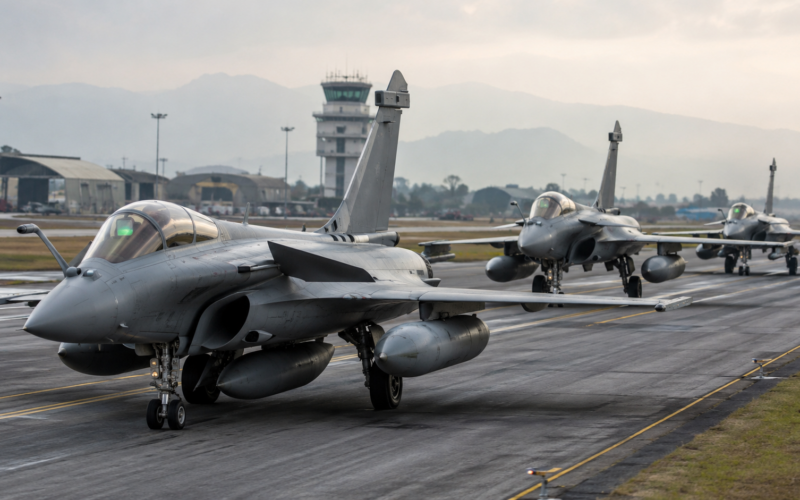
India has moved closer to one of its largest combat aircraft procurement decisions after finalising a Letter of Request for 114 Rafale fighter jets from France, a step that could reshape the Indian Air Force’s fighter fleet, deepen India-France defence cooperation, and expand domestic aerospace manufacturing under India’s self-reliance push.
The proposed procurement is expected to be pursued through a government-to-government framework with France. The Letter of Request is set to outline India’s operational, technical, commercial, industrial, and delivery requirements before France sends a formal response. The deal remains subject to further negotiations, final approvals, price discussions, contract structuring, and Cabinet-level clearance.
The Indian Air Force already operates 36 Rafale fighter jets acquired under the earlier India-France agreement. The Indian Navy is also set to induct 26 Rafale Marine aircraft for carrier operations. A further 114 Rafale jets for the Indian Air Force would therefore mark a major expansion of India’s reliance on the Dassault Aviation-built fighter platform across both land-based and maritime aviation roles.
The scale of the proposed procurement is politically and strategically significant because India continues to face a fighter squadron shortfall at a time when its military planning remains shaped by the China border, Pakistan, Indian Ocean security, and the need for faster modernisation of ageing combat aircraft fleets.
Why is India moving closer to a 114 Rafale fighter jet procurement from France now?
India’s proposed 114 Rafale fighter jet procurement comes at a time when the Indian Air Force is trying to close a long-standing fighter squadron gap. The Indian Air Force has been operating below its authorised strength, creating pressure to induct new multirole fighter aircraft while domestic aircraft programmes continue to scale up.
The Letter of Request is an important procurement milestone because it formally conveys India’s requirements to France. It is not the final contract. It is the start of a more detailed government-to-government negotiation process in which aircraft configuration, weapons package, maintenance support, technology transfer, local production, training, delivery schedules, and price will be examined.
The institutional importance lies in the shift toward a more defined procurement pathway. India has debated medium multirole combat aircraft requirements for years. The earlier plan to acquire 126 fighter aircraft evolved into the 2016 agreement for 36 Rafale jets. A new 114-aircraft acquisition would revive the larger fleet-expansion ambition, but through a structure that appears more tightly aligned with government-to-government procurement and domestic production requirements.
The timing also reflects wider regional security pressures. India’s air power planning must account for the western front with Pakistan and the northern and eastern border challenge with China. The Indian Air Force requires aircraft that can perform air superiority, deep strike, reconnaissance, maritime strike support, and precision attack missions. The Rafale platform has already been integrated into Indian Air Force operations, which may reduce some induction complexity compared with selecting a completely new fighter type.
How would the Rafale deal affect India’s air power balance with China and Pakistan?
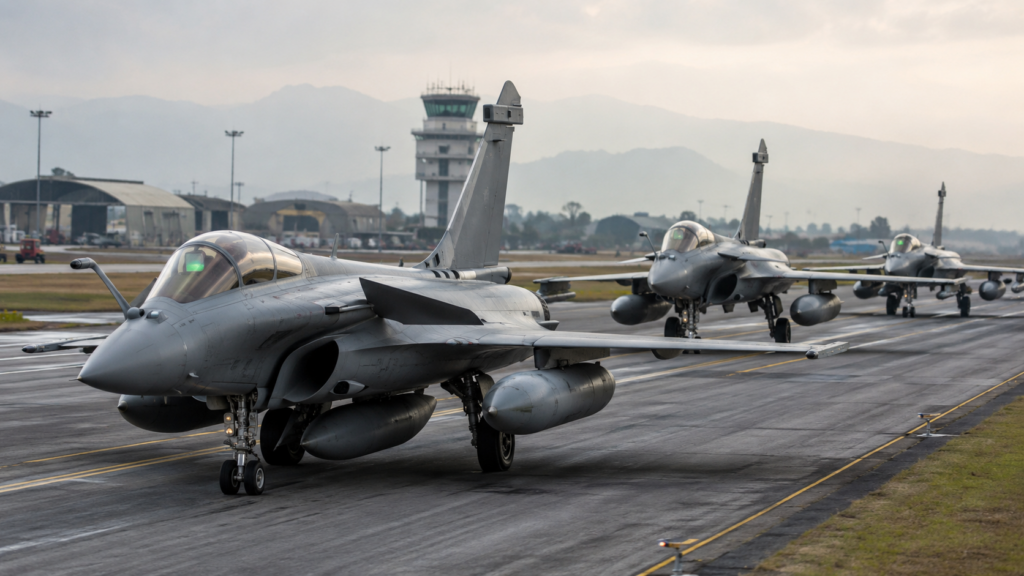
The proposed 114 Rafale fighter jet deal would strengthen India’s combat aviation posture by adding a large number of 4.5-generation multirole aircraft to the Indian Air Force. The Rafale is designed for multiple mission profiles, including air defence, ground attack, nuclear deterrence support, reconnaissance, and anti-ship roles depending on configuration and weapons integration.
For India, the strategic value is not just the number of aircraft. It is the combination of aircraft availability, advanced sensors, electronic warfare systems, precision weapons, and integration with existing Indian Air Force doctrine. A larger Rafale fleet could allow India to deploy more capable squadrons across key theatres while standardising training, logistics, maintenance, and weapons support.
China’s expanding air and missile capabilities remain a central factor in Indian defence planning. The People’s Liberation Army Air Force has modernised rapidly, while Chinese infrastructure along the Line of Actual Control has improved airbase access, logistics, and operational depth. India’s fighter procurement decisions must therefore be evaluated against a broader Chinese military ecosystem, not merely against aircraft numbers.
Pakistan remains the other operational reference point. Pakistan’s air force modernisation, combined with its defence cooperation with China, requires India to maintain credible air superiority and rapid response capabilities. A larger Rafale fleet could improve India’s ability to maintain readiness across multiple fronts, but the procurement would still have to be integrated with air defence systems, tanker support, drones, missiles, and command networks.
Why does local production matter in India’s proposed Rafale fighter jet acquisition?
Local production is central to the political and industrial logic of the proposed 114 Rafale fighter jet procurement. Reports indicate that a significant portion of the aircraft could be manufactured in India, while a smaller initial batch may arrive in flyaway condition from France. This structure would allow faster induction of some aircraft while building a longer-term Indian manufacturing base.
For India, local production serves three purposes. It reduces dependence on direct imports over time, expands the domestic aerospace supply chain, and creates industrial capability that can support future upgrades, maintenance, repair, overhaul, and possible export-linked work. It also fits India’s broader goal of positioning defence manufacturing as a strategic economic sector.
For France and Dassault Aviation, deeper local production would embed the Rafale platform more firmly into India’s defence ecosystem. A large India-based production arrangement would create a long-duration industrial partnership involving aircraft assembly, component supply, engineering support, and lifecycle sustainment. That would make the deal more than a simple aircraft purchase.
The challenge is execution. Fighter aircraft manufacturing requires precision engineering, quality control, skilled labour, supplier certification, avionics integration, and long-term maintenance discipline. India’s domestic aerospace sector has grown, but large-scale private and public integration in advanced fighter production remains complex. The success of the proposed Rafale programme would depend on how quickly Indian partners can absorb production responsibilities without causing delivery delays.
How does the proposed Rafale acquisition fit into India-France strategic relations?
The proposed 114 Rafale fighter jet deal would deepen one of India’s most important defence partnerships. India and France have built a long-running strategic relationship across combat aircraft, submarines, space cooperation, nuclear energy, maritime security, and Indo-Pacific diplomacy.
France is attractive to India as a defence partner because Paris has often been seen in New Delhi as a relatively reliable supplier with fewer political restrictions than some other Western partners. France has also supported India in areas such as naval modernisation and aerospace cooperation. The earlier Rafale acquisition and the Indian Navy’s Rafale Marine selection have already created a deeper platform-level connection between the two countries.
The new fighter proposal would extend that relationship into a much larger industrial and operational phase. If the deal advances, India would not simply buy more aircraft. India would potentially host major production activity and build a deeper maintenance and upgrade ecosystem around French combat aviation technology.
The geopolitical significance is also clear. France has its own Indo-Pacific strategy and views India as a major partner in balancing security challenges across the Indian Ocean and beyond. For India, closer defence cooperation with France complements ties with the United States, Russia, Israel, and other partners while preserving strategic autonomy. A major Rafale deal would therefore carry meaning beyond air force numbers.
What are the procurement risks and cost questions in India’s 114 Rafale fighter jet plan?
The proposed Rafale acquisition is likely to face intense scrutiny over cost, contract structure, local production commitments, delivery timelines, weapons package, maintenance terms, and technology transfer. A deal of this scale will be one of India’s most expensive defence purchases if it moves to final contract stage.
Cost will be a major public and parliamentary question because fighter aircraft acquisitions include much more than the platform price. Weapons, simulators, training, spares, maintenance support, infrastructure, software updates, India-specific enhancements, and lifecycle sustainment can significantly alter total programme cost. The final figure will depend on configuration and negotiated terms.
There is also a timing risk. India needs faster combat aircraft induction, but large defence procurements often move through complex negotiation stages. The Letter of Request begins the process, but a formal French response, commercial evaluation, contract negotiation, and Cabinet Committee on Security approval would still be required before signing.
Industrial execution is another risk. If most aircraft are to be manufactured in India, the production ramp-up will require clear responsibility between Dassault Aviation and Indian partners. Any delay in site selection, supply-chain qualification, skills development, or certification could slow deliveries. The balance between urgent air force needs and long-term industrial development will be the key procurement tension.
What could happen next in the India-France Rafale fighter jet negotiations?
The next formal step would be the transmission of India’s Letter of Request to France. France would then respond with a proposal that addresses aircraft configuration, cost, delivery schedule, production arrangements, technology transfer, training, maintenance, and weapons integration. That response would become the basis for negotiations.
India’s defence acquisition process will then have to evaluate whether the French proposal meets operational requirements, industrial expectations, and financial limits. The Ministry of Defence, the Indian Air Force, the Defence Acquisition Council, and the Cabinet Committee on Security will all be relevant in the final decision chain.
The deal could also interact with India’s domestic fighter programmes. India is developing the Light Combat Aircraft Tejas Mk1A, the Tejas Mk2, and the Advanced Medium Combat Aircraft. The Rafale decision will therefore be assessed alongside the need to support Indian-designed platforms while also meeting immediate Indian Air Force readiness requirements.
The clearest implication is that India is trying to avoid a single-track solution. The proposed 114 Rafale deal would address near-term capability needs and deepen India-France industrial cooperation, while domestic aircraft programmes would remain central to longer-term self-reliance. Whether that balance works will depend on speed, cost discipline, local production success, and operational integration.
What are the key takeaways from India’s proposed 114 Rafale fighter jet procurement?
- India has finalised a Letter of Request for 114 Rafale fighter jets from France. The Letter of Request is expected to begin a government-to-government procurement process, but it is not the final contract.
- The Indian Air Force already operates 36 Rafale fighter jets acquired under an earlier India-France agreement. The Indian Navy is also set to induct 26 Rafale Marine aircraft for carrier-based operations.
- The proposed acquisition is aimed at strengthening Indian Air Force combat capability amid squadron shortages. India’s air power planning is shaped by security pressures involving China, Pakistan, and the wider Indo-Pacific region.
- Local production is expected to be a central feature of the proposed procurement structure. A large India-based manufacturing component would support domestic aerospace capability and India’s defence self-reliance strategy.
- The deal would deepen India-France defence cooperation across aircraft production, sustainment, and strategic alignment. France remains one of India’s most important defence partners across aviation, naval systems, space, and Indo-Pacific security.
- The proposal still faces cost, timeline, technology transfer, and approval challenges before it can become a signed contract. The next steps include the French response, commercial negotiations, industrial planning, and final Indian government clearance.
Share this:
Discover more from Business-News-Today.com
Subscribe to get the latest posts sent to your email.