




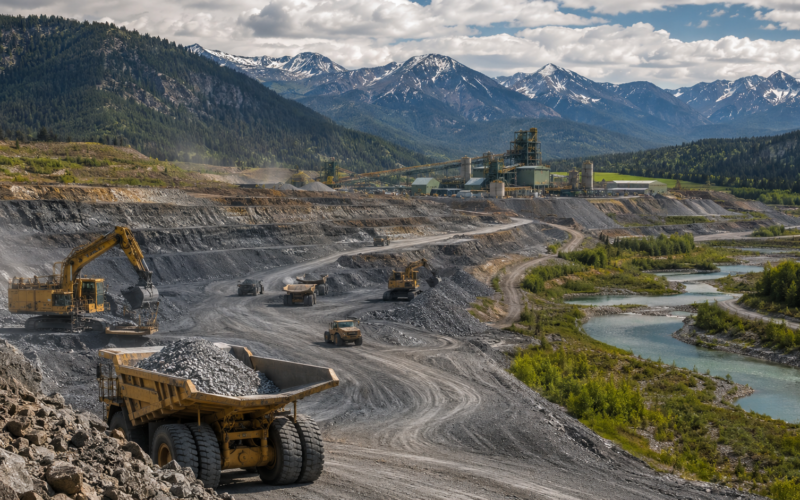
Perpetua Resources Corp. (Nasdaq: PPTA, TSX: PPTA) has secured unanimous approval from the Export-Import Bank of the United States for a $2.9 billion senior secured long-term loan to support development of the Stibnite Gold Project in Idaho. The financing, approved under the Make More in America Initiative, is expected to fund the direct construction costs of a project positioned as the only identified domestic reserve of antimony in the United States. The announcement shifts Perpetua Resources from a permitting and financing story into a more advanced execution story, with national security, critical minerals, gold economics, and rural economic development now tied to one project. For investors, the question is no longer whether Washington sees Stibnite as strategically important, but whether Perpetua Resources can convert federal backing into mine construction, commercial production, and durable shareholder value.
Why does the $2.9bn EXIM loan approval matter for Perpetua Resources and U.S. critical minerals security?
The approval gives Perpetua Resources something junior mining companies rarely receive at this scale: a federal financing pathway large enough to materially de-risk construction funding. The $2.9 billion loan, combined with cash on hand, is expected to fully fund the direct construction of the Stibnite Gold Project based on the company’s current capital cost estimates. That is a major shift because mining development risk often moves from geology to capital availability once permits and engineering studies mature.
The strategic relevance is also unusually direct. Antimony is used in defense, energy, and manufacturing supply chains, and the United States has been trying to reduce reliance on overseas sources for critical minerals. Perpetua Resources is not just pitching Stibnite as a gold mine with a by-product. It is framing the project as a domestic industrial security asset that happens to have gold economics strong enough to support the broader development case.
That distinction matters. Many critical minerals projects struggle because the commodity most important to policy goals is not always the commodity that makes the project financeable. In Stibnite’s case, gold provides the economic anchor, while antimony provides the national security urgency. That combination gives Perpetua Resources a more compelling funding story than a single-commodity development project, although it also increases scrutiny because the project now sits at the intersection of mining, environmental restoration, defense supply chains, and federal industrial policy.
How does the Stibnite Gold Project fit into Washington’s Make More in America strategy?
The Make More in America Initiative is designed to support domestic production in sectors viewed as strategically important to the United States. The Stibnite Gold Project fits that mandate because it addresses a supply chain vulnerability that reaches beyond mining. If developed successfully, the project could support domestic access to antimony while also creating jobs in rural Idaho and contributing tax revenue to local and state governments.
For Washington, the financing approval sends a policy signal. The United States is increasingly willing to use federal balance-sheet support to close gaps in critical minerals supply chains. That does not mean every mining project will receive similar support. It does suggest that projects combining national security relevance, advanced permitting status, domestic job creation, and commercial economics may receive a more serious hearing from federal agencies than they would have a decade ago.
For Perpetua Resources, the benefit is obvious, but the burden is also heavier. A project backed by federal financing will be judged not only on shareholder returns but also on delivery against public policy objectives. That includes whether the project can produce antimony reliably, whether environmental restoration commitments remain credible, and whether local employment and community benefits materialize as promised.
What are the key financial terms of the EXIM loan and why do they matter for investors?
The loan is expected to be structured as a 13-year senior secured credit facility. Perpetua Resources said the package includes an upfront facility of $2.4 billion, with the remainder covering capitalized interest during construction and the Export-Import Bank of the United States exposure fee. Definitive documentation and customary conditions still need to be completed, with availability expected in the second half of 2026.
The interest rate is expected to be set at the applicable long-dated U.S. Treasury bond rate plus 100 basis points, fixed at the time of first drawdown. Scheduled repayments are anticipated to begin in 2030. For a capital-intensive mining project, that structure is important because it gives Perpetua Resources a longer runway before repayments begin, aligning debt service more closely with the expected ramp-up timeline.
The financing also changes the market’s framework for Perpetua Resources. Before this approval, investors had to price a heavier financing overhang into the stock. After this approval, attention shifts toward final documentation, construction readiness, cost discipline, permitting durability, and production timing. That is progress, but not a free lunch. Mining projects still have a charming habit of turning spreadsheets into stress tests once earthworks, procurement, inflation, labor availability, and contractor performance enter the chat.
Why could antimony make the Stibnite Gold Project more strategically important than a conventional gold mine?
Gold is the financial engine of the Stibnite Gold Project, but antimony is the strategic headline. Perpetua Resources has described Stibnite as holding the only identified domestic reserve of antimony in the United States. That gives the project unusual relevance at a time when governments are reassessing exposure to concentrated mineral supply chains.
The presence of antimony changes the investor narrative in three ways. First, it gives Perpetua Resources a policy tailwind that pure gold developers do not usually enjoy. Second, it creates potential demand visibility from defense and industrial users that could support long-term strategic interest. Third, it raises the probability that the project will remain part of broader U.S. industrial policy discussions even if gold prices fluctuate.
However, the antimony angle also introduces complexity. Critical minerals projects often attract political support, but they can also attract higher public scrutiny. Production quality, processing partnerships, offtake structures, and environmental safeguards will matter. Perpetua Resources still needs to show that the antimony opportunity can move from strategic talking point to operational reality.
What execution risks remain after Perpetua Resources secured federal loan approval?
The most important point for investors is that loan approval is not production. It is a financing milestone, not the end of the development journey. Perpetua Resources still needs to complete definitive loan documentation, satisfy conditions precedent, move into construction, manage capital costs, and ultimately bring a complex mine into operation.
Environmental and social risk remains central. The Stibnite Mining District has historical mining impacts, and Perpetua Resources has positioned the project as both redevelopment and restoration. That dual mandate is powerful if executed well because it allows the company to argue that mining activity can fund environmental cleanup. It is also risky because the company must deliver operational outcomes and restoration outcomes at the same time.
Cost inflation is another key issue. The company says the EXIM loan and cash on hand are expected to fund direct construction based on current capital cost estimates. If construction costs rise materially, investors may again have to think about contingency funding, equity dilution, alternative debt, or schedule adjustments. In mining, “fully funded” is a strong phrase, but markets will still watch every update like a hawk with a calculator.
How should investors read PPTA stock performance after the EXIM loan approval?
Perpetua Resources stock has already reflected both excitement and volatility. On May 22, 2026, Perpetua Resources shares were trading around $25.68 to $25.72 on Nasdaq, below the 52-week high of $37.37 but well above the 52-week low of $11.68. Trading 212 data showed the stock down about 8.7% over the past week and down about 15.23% over the past month, while remaining up about 88.29% over the past year.
That pattern suggests investors are not ignoring the strategic value of Stibnite, but they are also not giving Perpetua Resources a blank cheque. The stock has delivered strong longer-term gains, yet recent weakness shows the market is still digesting valuation, timing, construction risk, and the gap between federal approval and actual production. In other words, the loan approval strengthens the investment case, but it does not eliminate the development risk discount.
A neutral reading suggests Perpetua Resources is now a higher-conviction critical minerals story with a clearer funding path, but also a stock where expectations may become less forgiving. Once a project receives this level of federal backing, investors tend to move quickly from “can it be financed?” to “can it be built on time and on budget?” That is a much tougher exam, and there are no participation trophies in project finance.
What does this financing signal for other U.S. mining and critical minerals developers?
The Perpetua Resources loan approval could become a reference point for other U.S. mining developers seeking federal support. It shows that Washington is prepared to back mineral projects when they align with domestic manufacturing, defense resilience, and job creation goals. That could encourage more companies to position projects not only as commodity developments but as supply chain security assets.
However, Stibnite also shows that federal support is likely to remain selective. Perpetua Resources had a project with advanced review history, critical mineral relevance, gold-backed economics, and a clear geographic connection to U.S. industrial security goals. Projects without that combination may find it harder to attract similar financing.
The broader implication is that U.S. mining finance may be entering a more policy-sensitive phase. Capital markets alone may not be enough to build strategic mineral supply chains at the speed governments now want. Federal credit agencies, defense-related funding, industrial policy programs, and private capital could increasingly overlap. For investors, that creates opportunity, but also makes political and regulatory literacy more important.
What happens next for Perpetua Resources as the Stibnite Gold Project moves toward construction?
The next phase is about converting approval into availability. Perpetua Resources expects the loan to become available after definitive documentation and customary conditions are completed, with that process expected in the second half of 2026. Investors will watch for updates on final loan terms, drawdown timing, construction planning, procurement, equipment financing, and any changes to capital cost assumptions.
The company will also need to maintain stakeholder confidence. Rural job creation, environmental restoration, water quality improvements, fish habitat access, and domestic antimony production are all part of the Stibnite narrative. That gives Perpetua Resources several ways to build support, but also several ways to disappoint if execution falls short.
The upside case is clear. If Perpetua Resources delivers Stibnite successfully, it could become one of the most strategically visible mining projects in the United States, combining gold production with domestic antimony supply. The downside case is equally clear. If costs rise, timelines slip, or environmental and legal challenges intensify, the stock could remain volatile despite federal backing.
Key takeaways on what Perpetua Resources’ EXIM loan approval means for critical minerals investors
- Perpetua Resources has moved from financing uncertainty toward a clearer construction funding pathway, which materially changes the investment debate around the Stibnite Gold Project.
- The $2.9 billion Export-Import Bank of the United States loan approval strengthens the company’s ability to position Stibnite as a national security-linked critical minerals project rather than only a gold development.
- The project’s antimony reserve gives Perpetua Resources strategic relevance because the United States is trying to reduce dependence on foreign critical mineral supply chains.
- Gold remains essential to the project’s economics, making Stibnite a hybrid story where precious metals cash flow supports critical minerals policy objectives.
- The loan structure, including expected repayments beginning in 2030, gives the company a longer runway but still leaves construction execution risk firmly in focus.
- Perpetua Resources stock remains volatile, with recent weekly and monthly declines showing that investors are not treating federal backing as a risk-free outcome.
- The next major catalysts are definitive loan documentation, satisfaction of conditions precedent, construction readiness, and updated cost visibility.
- The project could become a template for selective U.S. federal support of strategic mining projects, especially where domestic supply chain resilience is central to policy goals.
- Execution risk remains high because mining projects can face inflation, permitting scrutiny, environmental opposition, procurement delays, and contractor challenges.
- For long-term investors, Perpetua Resources is now less of a binary financing story and more of a delivery story tied to U.S. industrial policy, critical minerals security, and mine construction discipline.
Discover more from Business-News-Today.com
Subscribe to get the latest posts sent to your email.